
Logseq: An Open Source Knowledge Base Built Out of Blocks
Summary
Logseq is an open source knowledge base where every line is a block: inline it into an outline or point at it from another page. Daily notes, card review and queries cover writing, revisiting and gathering.
Recommend- Name
- Logseq
- Version
- 2.0.2
- Pricing
- Free
- Open source
- Open source
- Operating system
- WindowsmacOSLinuxAndroidiOS
- Website
- https://logseq.com/
- Updated
- 2026-10-11 20:21
The hard part of taking notes is not the writing. It is finding the note again afterwards.
Structure from blocks and references
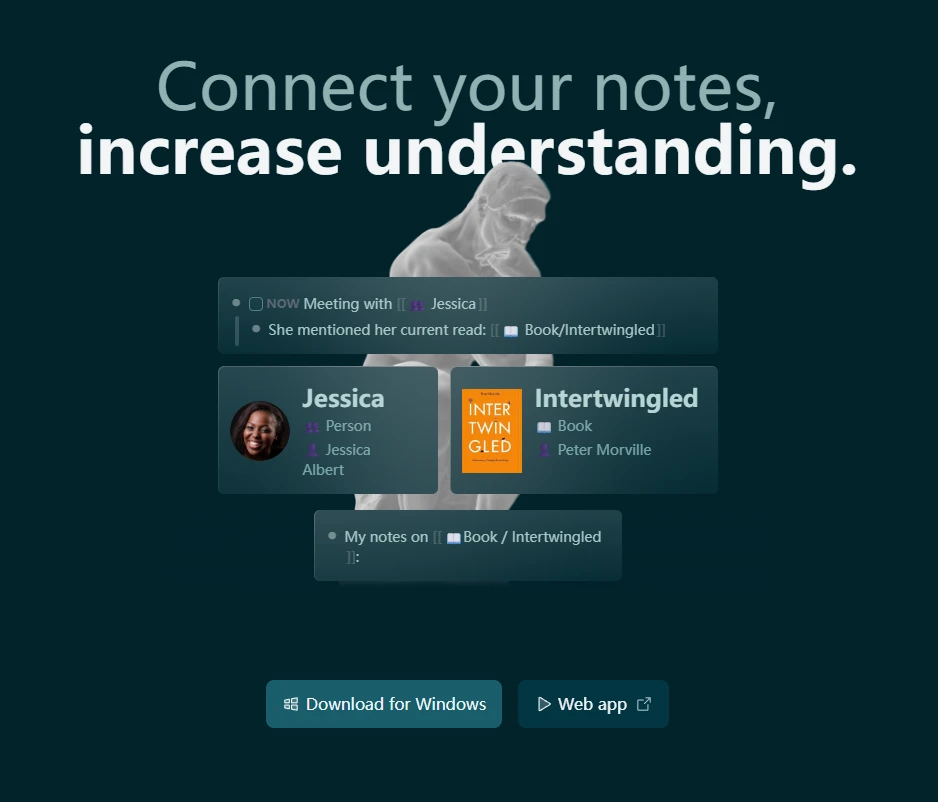
Logseq is an open source knowledge base tool, and the official site describes it as an open source knowledge base that puts personal data first. Its basic unit is the block: every line of text is a block of its own, blocks nest into an outline, and any block can be referenced from another page. The official documentation calls this block referencing, and its value is simple, a piece of information is written once and then pointed at from wherever it is needed.
Around that model the documentation offers three ways in: split content into paragraphs and express hierarchy with indentation, use queries to gather scattered items into a table, and mark what needs revisiting. The order matters too. Let the content be written down loosely first, and let structure grow out of it afterwards.
Daily notes and card review
Daily notes are the entry point people use most. Open today's page, write down whatever must not be forgotten, open a fresh page tomorrow, with no directory to plan in advance. The official getting started guide puts this step first, on the grounds that the habit of writing every day comes before everything else, and the remaining features can be added once there is something to organise.
Cards handle revisiting. Mark the content worth remembering as a card and the tool brings it back on a schedule. Queries handle gathering: in the official example a query produces a table of information on a topic, saving the manual sorting. Stacked together, the two compress writing down and reading again into the same page.
One consequence is worth spelling out. Because a reference points at the block rather than copying its text, editing the original changes what every other page shows. Notes that repeat the same idea can no longer drift apart, and the collection grows differently: fewer summary pages restating what was already decided, more lines aimed at the single place where it was decided. The price is a little discipline, since a badly named block stays badly named everywhere it is pointed at.
Item | Official notes |
|---|---|
Unit | Blocks, nested into an outline |
Linking | Block references point at one piece of content from many places |
Daily entry | Daily notes, written day by day |
Review | Cards, revisited on a schedule |
Gathering | Queries build a table of information on a topic |
Where the data lives, and under what licence
Data storage is the other main thread of this tool. Personal data comes first in the site title, notes are kept as files on the user's own device, and the official sync service is an option rather than a precondition. For anyone who cares about ownership, that point usually weighs more than a feature list, because files in hand means the initiative over migration and backup stays in hand too.
In code terms, Logseq is published in a public repository under AGPL-3.0. The project currently runs on two lines: a long-maintained classic version, and a 2.0 series built on a new database architecture that the official pages label an early test release. Desktop covers Windows, macOS and Linux, mobile adds Android and iOS, and personal use costs nothing.
A tool willing to hand you the files is the only kind worth handing years of records to.
Practical notes. For the first two weeks, open only the daily note and let content accumulate instead of building a directory tree. When one kind of content has appeared three times or more, then consider a page of its own with block references. And if you already have notes, start from an import so old and new sit together, and leave the tidying for later.