
Karakeep 0.34: a Self-Hosted Bookmark Vault With AI Tags and Semantic Search
Summary
Karakeep is a free, open-source place to keep links, notes, images and PDFs: an AI model tags and summarises what you save, and full-text plus semantic search brings it back later.
Recommend- Name
- Karakeep
- Version
- 0.34
- Open source
- Open source
- Operating system
- WebiOSAndroid
- Website
- https://karakeep.app/
- Updated
- 2026-11-03 20:16
Karakeep is a free, open-source application for keeping everything you meant to read: links, notes, images and PDFs go into one place, an AI model attaches tags and a summary, and search gets them out again. It runs on the web, on iOS and on Android, and can be hosted on your own machine so the archive stays in a volume you control.
Why a reading list turns into a graveyard
Articles saved in a chat app, bookmarks piled up in a browser, screenshots in a photo library: at the moment of saving, all of it feels useful later. The trouble arrives at the moment of need. The title is half remembered, the reason for saving it is gone, half an hour of scrolling finds nothing, and the search box gets used instead. Saving costs a second, retrieving costs an afternoon, so the list only grows.
Drop it in and let the model do the filing
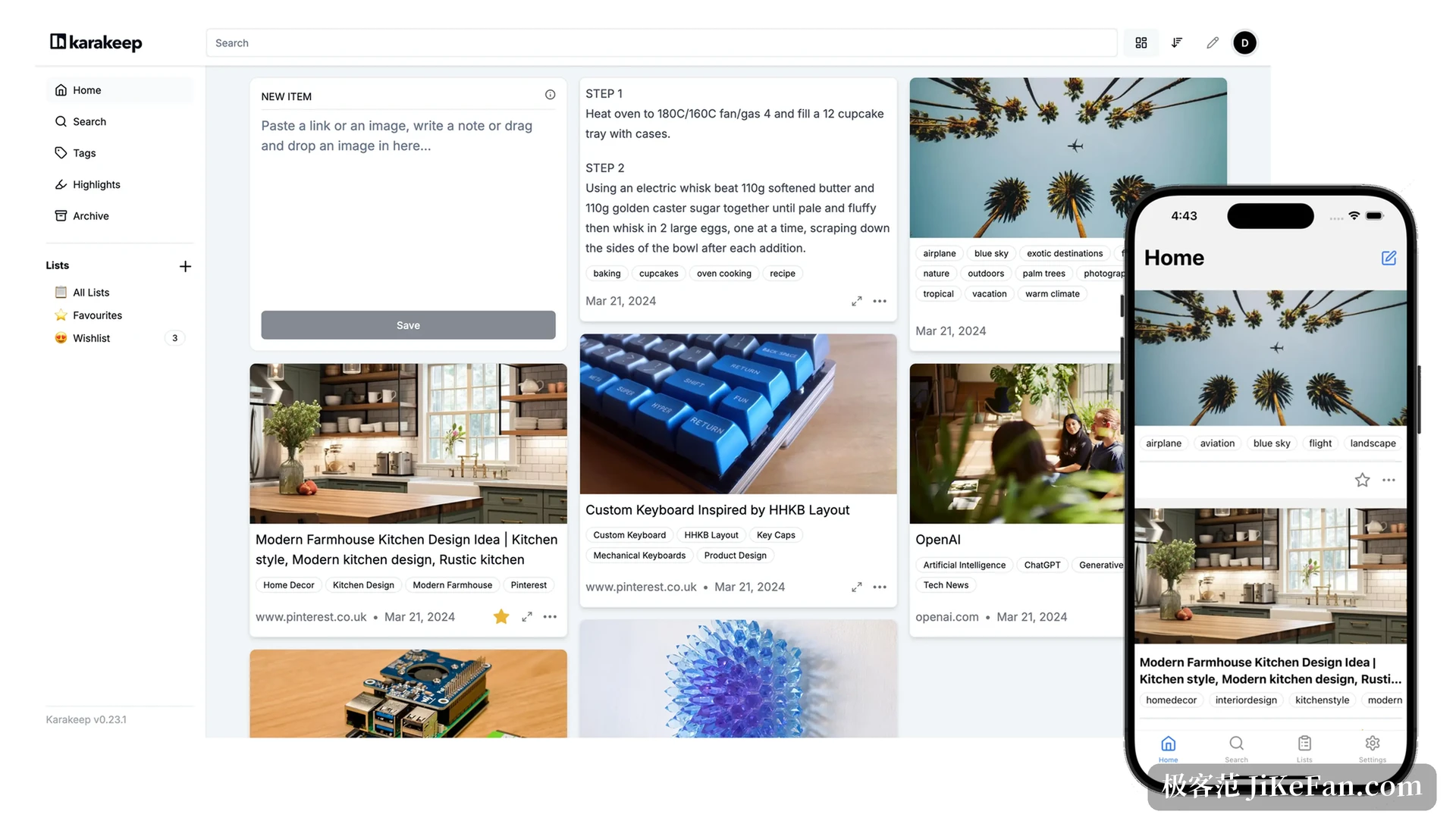
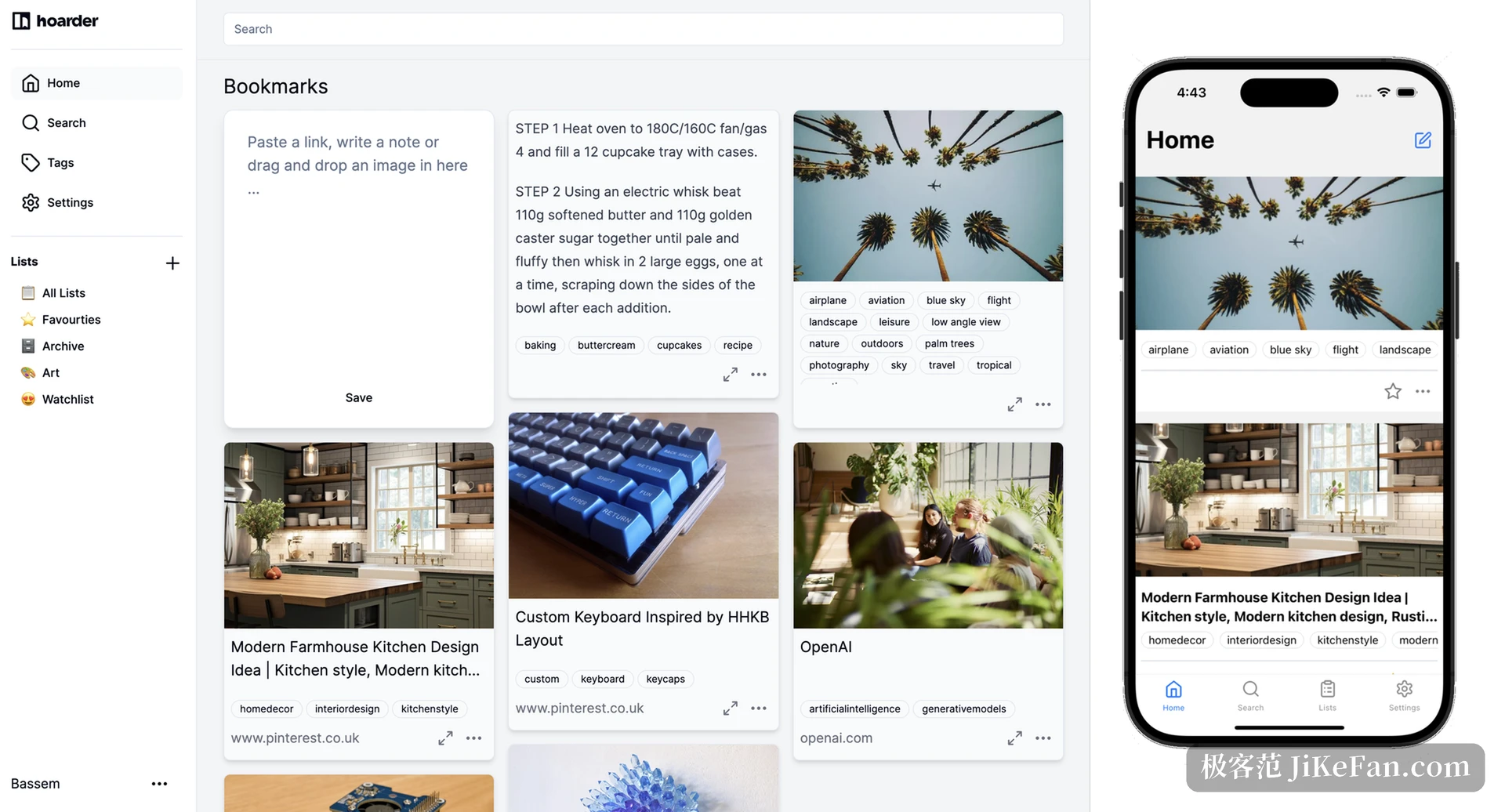
Karakeep removes the filing step. Give it a link and it fetches the title, description and cover image. Give it a picture and OCR pulls the text out so the image becomes searchable as words. Give it a note and the note is stored as written. The model then reads the content and adds tags and a summary. It is not tied to one provider: an OpenAI-compatible endpoint brings in a cloud model, while Ollama runs one locally, which is the option for anyone unwilling to feed a personal archive to an outside service.
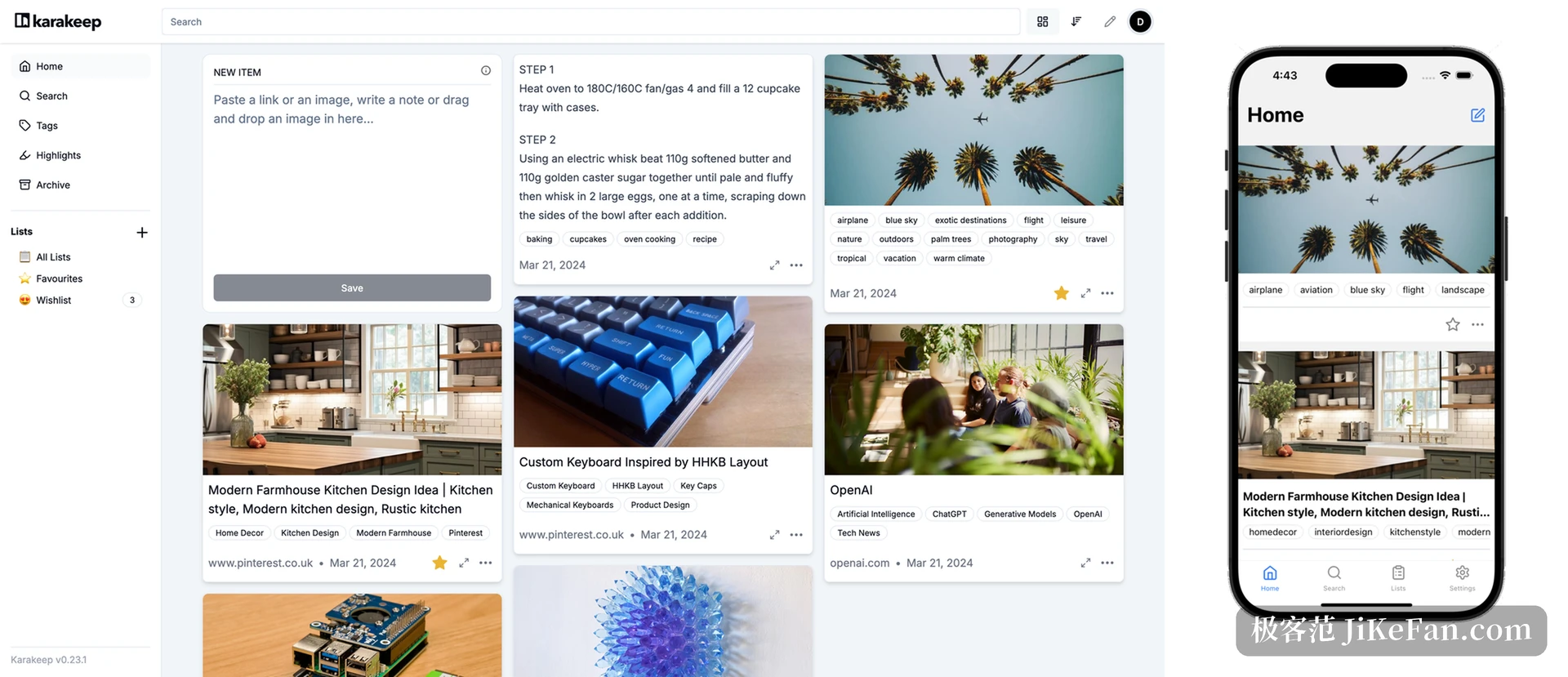
Tag upkeep is handled too: sort by how often a tag is used, merge duplicates, delete the ones that never helped. The project was called Hoarder until it took its current name in 2025.
Two ways back in: full text and meaning
Search is where tools of this kind separate. Karakeep builds a full-text index with Meilisearch, so keyword queries return almost immediately. Saved content is also embedded as vectors, and in semantic mode a vague memory, something about powering a Raspberry Pi, is enough to surface the piece. Query syntax stacks conditions by type, tag or favourite state, which beats clicking down a folder tree, and articles open in a reader view where highlights can be kept for later.
Link rot gets an answer: keep a copy
Once the original page returns a 404, a saved bookmark is just a headline, and every read-later tool has the same weak spot. Karakeep packages the whole page into an archive and adds a screenshot, so the copy survives the site. RSS feeds can be subscribed to as well, with new articles collected and tagged automatically, which turns a handful of sites into a searchable library. A rules engine files things by condition, so a new save from a given domain can pick up its tag and its list without being touched.
Version 0.34 works on mobile and on fetching
The current release, 0.34, spends its effort in two places. The mobile apps catch up with what used to be web-only: automatic offline download of recent saves, a whole list made available offline, a split layout on tablets, tags that can be renamed or deleted, and public lists with collaborators managed from the phone. On the fetching side the driver changed to patchright running a real Chrome, so an interstitial page that checks the browser is waited out instead of being stored as the article; the cost is a larger browser image. The release also replaces next-auth with better-auth, preparing two-step verification and OAuth sign-in on mobile, and fixes a memory leak traced to query caching.
A proper interface for AI assistants
Karakeep ships an MCP server, a complete CLI and an API that speaks mostly Markdown. API keys carry scopes, so read-only and read-write access are granted separately, which means an AI assistant can search and save inside the archive without being handed the whole thing. The project also publishes a skill file, and after installing it in an AI client, asking in plain language for the piece saved last week does work.
Who it suits, and where it stops
Karakeep is licensed under AGPL-3.0, with the code open and a little over thirty thousand stars on GitHub. Self-hosting is complete, so the data sits in a volume on your own machine; a hosted edition exists with a small free allowance and a monthly subscription beyond it. The costs are as clear as the benefits: self-hosting means owning the server, the backups and the upgrades, fetching can stay incomplete on sites that fight scrapers, and anything important deserves a look after it is saved. It is not a document editor either, since notes stop at the quick jotting stage. For storing everything, having a model do the filing and keeping the data at home at the same time, it is a fairly complete answer.
What Karakeep removes is not the act of saving but the later hunt for where something went. Hand the tagging, summarising, indexing and archiving to a machine, and the attention left over goes to the part that needs judgement: reading it, and using it.