
Hubstaff keeps the time ledger of a remote team
Summary
In distributed work the hardest account to keep is not money but time: who put how much into which project, what a contractor invoice should be based on, whether the daily load is sane. Hubstaff records on duty hours, activity and app usage in the background, builds timesheets automatically and turns them into payroll.
Recommend- Name
- Hubstaff
- Version
- 20260922
- Pricing
- Free
- Open source
- Proprietary
- Operating system
- WindowsmacOSLinuxAndroidiOS
- Website
- https://hubstaff.com/
- Updated
- 2026-10-06 20:41
The time ledger of a distributed team
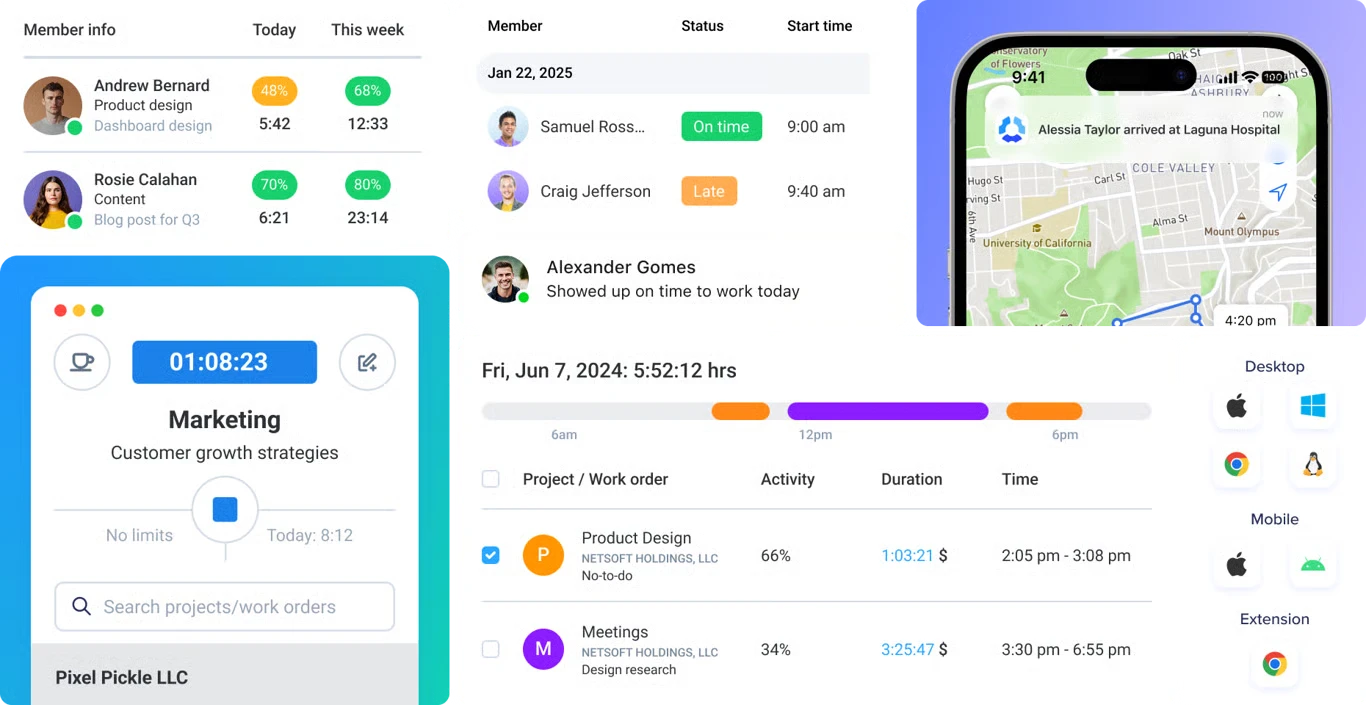
In distributed work the hardest account to keep is not the money. It is the time. Who put how much into which project, what a contractor invoice should be based on, whether the load someone carries on a Tuesday is reasonable or a sign that the plan was fiction. Most teams answer those questions from memory and a chat scroll, which is why the same argument returns every month. Hubstaff records the answers as they happen: the client counts on duty hours in the background, watches keyboard and mouse activity, and notes which applications and sites were in use. Timesheets build themselves, and reports sorted by project or by person are ready when the invoice is due.
For teams working with contractors and hourly billing, the last step is the one that saves the argument. Hours flow straight into payroll, so there is no separate reconciliation round where two spreadsheets disagree by four hours and nobody can say which is right. Paying people on time, with a shared reference everyone can look at, removes a category of friction that has nothing to do with the work itself.
Transparency with a scale you control
Employee monitoring is a sensitive subject, and it is sensitive precisely because of the scale. A tool that watches everything and reports to a manager is surveillance. A tool that records agreed hours and gives the same data back to the person being measured is a shared instrument. Between those two there is a dial, and the dial is the whole design question.
Hubstaff puts the dial in the team policy. Screenshot frequency is configurable, the granularity of application tracking is configurable, and a lightweight mode records duration without collecting detail at all. A team can start narrow, add detail later, and write down what it decided. This matters less for legal reasons than for human ones: people accept measurement they were told about, and resent measurement they discovered.
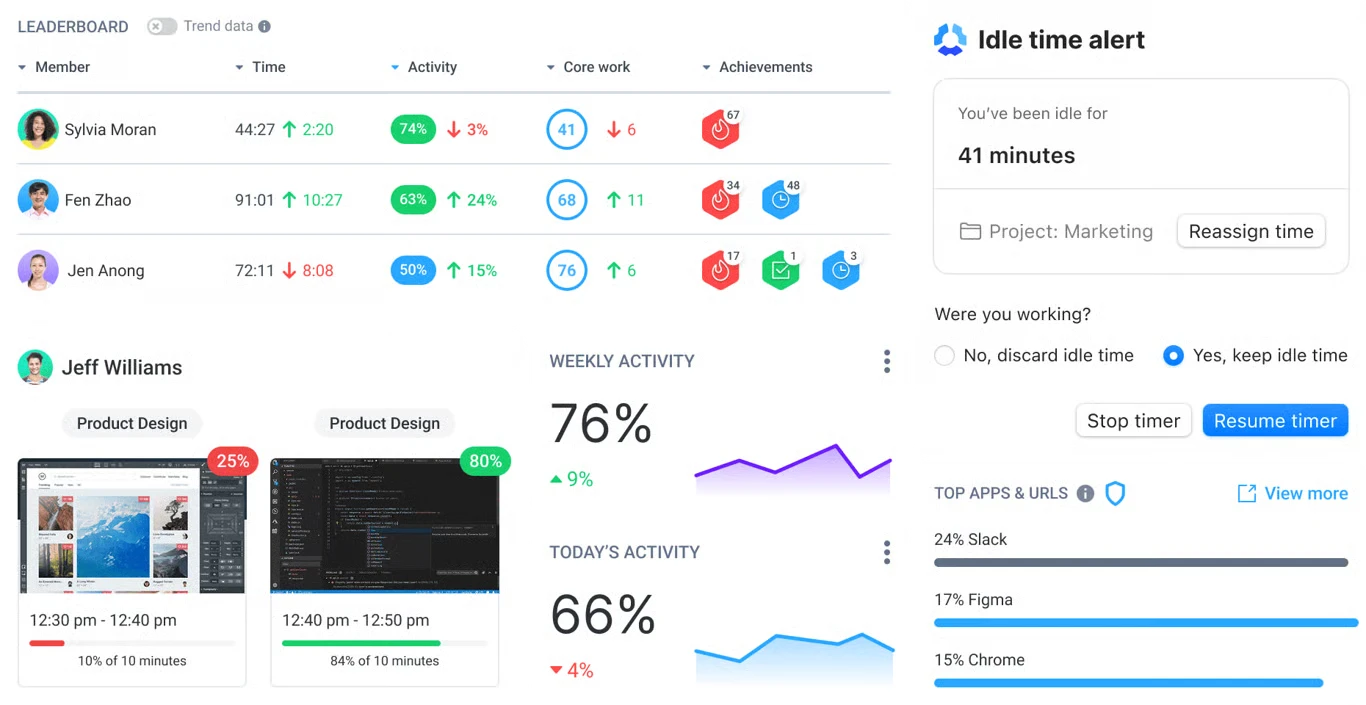
Recent versions add workforce analytics on top of the raw record, drawing trends of project cost and of how efficiently people work from the accumulated hours. Read carefully, that is a planning instrument rather than a scoreboard. A project whose cost curve climbs while output stays flat is telling you something about scope, not about the people on it, and a team that treats the distinction seriously gets more value from the numbers than one that does not.
The first month is usually the uncomfortable one. A team that has been estimating its own hours discovers that the estimate was optimistic by a fixed percentage, that the meetings nobody counted occupy a real slice of the week, and that two people carry far more context switching than the others. None of that is misconduct. It is the normal distance between what work feels like and what it measures as, and the value of a ledger is that the distance becomes a number a manager can plan against instead of a suspicion that quietly hardens.
There is a second effect that teams rarely expect. When the record is visible to the person producing it, the conversation about workload stops being personal. Nobody has to argue that they are busy; the week is on the screen, and the question becomes what should come off the list. That shift, from defending effort to allocating it, is worth more than any report the tool can print.
Think of it as a dashboard for remote collaboration: where the time went, where the project budget went, and the numbers doing the talking. Trust rests on agreed rules rather than suspicion, and transparent data can be exactly what gives a distributed team its sense of safety.
The boundaries deserve the same clarity. It suits teams that need hour settlement and project cost accounting. For creative and research roles where fine grained tracking feels wrong, the duration only mode exists for that reason, and choosing it deliberately is better than quietly resenting the default. Freelancers can use the free tier as a personal ledger, which is a fair way to learn the tool before proposing it to anyone else.
Clients are available across the major platforms, sign up happens on the site, and the paid tier scales by seat, so small teams can test the whole arrangement at the price of one lunch a month before committing the company to it.