
Whisper ships in six sizes, and the memory budget decides which one
Summary
A general purpose speech recognition model that handles transcription, translation into English and language identification in one pass. Six sizes run from about 39 million to about 1.55 billion parameters, and code and weights are both MIT licensed.
Recommend- Name
- Whisper
- Version
- 15.5
- Pricing
- Free
- Open source
- Open source
- Operating system
- WindowsLinuxmacOS
- Updated
- 2026-10-06 16:03
One model instead of a pipeline
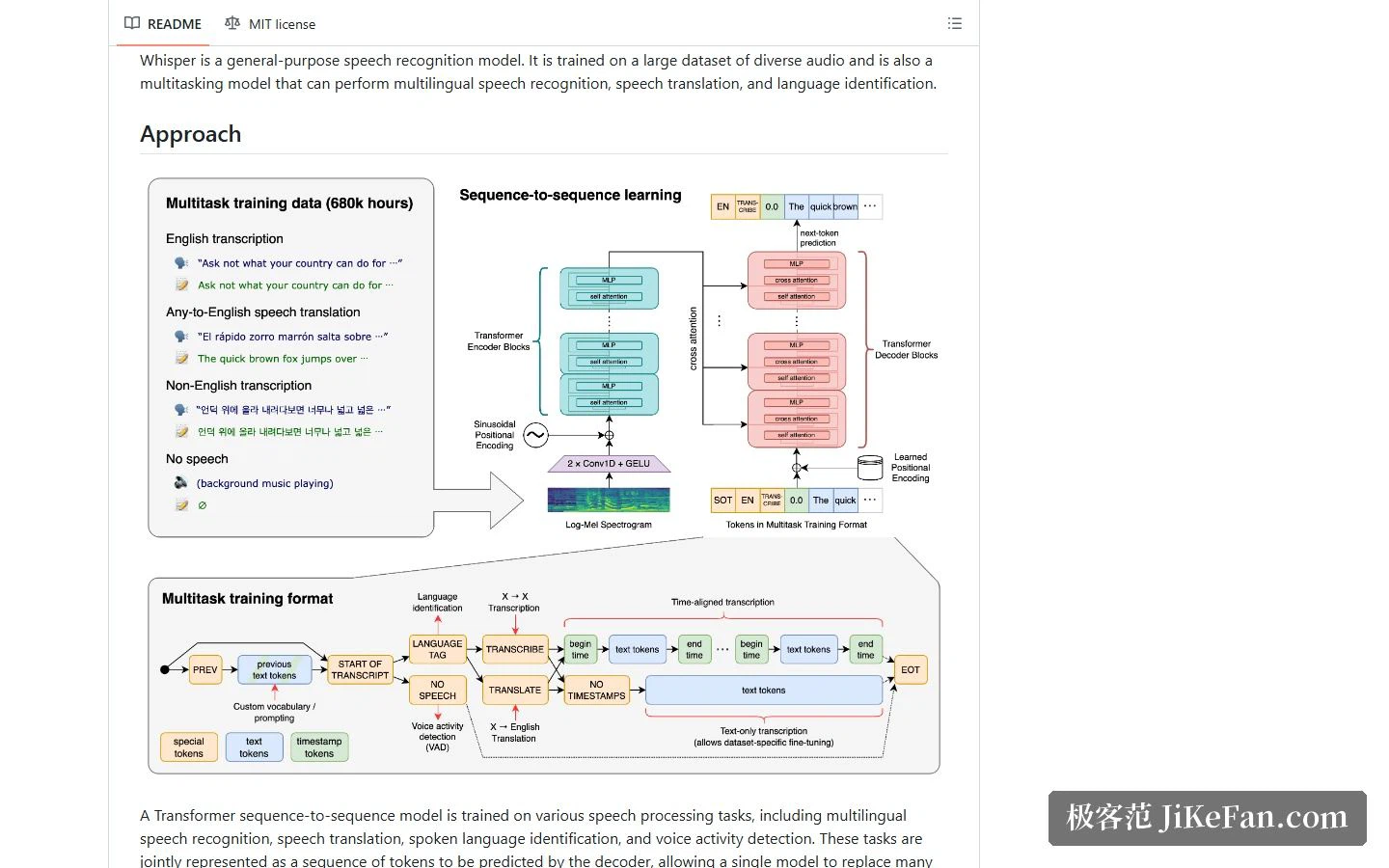
Whisper is the kind of project that replaces a whole chain with a single model. Conventional speech processing walks through several stages: detect the language, then transcribe, then hand the result to a separate translation model if one is needed, with voice activity detection sitting off to the side as its own step. Whisper folds those tasks into one sequence of tokens that the decoder predicts, learned jointly inside a single encoder-decoder Transformer.
The repository quotes a multitask training set of 680,000 hours, drawn from many languages and a wide range of recording conditions. The stated goal is plain: a general purpose speech recognition model.
Four capabilities, one direction of translation
The official list has four entries: multilingual transcription, speech translation, spoken language identification and voice activity detection. Translation here means turning non-English speech directly into English text. It is not translation between arbitrary language pairs, and that distinction matters before you plan a workflow around it.
Long recordings, 30 second windows
Long audio is handled by a sliding window. The documentation explains that the transcribe call reads the whole file and then predicts autoregressively in 30 second windows. An hour long recording therefore becomes more than a hundred windows processed back to back, and you do not have to cut it up yourself first.
Choosing among six sizes
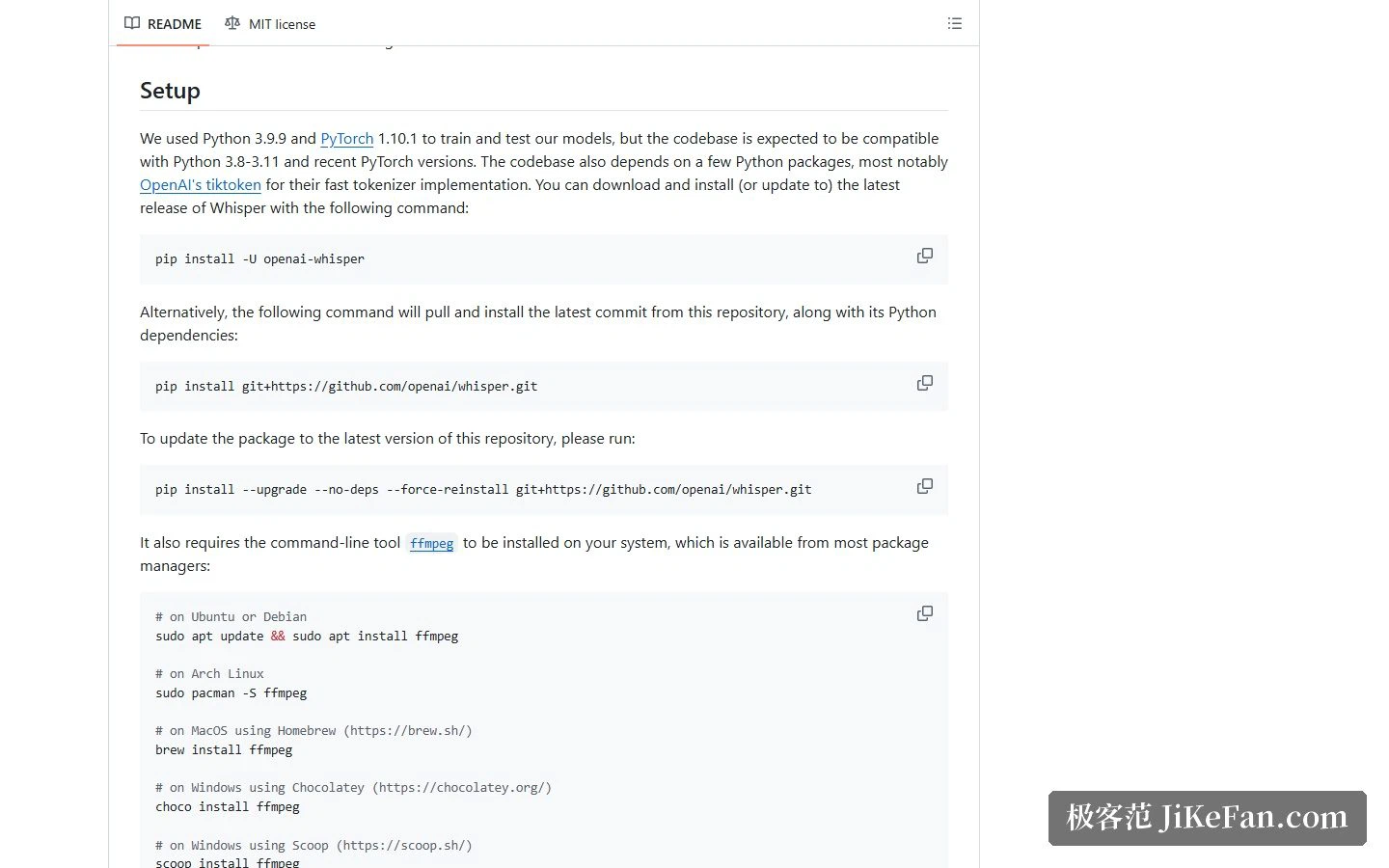
This is the table to read before anything else. Six sizes ship, from tiny at roughly 39 million parameters up to large at roughly 1.55 billion, with memory demand climbing from about 1 GB to about 10 GB. The relative speed column is measured against large: tiny runs at roughly 10 times that rate and turbo at roughly 8 times. Speed and size form a fairly smooth trade-off curve.
When memory is tight, tiny and base both fit in roughly 1 GB, which is workable even on an ordinary laptop. Better accuracy means moving up to medium and large. The turbo entry deserves a note of its own: the project describes it as an optimised version of large-v3 that trades a very small accuracy loss for a clearly faster transcription rate, which makes it the compromise pick.
Four of the sizes, tiny, base, small and medium, also come in English-only variants. The project observes that these tend to do better on purely English work, though the gap narrows as the parameter count grows.
Installing: pip plus ffmpeg
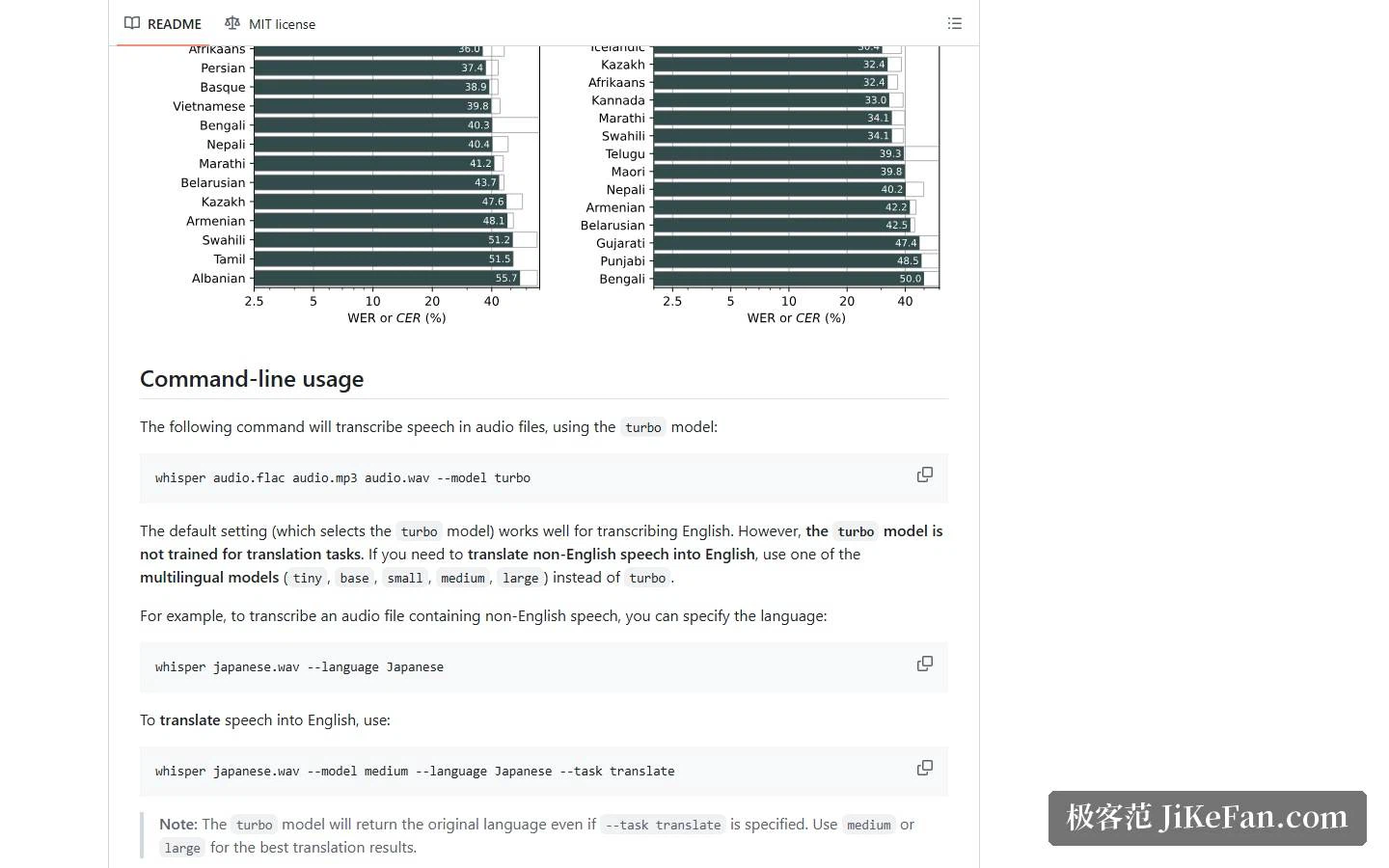
The install itself is one pip command. What actually needs attention is the system dependency: Whisper calls the ffmpeg command line tool to decode audio. The project lists install routes per operating system, and the common package managers are all covered.
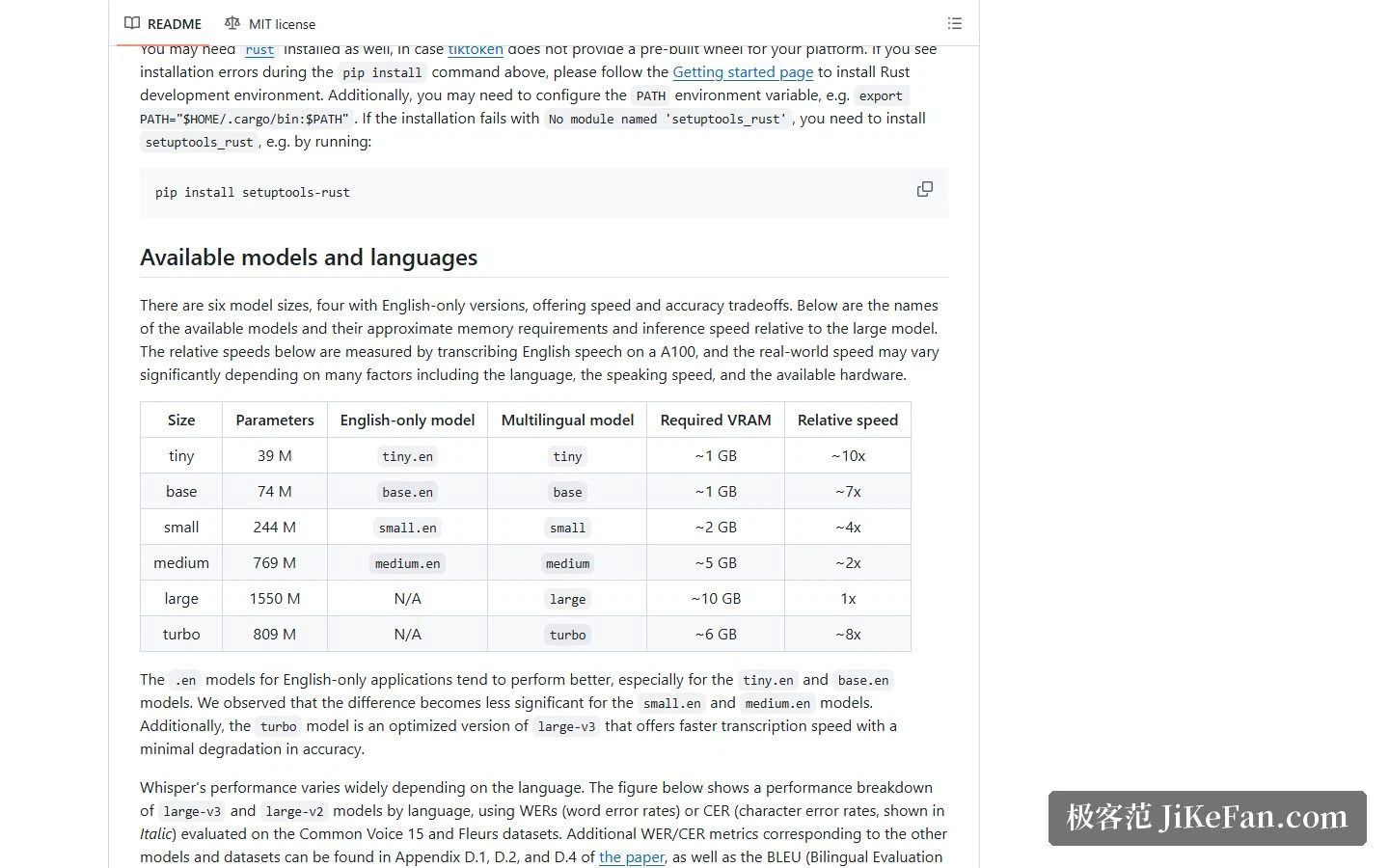
One more thing to watch. The project warns that if your platform has no prebuilt tokenizer package, the pip install will need a Rust environment; when the error mentions a module that cannot be found, installing the matching package resolves it. On versions, the codebase supports Python 3.8 through 3.11 and reasonably recent PyTorch releases.
Two ways in: shell and Python
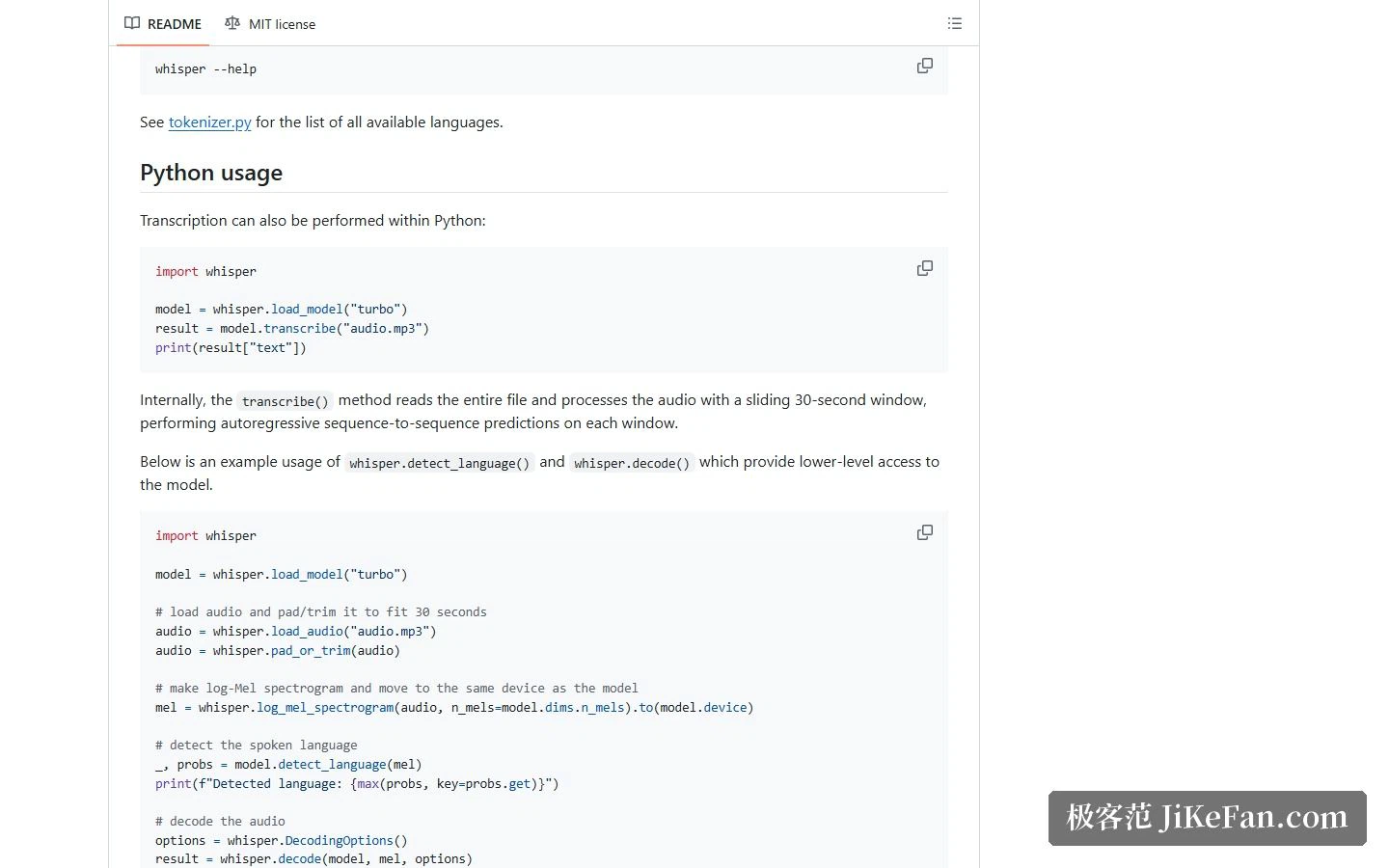
The command line is the fastest way to check whether it works. Give the audio file as an argument, name the model with the model option, add the language option when the audio is not English, and switch the task option to translation when that is the goal.
One limit is worth memorising: the project states plainly that turbo was never trained for translation. Even with the translation task selected, it still returns the original language. Use tiny, base, small, medium or large for that, and the project recommends medium or large for better results.
The Python call is just as short. Load the model, hand the audio path to the transcribe method, read the text field off the result. A lower level interface is exposed as well, so you can load audio yourself, compute the log mel spectrogram, and call language detection or decoding on its own when the job has to sit inside a larger pipeline.
The licence is a genuine advantage
Code and model weights both ship under the MIT licence, with very few commercial restrictions. That is not the norm in speech recognition, where plenty of models attach a separate and stricter agreement to their weights. If you need to put transcription inside your own product, this removes a fair amount of legal back and forth.
Who it suits
If the job is batch subtitling for video, turning meeting recordings into text, or adding local transcription to an application, the cost of entry is low: one command to install, one to run, and six sizes to try from the small end upward. The MIT licence means the paperwork does not come back once the integration works.
It is not universal. Translation only runs toward English. Scenarios with real time demands need a hardware assessment first. And accuracy in noisy rooms tracks the quality of the recording directly. Treated as a dependable offline transcription tool, the expectations hold up.
An open codebase with a permissive licence is why so many projects reach for Whisper as the default. The tool itself is no longer the barrier; the remaining difference is usually how clean the audio is going in.