
GoLand review: a flagship IDE that stopped charging individuals
Summary
Code insight that follows the type system and the concurrency model, refactors that stay safe across files, and a debugger with a goroutine view: the parts of Go work that a text editor quietly leaves to you.
Recommend- Name
- GoLand
- Version
- 20260923
- Pricing
- Free
- Open source
- Proprietary
- Operating system
- WindowsmacOSLinux
- Website
- https://www.jetbrains.com/go/
- Updated
- 2026-10-08 16:55
The language is simple, the projects are not
Go was designed to be readable, and that promise holds at the level of a single file: the syntax is small, the standard library is predictable, and a competent programmer can be productive with an editor and a terminal within a week. The promise gets harder to keep as a project grows. Interface implementations are implicit, so finding every type that satisfies an interface means reading carefully. Goroutines multiply, and a race that only appears under load is invisible to the naked eye. Refactoring a function signature touches call sites across a dozen packages, and every one of them is a chance to be wrong.
GoLand is built for exactly that stage. It reads the type system rather than the text, which means completion suggestions account for interface satisfaction and channel direction instead of offering every identifier in scope. Jumping to the implementation of a method is one keystroke, and the list it gives you is complete because the compiler is doing the work behind it.
Where the money goes
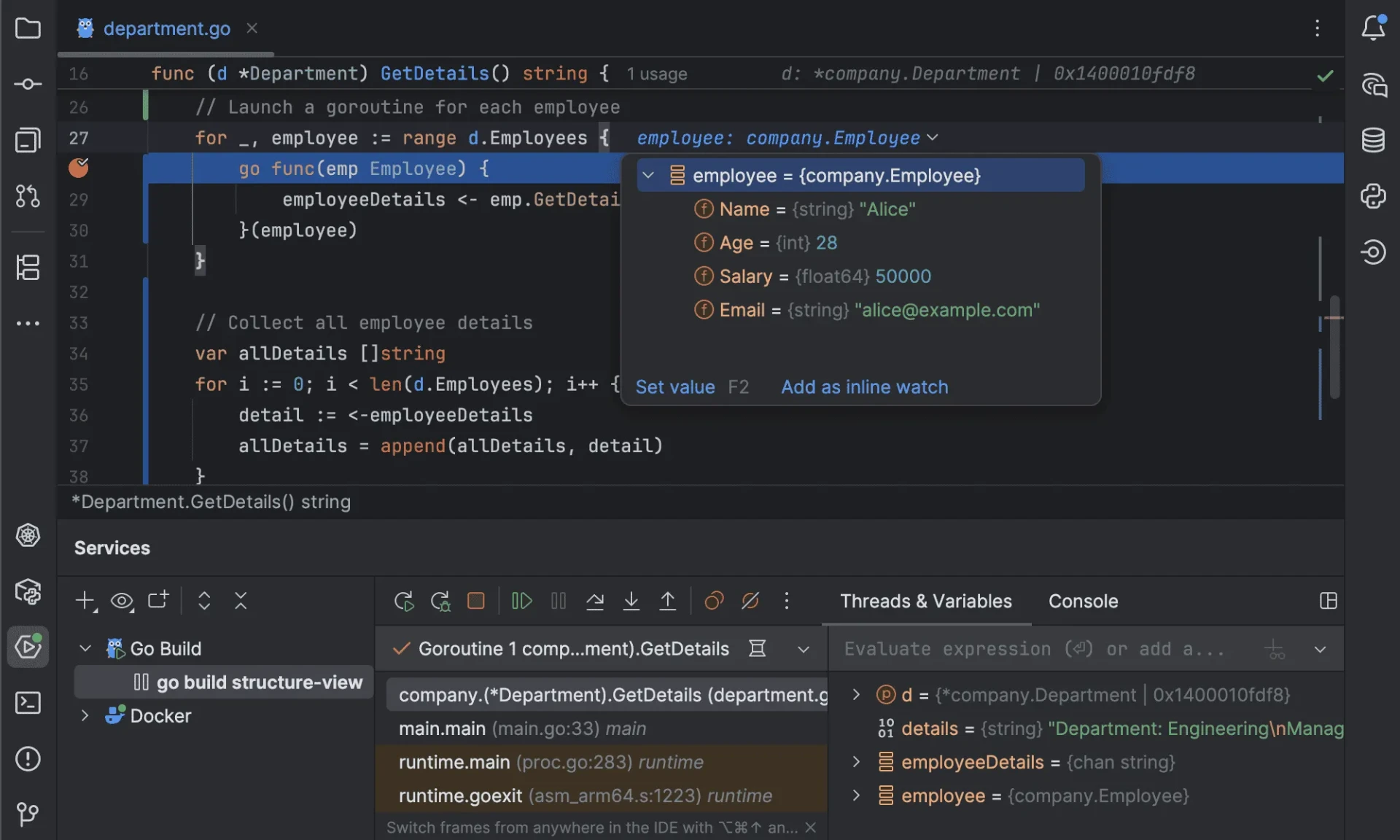
The debugger is the part that changes how you work. Breakpoints are ordinary, but watch expressions, the call stack and the goroutine view together let you see which of ten thousand concurrent paths is the one misbehaving. Stepping through a request that fans out across workers, then narrowing to the single goroutine holding a stale value, is a five-minute exercise instead of an afternoon of print statements.
Around that core sit the pieces that remove context switching. Test runs with coverage are a gutter icon, and the results appear next to the code they describe. The profiler launches from the same place, so a slow function discovered in a benchmark can be opened and inspected without leaving the window. Database tooling is built in, which removes one more client from the dock, and container and remote workflows are integrated rather than bolted on: a Kubernetes deployment can be debugged as if it were running locally.
The licensing change is the headline
For years the objection to JetBrains tools was simple arithmetic: excellent software, annual subscription, hard to justify for a side project. That objection has largely dissolved. Personal, non-commercial use is now free, which covers learning, open source work and the tools people build for themselves in the evening. Commercial teams still pay, and that is the arrangement that keeps the project alive.
The effect on the Go ecosystem is larger than it looks. A beginner now starts with the same instrument a professional uses, which means the habits form correctly the first time: formatted code, tests written alongside the implementation, a profiler consulted before guessing. The cost of entry drops to zero while the ceiling stays high, and that combination is rare in developer tooling.
The value here is that the language philosophy carries into the tooling. Go asks for simplicity and directness; the environment absorbs the complexity so that the person writing code can keep their attention on the problem.
A few habits worth forming early. Let the environment generate the standard project layout instead of assembling folders by hand, and let it manage modules rather than editing the manifest yourself. Learn the intention actions and postfix completions, because they delete a surprising volume of boilerplate. Run tests with coverage from the start, so that the number is visible before it becomes a target. And keep the toolchain updated: a fast-moving language rewards an environment that moves with it.