
GoFile: anonymous file sharing without an account or an advert
Summary
GoFile is a free anonymous file sharing service: upload without registering, no explicit hard limit on file size, files kept as long as people keep downloading them, a clean interface with no advertising and password protected links.
Recommend- Name
- GoFile
- Version
- 20260922
- Pricing
- Free
- Open source
- Proprietary
- Operating system
- 网页版
- Website
- https://gofile.io/
- Updated
- 2026-10-06 07:40
Sending a file should not require an account
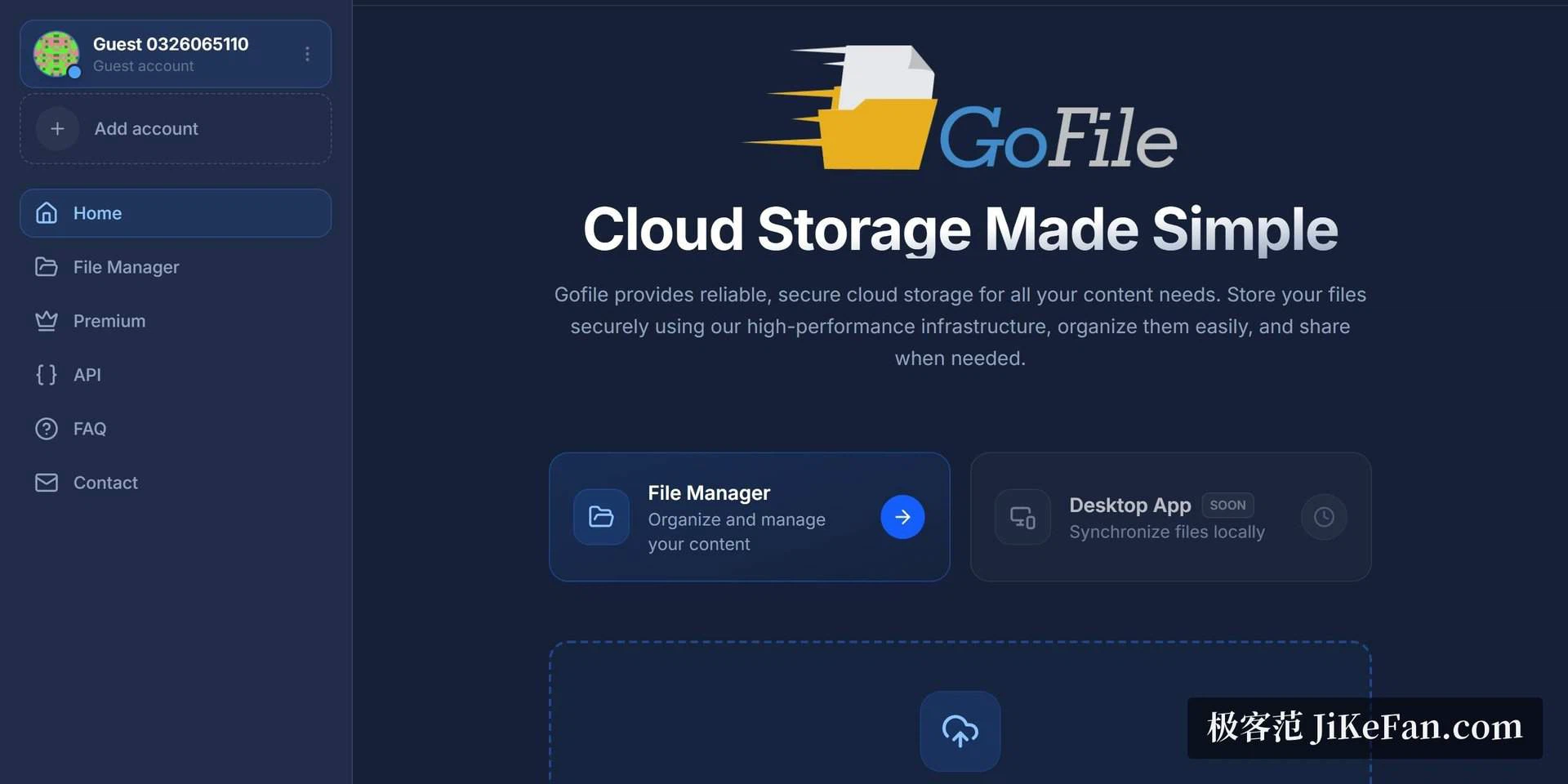
You want to send a friend a video of a few GB, or put a set of assets behind a temporary link for a client, and most cloud drives greet you with the same three demands: register, bind a phone number, install a client. GoFile does the opposite. Open the page, drag the file in, copy the link. Three steps, and no account at any point. It is a free anonymous file hosting service, and the clearest example of the use it and leave category.
What makes that worth writing about is how much machinery usually sits behind a simple request. An account exists so that a provider can recognise you later, and recognition is the beginning of storage, billing and retention policies. A service that skips the account is admitting that this particular job, handing something to one person once, does not need any of it.
Friendly to large files, plain about the rules
GoFile sets no explicit hard limit on file size, and large files upload directly, which suits design source files and video projects that run to several GB without thinking about it. The retention rule is just as plain: as long as the link keeps being downloaded, the file stays, and only files nobody asks for over a long period get cleaned up.
Share links can carry an access password and a description, and the recipient opens the page and downloads directly, with no preliminary step of any kind. The interface is clean enough that not one promotional overlay appears, which among free services of this kind is genuinely rare and is the reason people come back.
It can go further
For anyone who wants it inside a workflow, there is a public API: upload, manage and delete can all be done programmatically, and with a script the service becomes a piece of automated backup distribution or asset publishing rather than a page you visit by hand.
The convenience of anonymity carries responsibility with it, and it is worth saying plainly. Copyrighted material and files that belong to other people s privacy do not belong on a service like this, and important data should still be kept locally. Temporary sharing is what it does well; long term storage belongs to a solution built for it.
The same property cuts both ways in a second sense. A link without an account is a link that anyone holding it can use, so the password option is not decoration but the actual control, and it should be set before the link leaves your hands rather than afterwards.
The retention rule has a practical reading. A link that circulates keeps its file alive, and a link used once and forgotten starts a countdown nobody can see. For anything that has to be available next month, that is worth knowing before the link is sent, because the clock is the download traffic and not the calendar.
For client work the description field does quiet work. A link that arrives with a line saying what it contains and which version it is saves a round of messages, and the password can travel by a different channel, which is the only reason a password on a shared link means anything at all.
With the API the same service fits into a release process rather than a conversation: a build is uploaded, the link goes to the testers, and an old file is deleted when it is no longer needed. None of that requires anyone to open a web page.
One piece of advice that costs nothing. Keep the master copy on your own disk. A service built for handing things over is a good place for a link and a bad place for the only copy of anything.
The value here is that sharing a file goes back to what it originally was: a link. No account system, no marketing machinery, no wall of promotion, and passing a file along feels as natural as handing something over. Just remember that anonymity is a double edged blade.