
Flowise is archived: what the code still gives you after the shutdown
Summary
The project that made visual LLM flows mainstream has stopped: the repository was archived in August 2026 and the core team has left. The code stays under an Apache licence, which turns the question from what it can do into whether your team can carry it.
Recommend- Name
- Flowise
- Version
- 2
- Open source
- Open source
- Operating system
- WebLinuxmacOSWindows
- Website
- https://flowiseai.com/
- Updated
- 2026-10-06 06:00
Flowise was one of the earlier open-source projects on the visual LLM road: drag components together and you get a chat assistant, a knowledge retrieval flow or a multi-agent orchestration, with an API, an SDK and an embeddable chat widget supplied alongside. Before you start with it, there is one thing you have to know. The company has formally wound down during 2026, and the repository is now a read-only archive.
This article works from three sources that agree with each other, the website, the documentation and the official announcement, and sets out both what the product could do and the timeline of its shutdown.
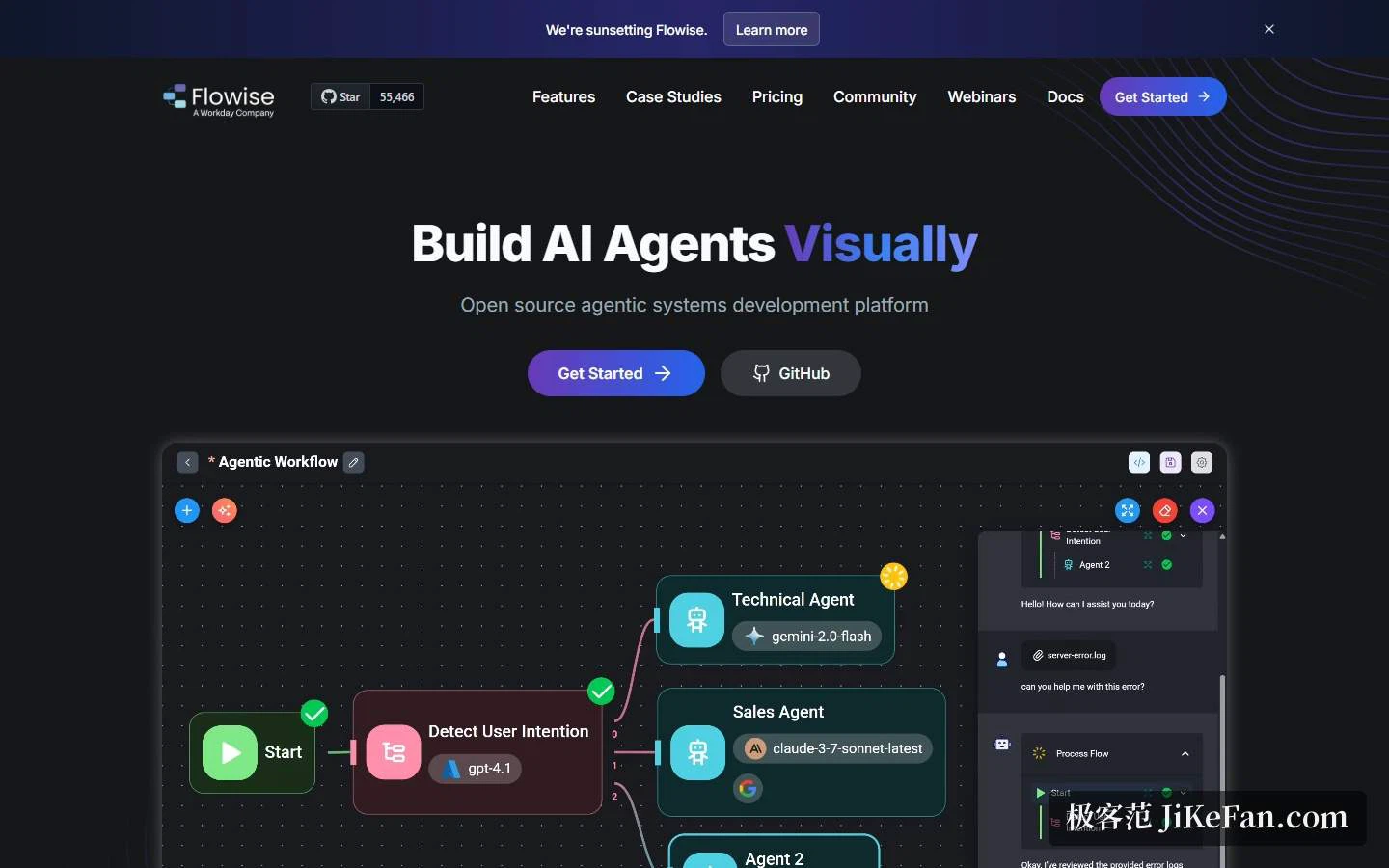
First, the conclusion: archived, and the timeline is public
A banner at the top of the site reads that Flowise is being sunset, with a link to learn more. The repository states that the owner archived it on 13 August 2026 and that it is now read-only. The announcement published in the discussion forum, titled The Future of Flowise, sets the pace precisely: on 29 July the announcement was made and the code frozen, with no new merge requests reviewed or accepted; on 13 August the repository moved into public archive, the code stays visible but issues and merge requests are locked and packages and container images are marked deprecated; on 31 August came end of life, when the core team's presence in the community and the repository ended.
The stated reason deserves attention rather than dismissal. Over recent months, developers increasingly relied on coding agents to handle complex tasks, and the rigid low-code approach to workflows hit its complexity ceiling quickly. That is an unusually candid explanation from a vendor about its own category. The code itself remains in the repository under an Apache licence, and the announcement explicitly encourages teams to fork and maintain it themselves.
What it could do: three visual builders
The documentation splits the builder into three levels. Assistant is for newcomers: a chat assistant that follows instructions, calls tools when needed, and retrieves knowledge from uploaded documents. Chatflow is for single-agent systems and simple flows, more flexible than Assistant and able to use graph retrieval, rerankers and retrievers. Agentflow is the superset of both, covering chat assistants, single agents, multi-agent setups and complex orchestration, and it has a second-generation version.
The website groups the capabilities into four cards. Agentflow spreads the orchestration of a multi-agent system across several cooperating agents. Chatflow combines tool calling with retrieval over multiple data sources and lists the formats it can ingest, from plain text and PDF through office documents, markup, structured data, spreadsheets and SQL. Human in the loop lets a person review the tasks an agent performed inside a feedback cycle. Observability supplies full execution traces and works with tools such as Prometheus and OpenTelemetry.
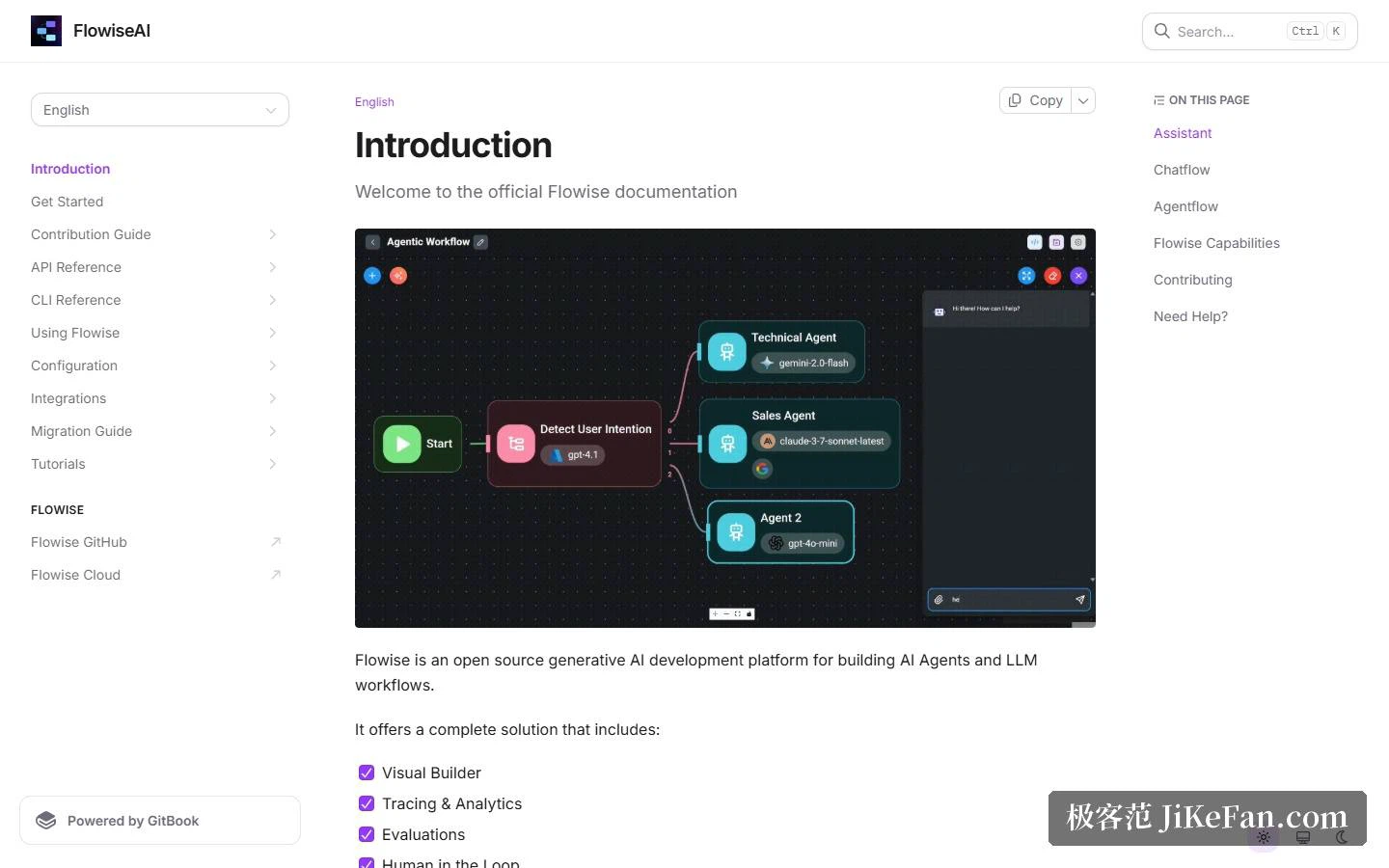
The feature list, from API to enterprise deployment
The matrix in the docs is finer grained than the website, organised by orchestration, data ingestion, monitoring, deployment, data processing, memory and planning, MCP integration, security and control, API and SDK, embedded chat, templates and components, governance, scalability and evaluations. A few entries deserve to be pulled out. The MCP section claims client and server nodes, a tool list, server-sent events and authentication. The deployment section covers self-hosting and air-gapped installs. Security and control covers roles and permissions, single sign-on, credential encryption, key management, rate limiting and domain restrictions. Scalability covers both vertical and horizontal growth.
The site's own summary is two phrases. Developer friendly, meaning the API, the SDK and embedded chat as a set, with TypeScript and Python SDKs. And enterprise ready, meaning cloud or on-premises deployment, coverage of more than 100 large models, embedding models and vector stores, and horizontal scaling through a message queue plus workers. Getting started locally is short: install Node 20 or newer, install the package globally and start it.
Pricing, from free to a 65 dollar workspace tier
Three tiers are listed. Free costs 0 a month and includes 2 flows and assistants, 100 predictions a month, 5MB of storage, evaluations and metrics, a custom-branded embedded chatbot and community support. Starter costs 35 a month with unlimited flows and assistants, 10,000 predictions a month, 1GB of storage and a free first month. Pro costs 65 a month with 50,000 predictions, 10GB of storage, unlimited workspaces, 5 users with additional ones at 15 per user a month, administrator roles and permissions, and priority support.
One caveat matters here: those tiers were designed for the cloud service, and since the product has reached end of life, actual availability has to be checked against the console and official announcements. Anyone considering a renewal should confirm whether the service still exists before paying.
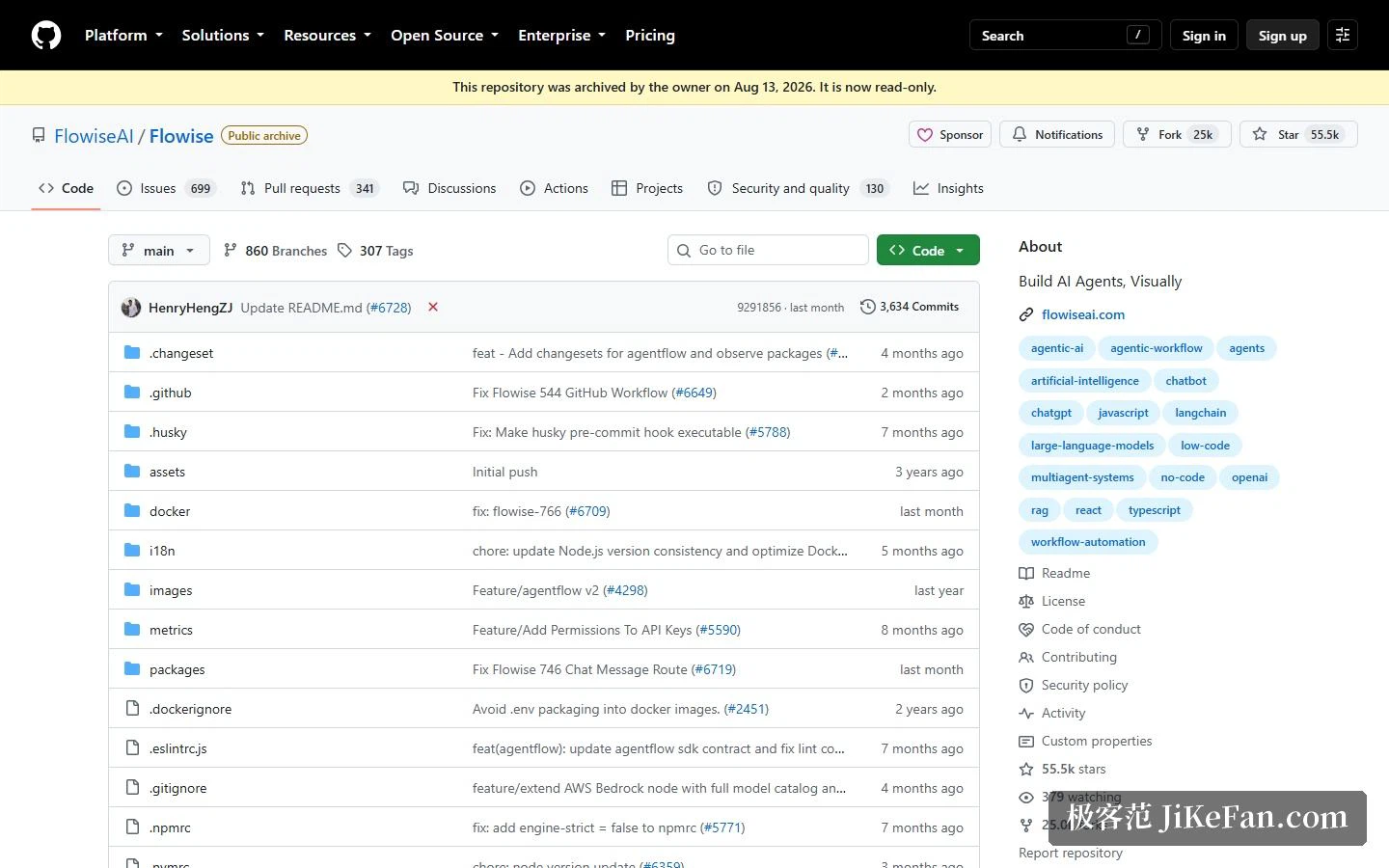
Is it still worth using?
Two distinct cases. If you are looking for a commercially maintained product for the long term, Flowise is no longer the right choice: the core team has left, the packages and container images are marked deprecated, and the upstream will not answer when something breaks.
If your situation is self-controlled, long-term self-built infrastructure, the value is still there. An Apache licence permits modification and commercial use, the code is intact, and the repository offers a starting point with roughly 55,500 stars, 25,000 forks, 337 contributors and 85 releases, with the documentation site still online. In other words, it has changed from a product you adopt into a code asset you take over, and the evaluation criterion moves with it, from how many features it has to whether anyone on your team can hold it.
What the shutdown actually teaches
The stated cause is the interesting part. A low-code canvas assumes the flow is the artefact worth maintaining, and the announcement says the opposite happened in practice: as tasks got complex, developers reached for coding agents and let the generated code carry the complexity. That is not an argument against visual tools in general, but it is a warning about who owns the intelligence in your stack. When the model writes the awkward parts, the canvas stops being the place where difficulty is solved and becomes a place where it is displayed.
For anyone picking a tool in this category today, the practical lesson is to check two things before the feature list: whether the licence lets you fork, and whether the flow format is portable. Flowise scores well on the first and offers export routes on the second, which is why it can still be a reasonable foundation and a poor subscription.
Two honest notes
First, at the time of writing the repository is in read-only archive, and the official announcement is the authoritative statement about the shutdown; anything later should be checked through official channels. Second, this article makes no recommendation about successor products. Anyone choosing a path along this technical line should evaluate projects that are still actively maintained, separately and on their own merits.
The ceiling of a low-code tool is not how complex a canvas can draw, but that once requirements get complex enough, the canvas itself becomes the bottleneck.