
FastGPT starts from the knowledge base, then adds the workflow
Summary
A platform where knowledge base Q&A, visual workflows, agent orchestration and tool calling share one workspace. The licence allows internal commercial use but not resale as a service, and the retrieval side is where the effort went.
Recommend- Name
- FastGPT
- Version
- 4.17
- Open source
- Open source
- Operating system
- WebLinuxmacOSWindows
- Website
- https://fastgpt.io/
- Updated
- 2026-10-06 13:16
FastGPT earned its reputation in Chinese-language circles for two things: a knowledge base question-and-answer system that works out of the box, and the decision to put visual workflows and agent orchestration on the same platform rather than selling them separately. The documentation defines it as an application development platform for agents built on large language models, gathering knowledge base Q&A, visual workflows, agent orchestration, tool calling and skill extension in one place. The international site is blunter about the audience, calling itself an enterprise AI productivity engine and promising secure, controllable enterprise agents.
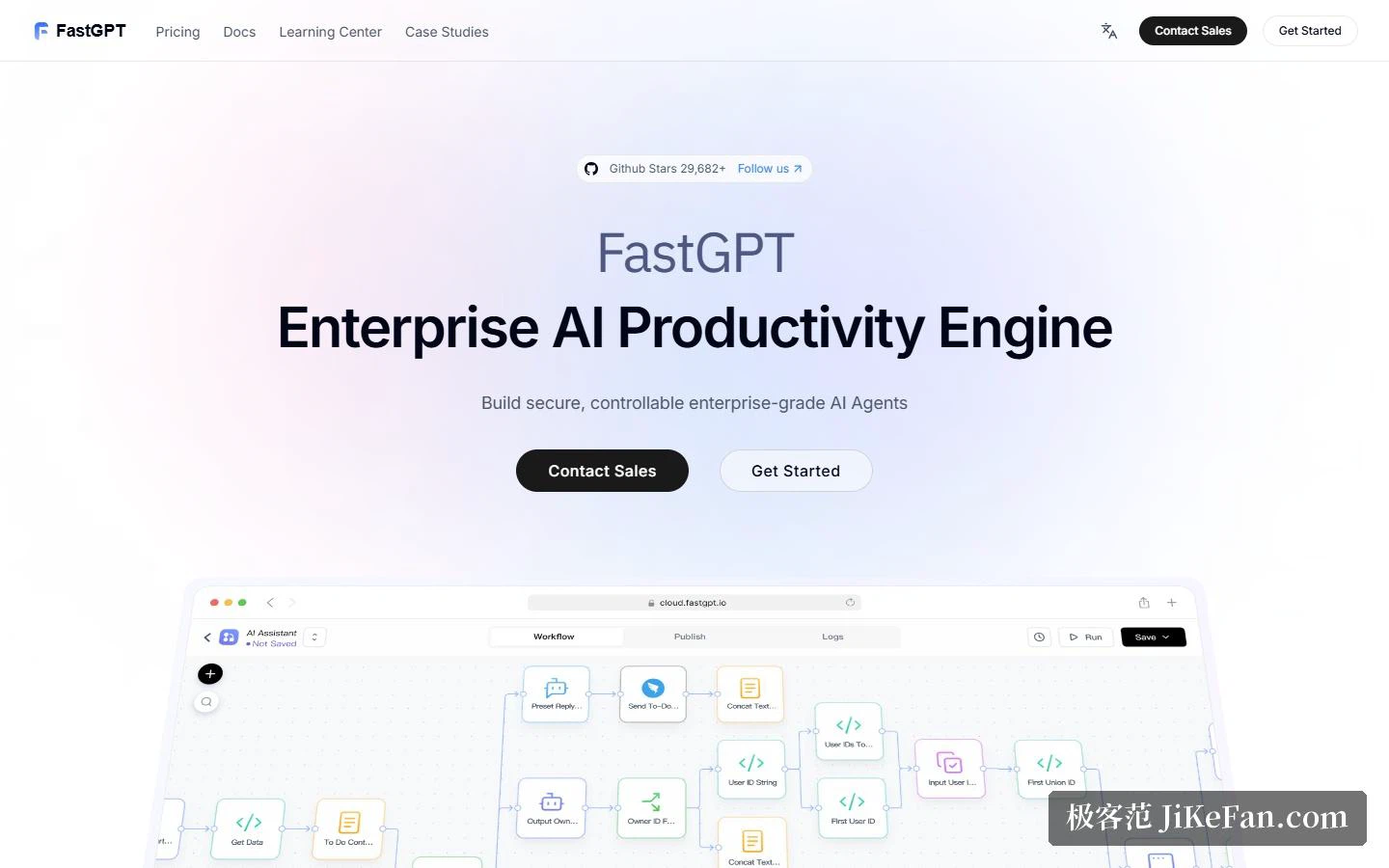
Six highlights, and all of them point at control
The homepage groups its claims into six. Production-grade agents, meaning business agents assembled like building blocks, with visual workflows and an API ecosystem built for extension. An enterprise knowledge base, which uses hybrid retrieval to cut hallucination and keeps data cleaned and updated. Full lifecycle management of models, with compatibility across providers and debugging plus audit. A production-grade architecture with single sign-on and role-based access control, serving as a secure portal whose view differs by person. And accompaniment from research through to a custom proof of concept.
The industry solutions split by function: sales and marketing, service and operations, administration and human resources, finance and legal. On the sales side three samples are shown, a smart sales assistant, a financial market briefing and a sales training sparring partner.
The case studies are stated as measured outcomes rather than adjectives. A research knowledge assistant cut the training cycle by more than a week, reduced repeat inquiries by a tenth and brought retrieval down to thirty seconds. Automating fund research reports reached an automation rate above nine tenths with data errors under one percent. Expense review raised review efficiency by half, lifted anomaly detection by seven tenths and cut final-review mistakes by six tenths. Customer service reached second-level responses and reduced handoffs to humans by forty-two percent. The company says it has helped more than a thousand enterprises, and lists its services in four kinds: open-source ecosystem support, expert consulting, implementation assistance and custom development.
The knowledge base is where the work actually went
The documentation gives data processing a section of its own, which is telling: it handles the complex structure of PDFs while keeping images, tables and mathematical formulas, detects scanned documents automatically and structures them into Markdown, and indexes images with automatic tagging so that the content inside a picture is searchable too. The readme adds the format list, from plain text and Markdown through HTML, PDF, Word and PowerPoint documents, CSV and spreadsheets, and supports manual entry, direct chunking, question-and-answer split imports, reading from a URL and batch CSV import.
On retrieval it offers reuse and mixing of several libraries, hybrid retrieval with reranking, and an API-based knowledge base as an option. That combination is the part a buyer should test hardest, because it decides whether an answer cites the right paragraph.
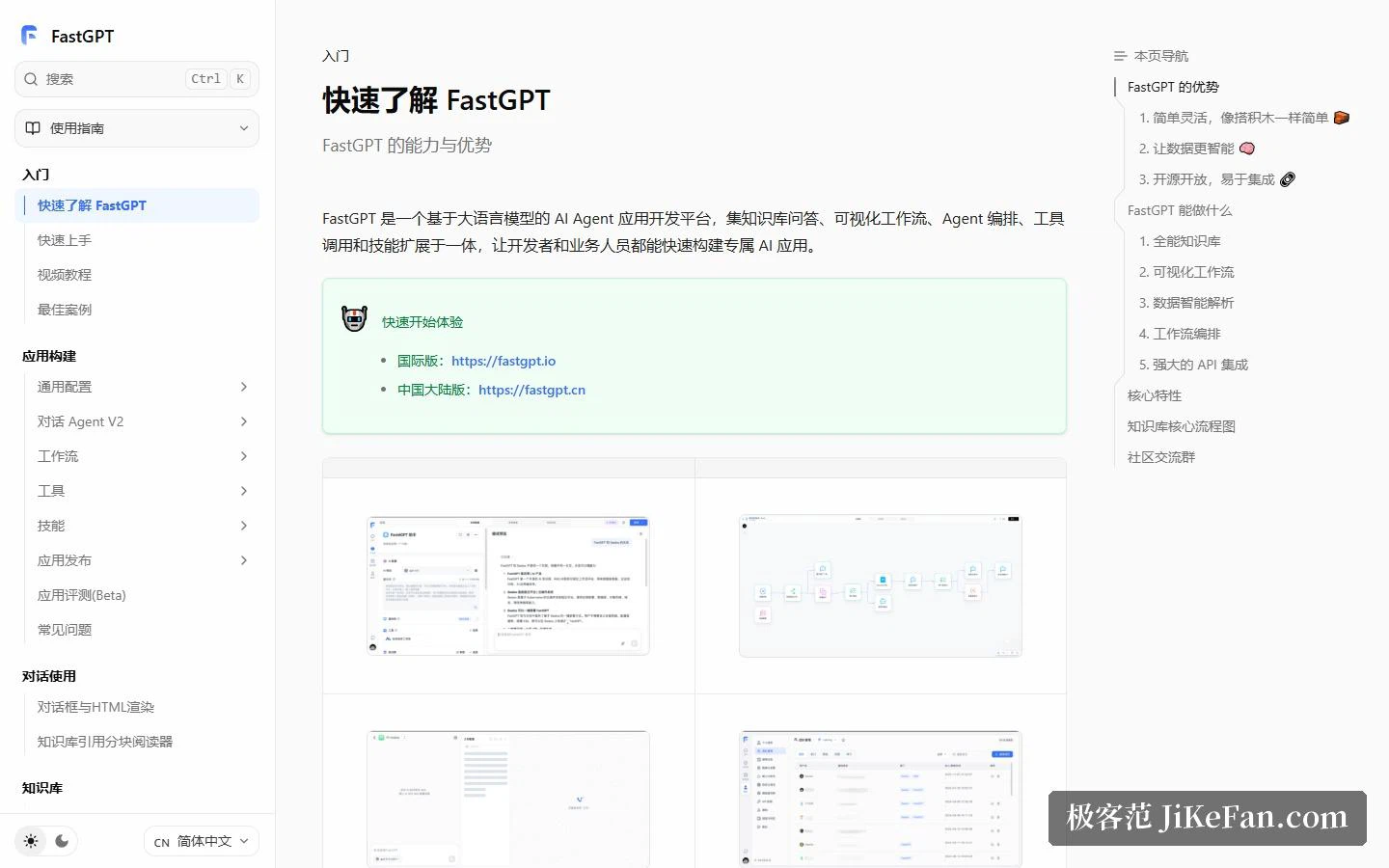
Orchestration and debugging: the real list is in the repository
The readme sorts the core features into five groups, and it is a better reference than the marketing copy. Application orchestration covers agent skill orchestration, chat and plugin workflows including basic RPA nodes, and bidirectional MCP. Application debugging covers single-point knowledge base search tests, dialogue feedback with citations that can be edited or deleted, full call-chain logs and application evaluation. Plugins cover system tools, RAG modules and hot updates of the agent loop. Operations covers a share window that needs no login, embedding through an iframe, and a unified view of conversation records with data annotation.
At the interface level the docs state that the API matches the OpenAI format exactly, and that connecting to the major domestic workplace platforms is a short step, WeCom, official accounts, Feishu and DingTalk among them. Deployment is one container command that pulls the configuration and then starts; once fully up, the service answers on local port 3000.
The licence draws the commercial boundary, and it matters
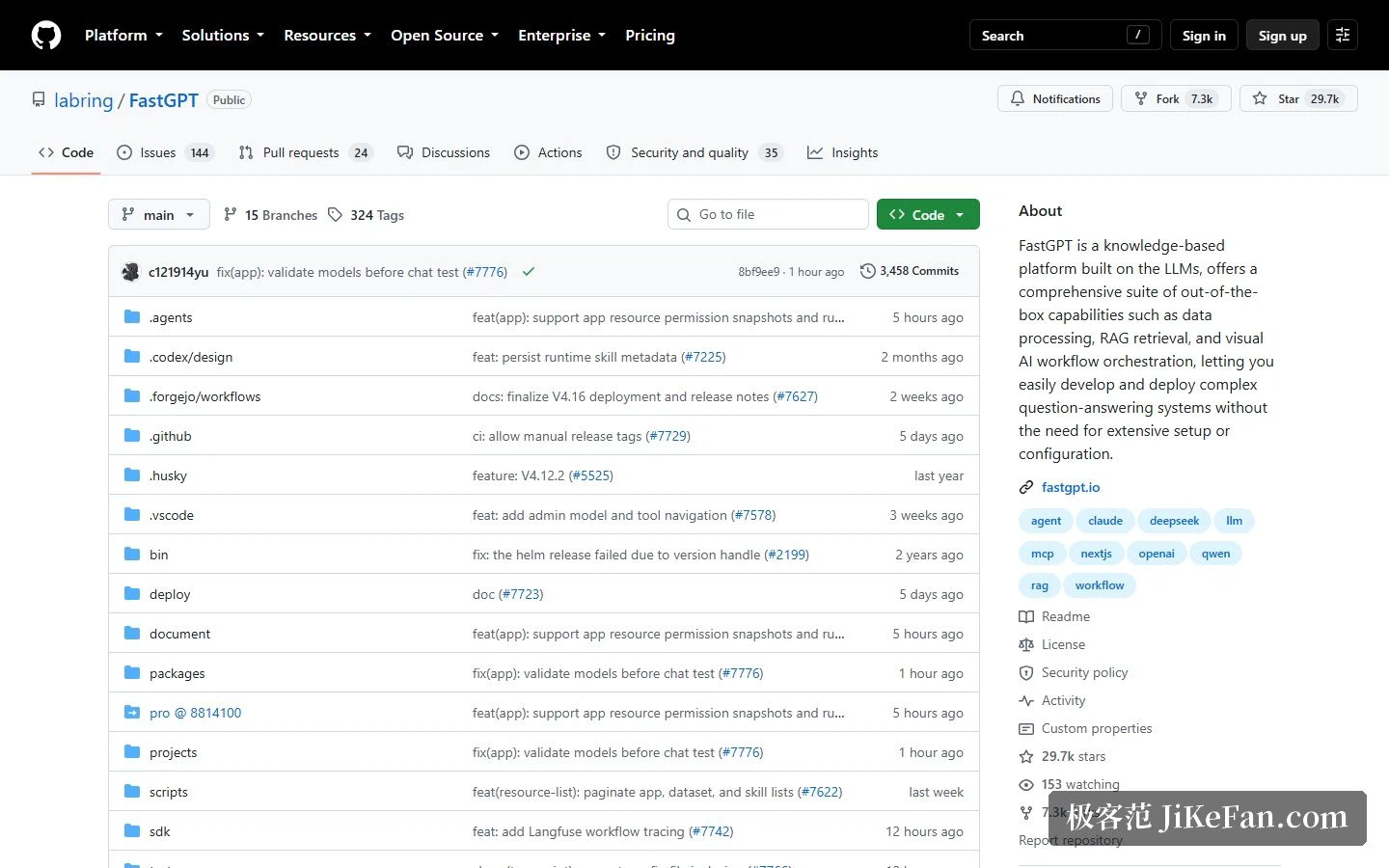
This is the paragraph a team planning commercial use should read twice. The repository uses the FastGPT Open Source License: it permits commercial use as a backend service, but does not permit offering a SaaS. Without a commercial licence, any form of commercial service must retain the relevant copyright notice. Put plainly, using it yourself and serving your own organisation is allowed; wrapping FastGPT and selling it to others as a service requires a commercial licence.
The repository shows roughly 29,700 stars, 7,300 forks, 200 contributors and 276 releases, written mostly in TypeScript. Neither the international nor the Chinese site publishes a price list today: cloud and private deployment are quoted through sales, actual figures appear in the console, and none is cited here.
Who it suits
Three groups fit the path the documentation lays out. Teams that need private question-and-answer over Chinese-language material, where multi-format import plus hybrid retrieval is the part the project invested in most. Business owners who need the Q&A wired into channels they already use, since an API aligned with the OpenAI format keeps integration cheap. And technical teams who want knowledge, workflows and agent orchestration maintained in one platform rather than three.
One thing to notice: delivery and support, meaning expert consulting, implementation help and custom development, are packaged as part of the commercial edition. If a project depends on delivery certainty, run the community edition first and evaluate the commercial side afterwards, rather than the other way round.
What the numbers in the case studies are worth
Vendor-published efficiency figures should be read as direction rather than precision. A claim of a ninety percent automation rate on research reports is useful because it says the task is now mostly machine work with human review, and a claim of sub-one-percent data errors is useful because it says the remaining job is verification. Neither tells you what your own corpus will produce, and both implicitly assume the documents going in are the ones the system was tuned for. The honest test is to feed it the worst PDF in your archive.
Two honest notes
First, no public prices exist for either site, so this article quotes none, and anyone budgeting should treat the sales conversation as the source of truth. Second, the licence distinction above is not a formality; it decides whether a service you build on top can be sold at all, so read the licence text before designing a product around it.
The dividing line between knowledge base products is not whether they can answer, but whether the citation they return is actually the right one after you throw in a badly formatted PDF.