
F5-TTS hands you MIT code and non-commercial weights, installed with one pip line
Summary
An open source speech synthesis project built on flow matching, with a pip package, command line inference and a Gradio web interface. The code is MIT; the pretrained weights are non-commercial because of the training data.
Recommend- Name
- F5-TTS
- Version
- 1.1.22
- Pricing
- Free
- Open source
- Open source
- Operating system
- WindowsLinuxmacOS
- Website
- https://github.com/SWivid/F5-TTS
- Updated
- 2026-10-06 20:44
F5-TTS is the official implementation of a paper, and the paper has a playful title: a fairytaler that fakes fluent and faithful speech with flow matching. The name is light, the technical route is not. Synthesis runs on flow matching, over a backbone of a Diffusion Transformer paired with ConvNeXt V2.
The project is open source, has shipped more than twenty releases, and the repository keeps the base model alongside the code for inference, training and deployment.
Three keywords: flow matching, ConvNeXt V2, Sway Sampling
The project notes lay out three items side by side. The first is F5-TTS itself, which pairs a Diffusion Transformer with ConvNeXt V2 and is described in the words of the authors as faster to train and to infer. The second is E2 TTS, a reproduction built on a Flat-UNet Transformer. The third is Sway Sampling, a strategy for sampling flow steps during inference, which the authors say visibly improves generation quality.
For anyone using the thing, the first two set the ceiling on what the model can do, and the third sets what a given model actually produces. Sway Sampling is the interesting one because it takes effect at inference and needs no retraining, which is presumably why it earned its own line.
Installing: one pip line, or switch to Docker
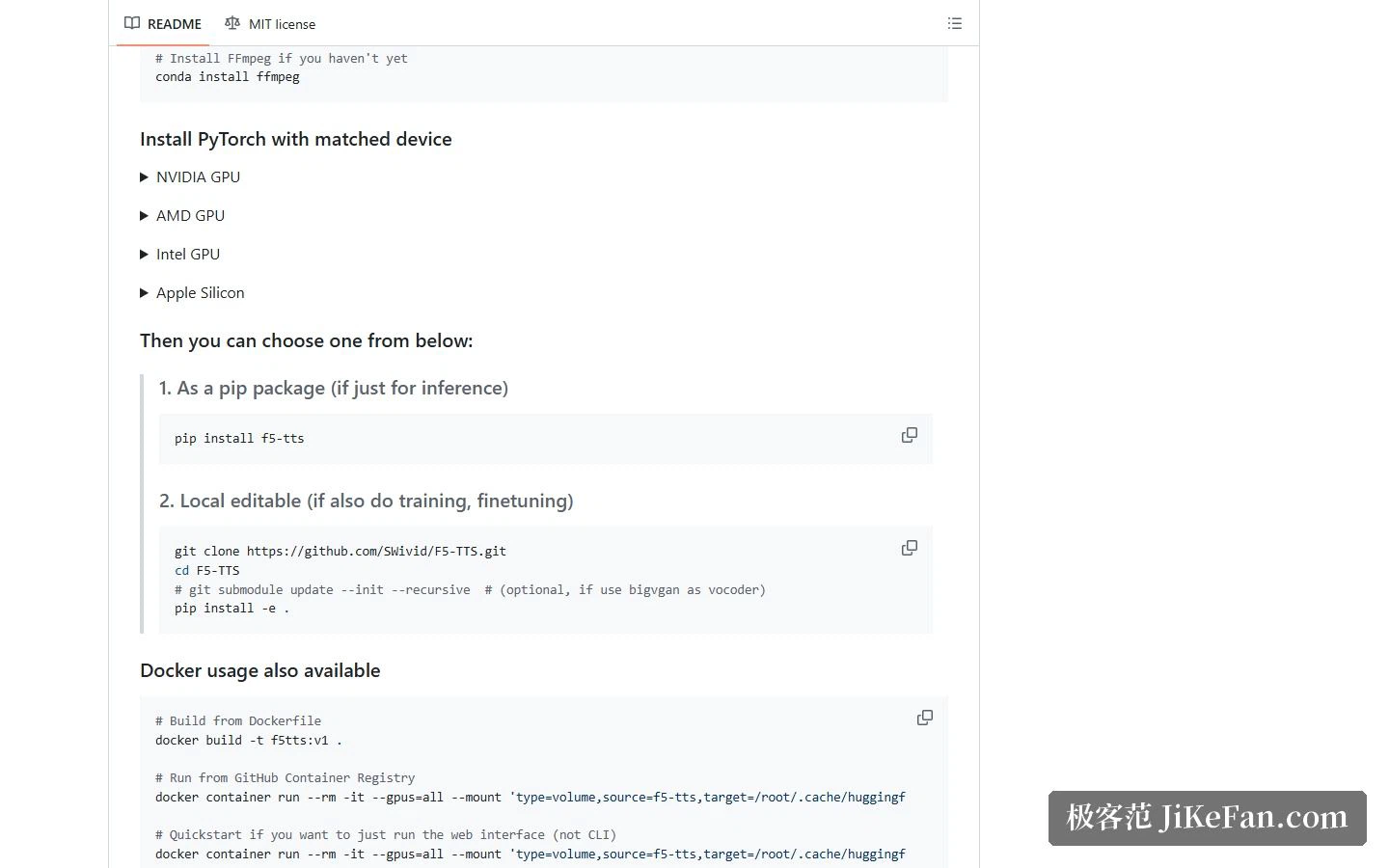
The installation splits into two cases depending on what you intend to do. For inference only, the pip package is enough. For training or fine-tuning, clone the repository and do an editable install. Before pulling PyTorch, match the version to your hardware; the notes give commands for NVIDIA, AMD, Intel and Apple Silicon separately.
Docker is the other route: build from the Dockerfile in the repository, or pull the official image and run it, and the notes include a shortcut command that starts nothing but the web interface.
Three ways to use it: terminal, web page, spoken dialogue
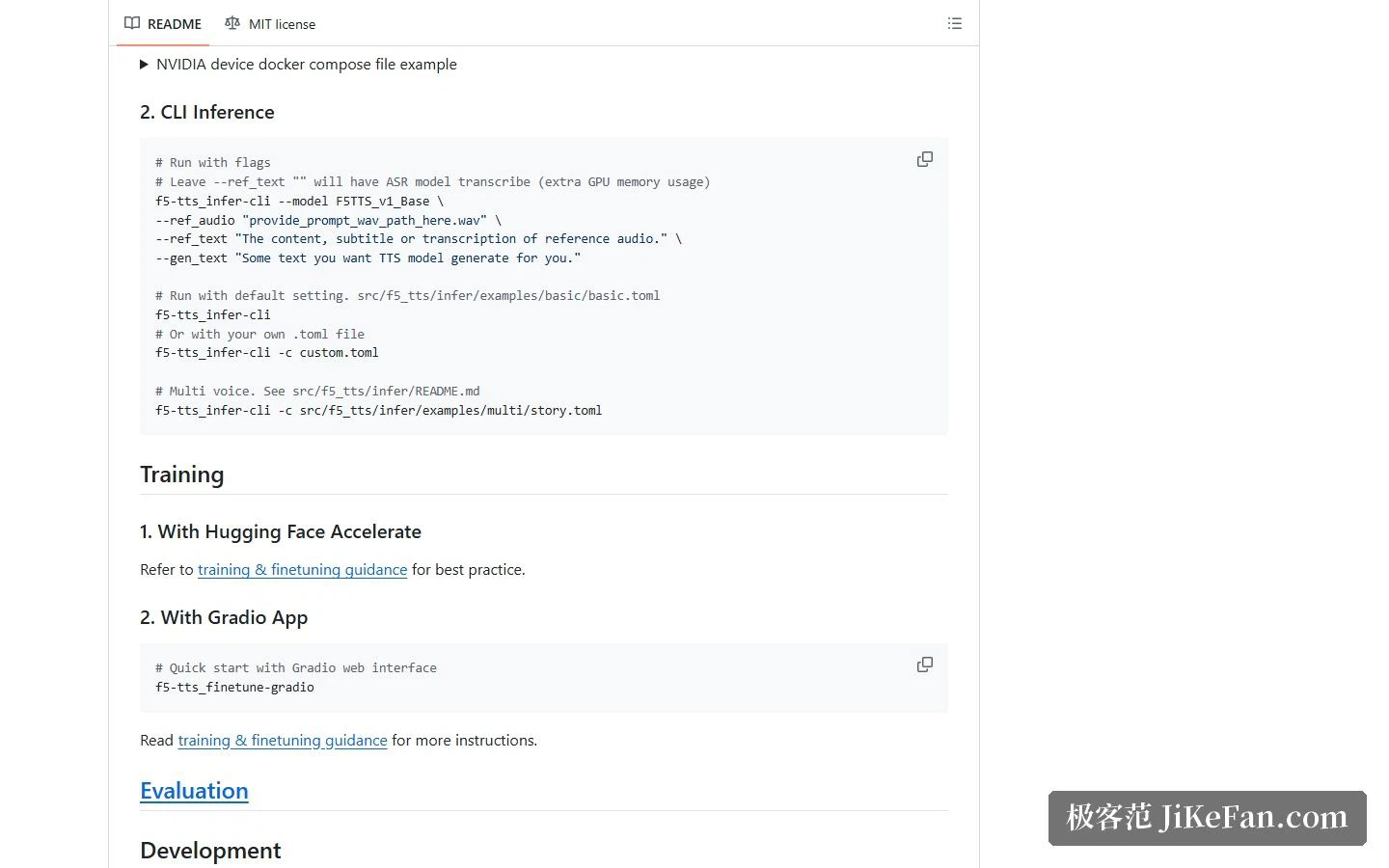
The command line parameters are easy to follow: hand over a reference audio clip, the transcript for that clip, and the text you want spoken, and the model reads the target text in the reference voice. One detail is worth knowing — the reference transcript may be left blank, in which case a speech recognition model transcribes it automatically, at the cost of some extra video memory.
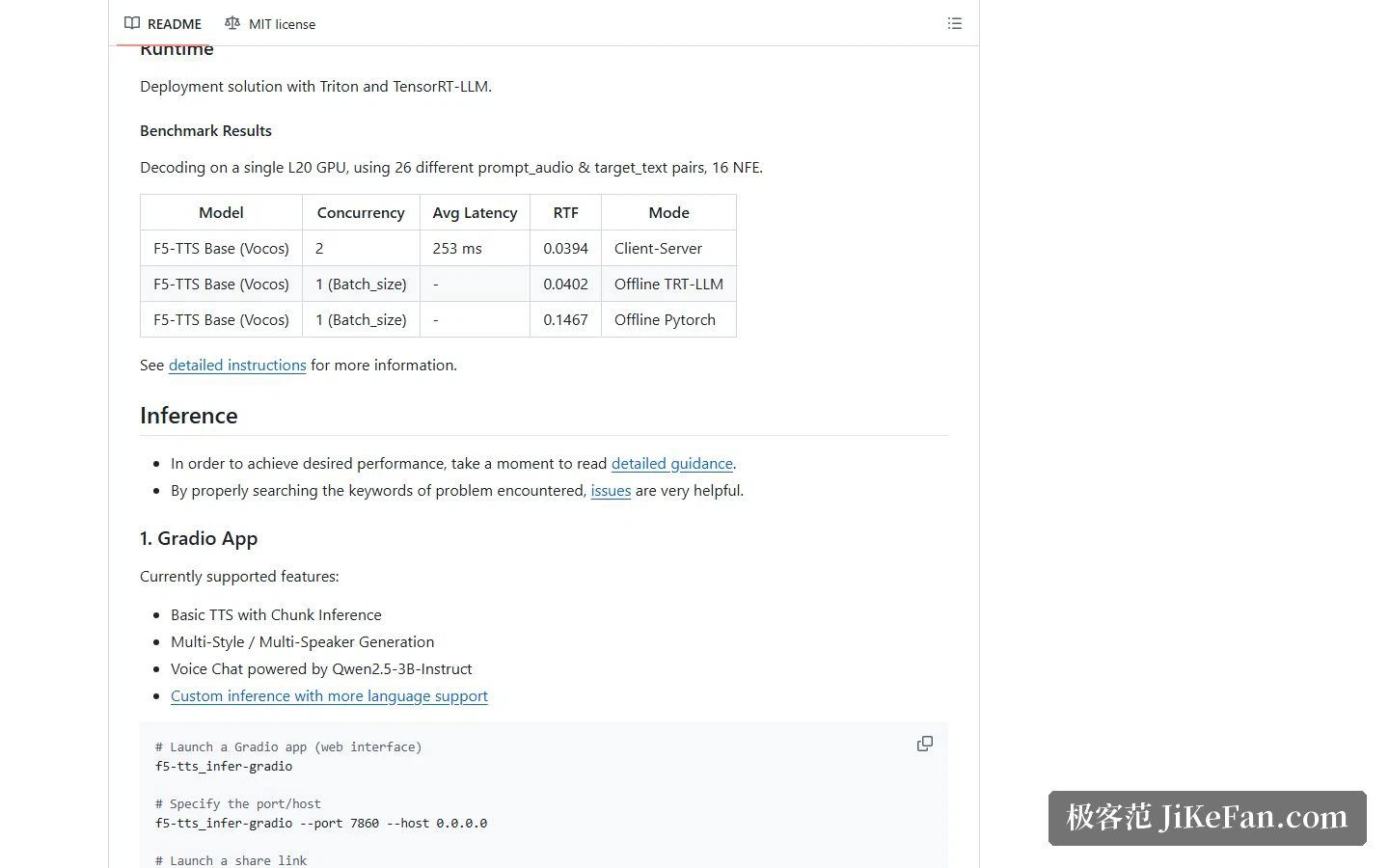
If the terminal is unappealing, start the Gradio interface. The features listed there go beyond basic synthesis to multi-style and multi-speaker generation, plus a spoken dialogue mode driven by a three-billion-parameter instruction-tuned language model. So the page does not merely turn text into audio; it can hold a turn of conversation in speech.
The performance numbers, measured on a single L20
The deployment section carries a benchmark: one L20 card, 26 pairs of reference audio and target text, 16 inference steps. F5-TTS Base in a client-server setup with concurrency 2 averages 253 milliseconds of latency at a real-time factor of about 0.0394; switching to offline TensorRT-LLM gives 0.0402, while offline PyTorch lands at 0.1467. The lower the factor, the further generation runs ahead of playback, and the spread across those three figures shows how much the deployment choice matters.
Training and fine-tuning
Training splits the same way, into two paths. One runs through Hugging Face Accelerate and suits ordinary training and fine-tuning. The other is a Gradio page, and the notes give a launch command for a dedicated fine-tuning interface, so no code is required. For anyone who just wants to bend the model toward a particular timbre, the second path is far less work.
The licence: MIT code, non-commercial weights
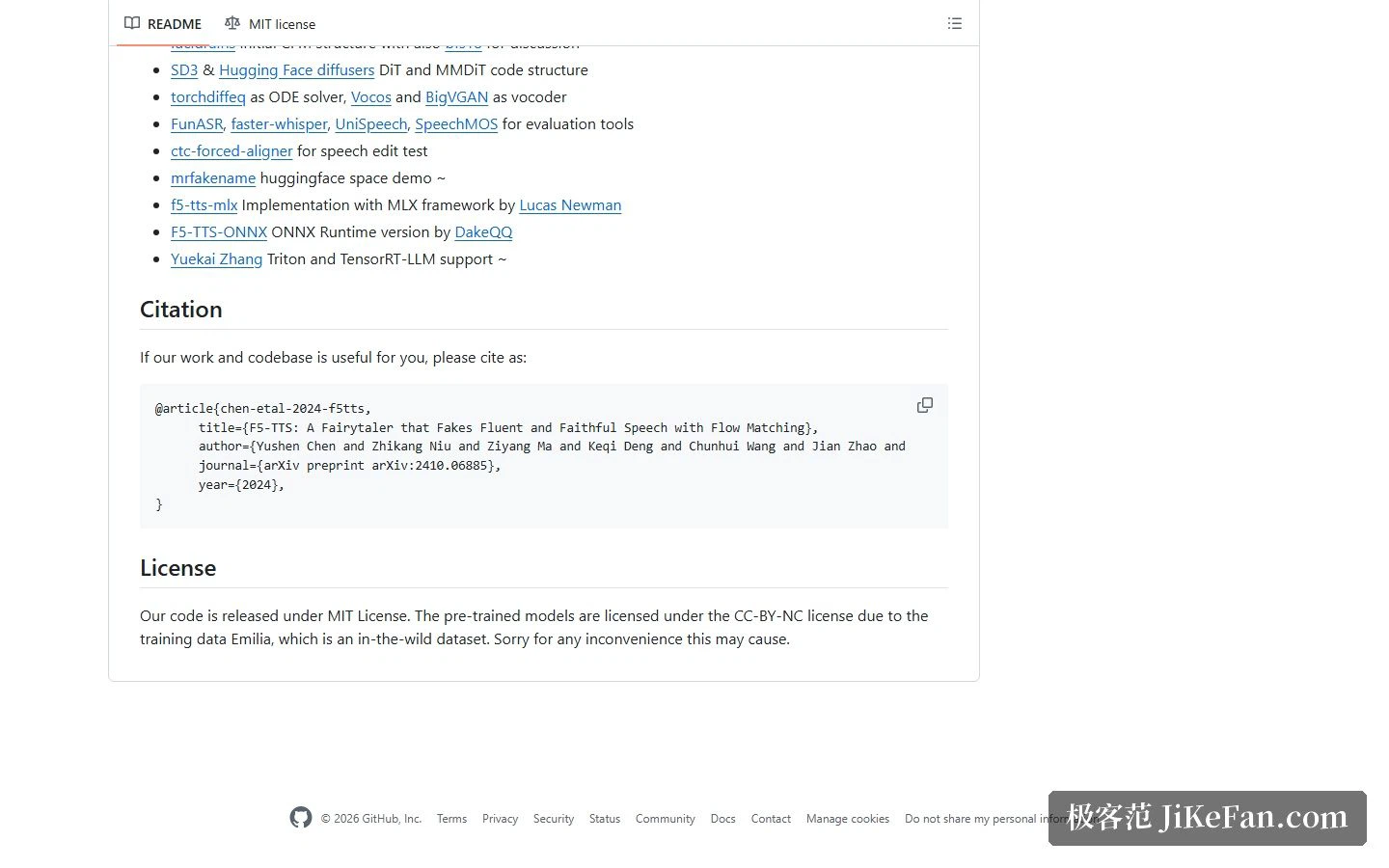
This part deserves careful reading. The licence section states that the code is released under MIT, but the pretrained models are licensed differently: because the training data, Emilia, is a dataset gathered in the wild, the weights ship under a non-commercial Creative Commons licence. The authors apologise for it in the same paragraph.
So you are free to build on the code, but putting the official weights straight into a commercial project runs into a licensing wall. Getting around it usually means training on a more permissively licensed dataset yourself, which costs additional compute and data preparation.
Who it fits
For researchers and developers who want to experiment on a clearly structured, actively iterated speech synthesis project, the code quality and documentation hold up: several install paths, deployment options covering Triton and TensorRT-LLM, and ready-made entries for both inference and training.
For anyone who simply needs a speech synthesis route they can use commercially, the licence is the first thing to solve, or the cost of self-training has to be weighed. Separately, whichever model you use, settle the authorisation around voice cloning first — building content from someone else's voice, and especially a public figure's, can touch personality and voice rights.
An open project puts the capability on the table and the restriction in the licence section. Two minutes spent reading that section before you start usually costs less than reworking afterwards.