
Eclipse IDE: an open source development environment on a quarterly clock
Summary
An open source, multi language integrated development environment and platform. Official packages cover Java, C and C++ and PHP, the plug-in catalogue is large, the installer bundles a JRE, and Windows, macOS and Linux are all supported. The current release is 2026-09.
Recommend- Name
- Eclipse IDE
- Version
- 2026-09
- Pricing
- Free
- Open source
- Open source
- Operating system
- WindowsmacOSLinux
- Website
- https://eclipseide.org/
- Updated
- 2026-10-16 22:11
Choosing a development environment is usually a decision you live with for years, so upkeep and extensibility end up mattering more than the feature list of any single release.
One platform, many plug-ins
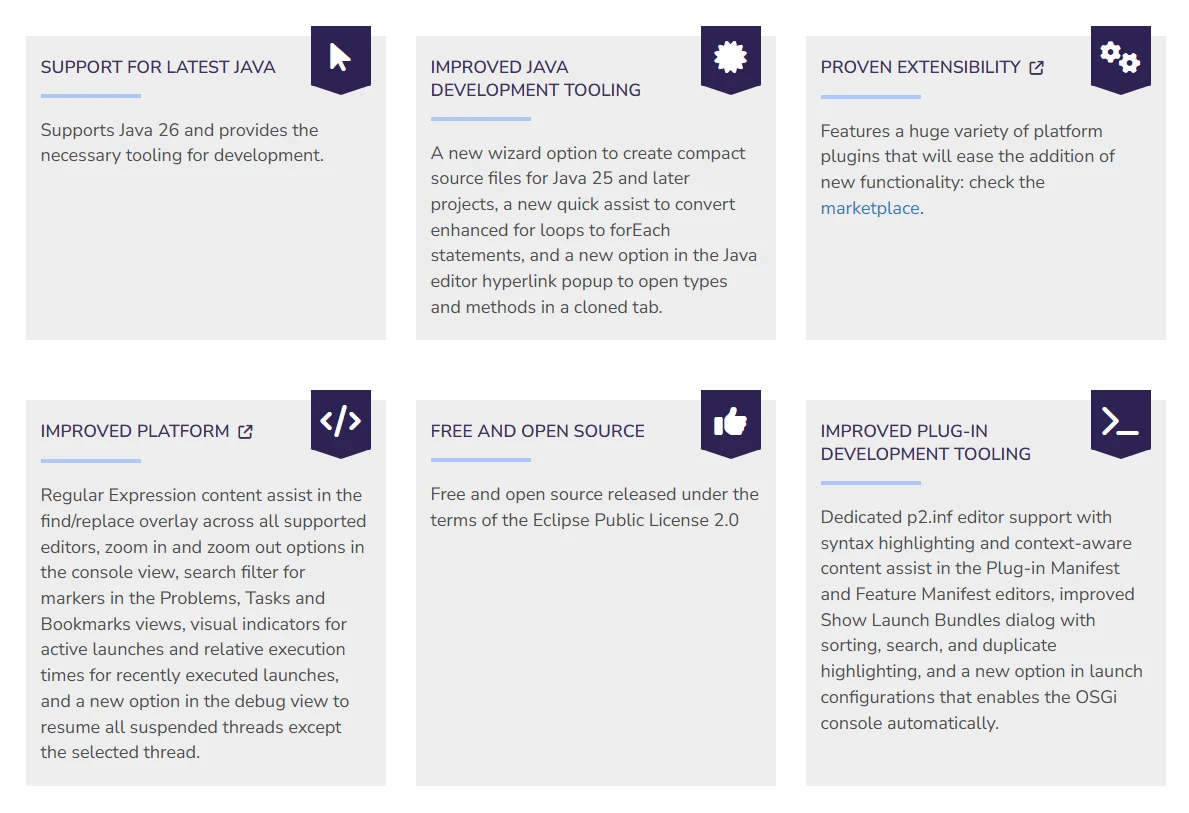
Eclipse is unusual in being both a working development environment and a layer on which other people build their own tools. The project describes itself as open, supported by industry and driven by a community. Open here covers source code as well as governance, since several organisations and communities take part in steering it. For a long lived project, the question of who maintains a toolchain and for how long tends to matter more than a handful of extra features in a given build.
Extensibility sits at the centre of that design. The platform carries a very large number of plug-ins, and new capabilities usually arrive as plug-ins distributed through a single marketplace. You assemble what you need instead of forcing one oversized installer to carry every feature. Around the same base, vendors can ship their own specialised tools while users keep a shared baseline of behaviour.
Several packages are published, organised by direction. There are downloads for Java, for C and C++, and for PHP, each giving the tools that direction needs out of the box. Python is the exception, since it normally means adding a third party plug-in afterwards. That is worth knowing before you commit to the environment.
Release rhythm and language support
Releases happen quarterly. The front page names the date of the next one, and the version list is laid out by year and month. A fixed rhythm makes upgrades predictable, so a team can schedule its version bumps by quarter rather than waiting for an update that arrives without a date. Recent releases also list support for the newest Java as a highlight, which means new language features usually reach the toolchain quickly.
The barrier to running it has dropped further. The installer now ships with a JRE, so on Windows, macOS and Linux you do not have to prepare a Java runtime beforehand. For a first attempt, that removes exactly the step where people tend to get stuck. All three mainstream desktop systems have packages, across several processor architectures, which makes it easier for a mixed fleet of machines to settle on one environment.
The platform also works as a base for building applications. The project provides a full set of tools for plug-ins, rich client applications and remote application platforms, and some commercial tools are built on the same foundation. That goes past the idea of an editor for source code, and treating it as reusable infrastructure is closer to the mark.
Licence and where to get it
It is released under the Eclipse Public License 2.0, written by the foundation itself. The terms include a patent grant and clauses meant to stay workable for businesses, so the boundary is fairly clear when a company folds the output into its own process. Both the licence and the downloads live on the official site, and release notes are archived by version number, which makes it straightforward to look up what changed in an older build.
The current version is 2026-09, with the platform at 4.41. Versions are named by year and month to match the quarterly rhythm, and a single release covers the platform plus each language package. The download page lists builds by system and architecture, so matching your machine is a matter of reading two lines.
Item | Official information |
|---|---|
Current version | 2026-09 (platform 4.41) |
Licence | Eclipse Public License 2.0 |
Systems | Windows, macOS, Linux, several architectures |
Official packages | Java, C and C++, PHP, RCP and RAP |
Release rhythm | Quarterly |
Runtime | Installer bundles a JRE |
When the environment is built as an extensible platform, features can be filled in by the community as needed rather than bet on inside one installer.
Practical notes. On a first install, take the package that matches your direction and skip assembling a blank environment piece by piece. When you want the newest Java features, move to the current quarter. Standardise architecture and install method across a team to cut down on platform differences. If you plan to work in Python, add the third party plug-in early and check where it comes from.