
Dify treats a visible execution path as the price of production
Summary
Visual blocks plus prompts define how an app thinks, retrieves, decides and asks a human. Cloud, private VPC and self-hosted run the same code, and the Sandbox tier starts free with 200 message credits and 5 apps.
- Name
- Dify
- Version
- 15.6
- Open source
- Open source
- Operating system
- WebLinuxmacOSWindows
- Website
- https://dify.ai/
- Updated
- 2026-10-06 17:12
Building an AI application is the easy half. The hard half is keeping it alive inside a team: the flow has to be readable by people who did not build it, the knowledge base has to be maintainable after the person who filled it has moved on, and the deployment shape has to survive a procurement conversation. Dify tries to solve those three in one workspace.
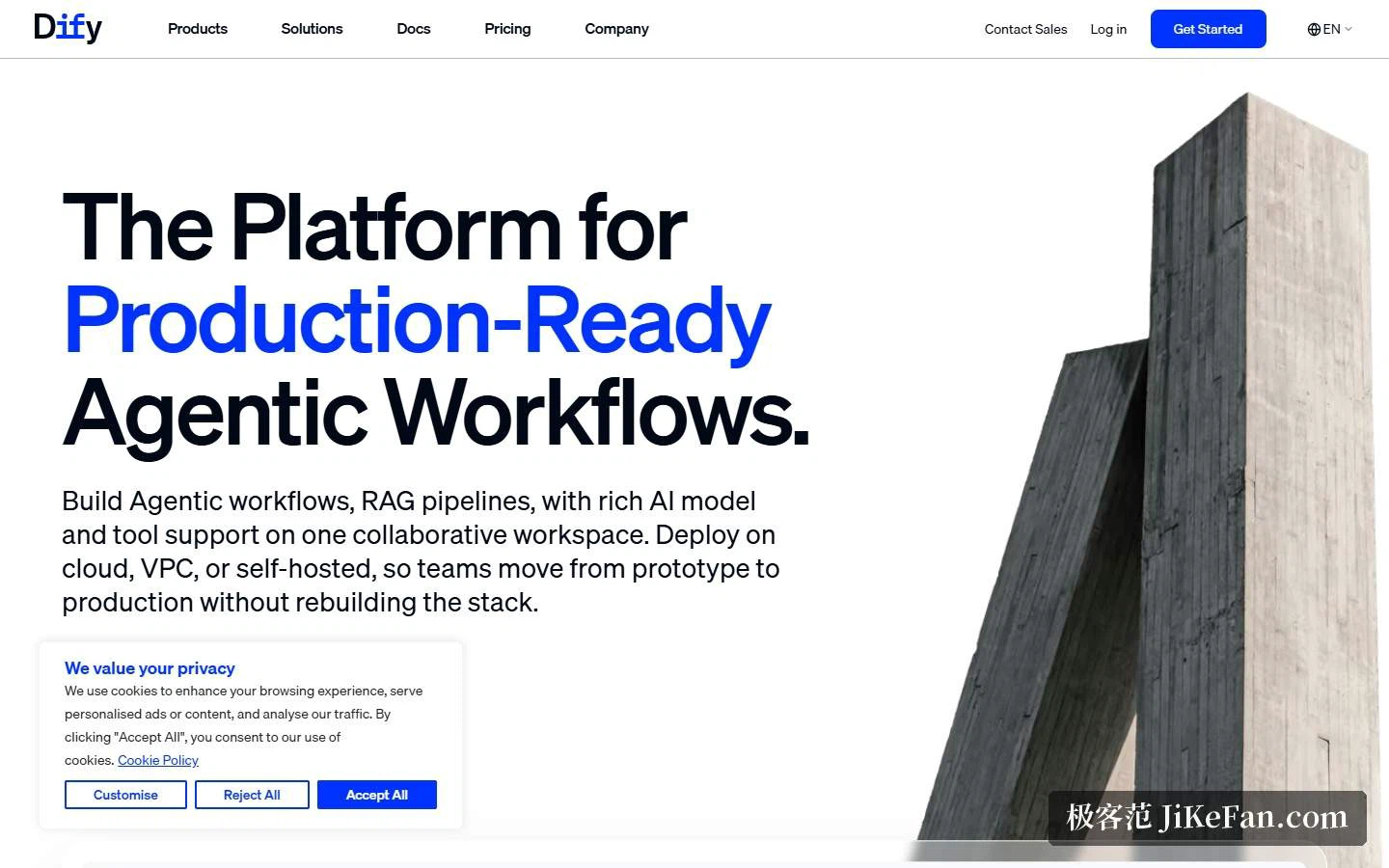
The positioning is unusually blunt about its audience. The site calls itself the platform for production-ready agentic workflows, and the footer names LangGenius, Inc. as the operator, which matters because the company behind a platform is what you are actually buying when a workflow ends up in a business process.
Turning a prompt into an execution path you can see
The centre of the product is Workflow Studio. Visual building blocks plus prompts define how an application thinks, retrieves data, makes decisions, uses tools, asks for human input and finishes the task. The point the documentation keeps returning to is that the logic stays visible: the flow you assemble is itself readable, and that readability is what allows a team to test it, debug it, deploy it, and hand it to someone else without a long verbal briefing.
The capability surface splits into five parts: workflows, agents, knowledge base pipelines, plugins, and publishing with monitoring. Read as a list, it is one chain from authoring to watching what happened after release, which is a different ambition from a tool that stops at the first working prototype.
Three shapes: cloud, private, self-hosted
The site presents three routes rather than one product with add-ons. Dify Cloud is the hosted option for starting with no infrastructure at all. Dify Enterprise is aimed at self-hosted and VPC settings, with an entitlement list that reads like a procurement checklist: SSO with SAML, RBAC, audit logs, SOC 2 Type II and ISO 27001, a Kubernetes Helm chart, a dedicated customer success manager and round-the-clock support. Community Edition is the open route, described as source-available under an Apache-2.0 derivative licence, deployed with a single Docker command, and shipped with the full agent runtime and workflow editor.
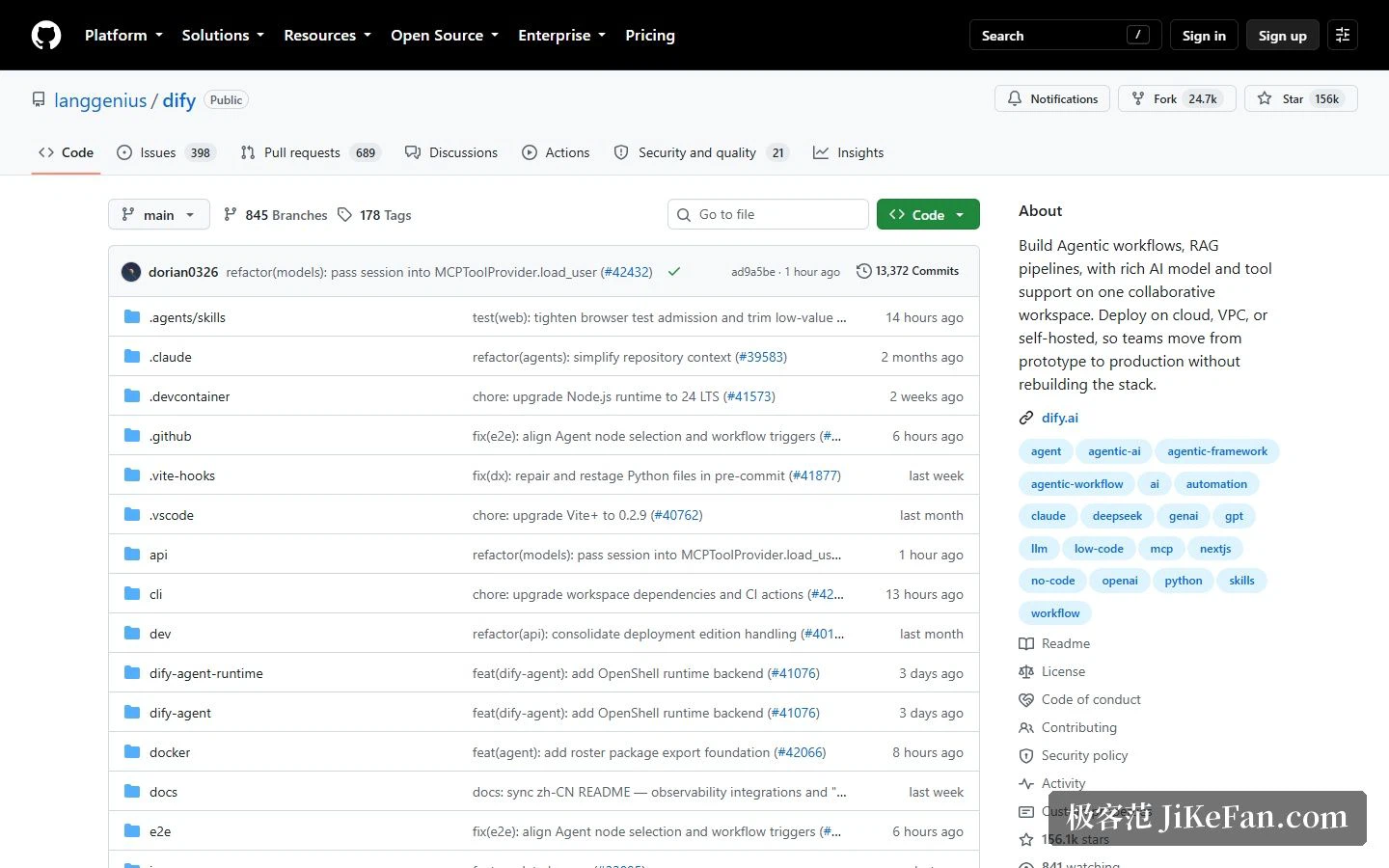
The public repository sits under the LangGenius organisation with 156,000 stars and 24,700 forks, tagged agent, mcp, low-code and workflow. Those tags are a fair summary of what the project thinks it is competing with.
Pricing: per workspace, with a free Sandbox
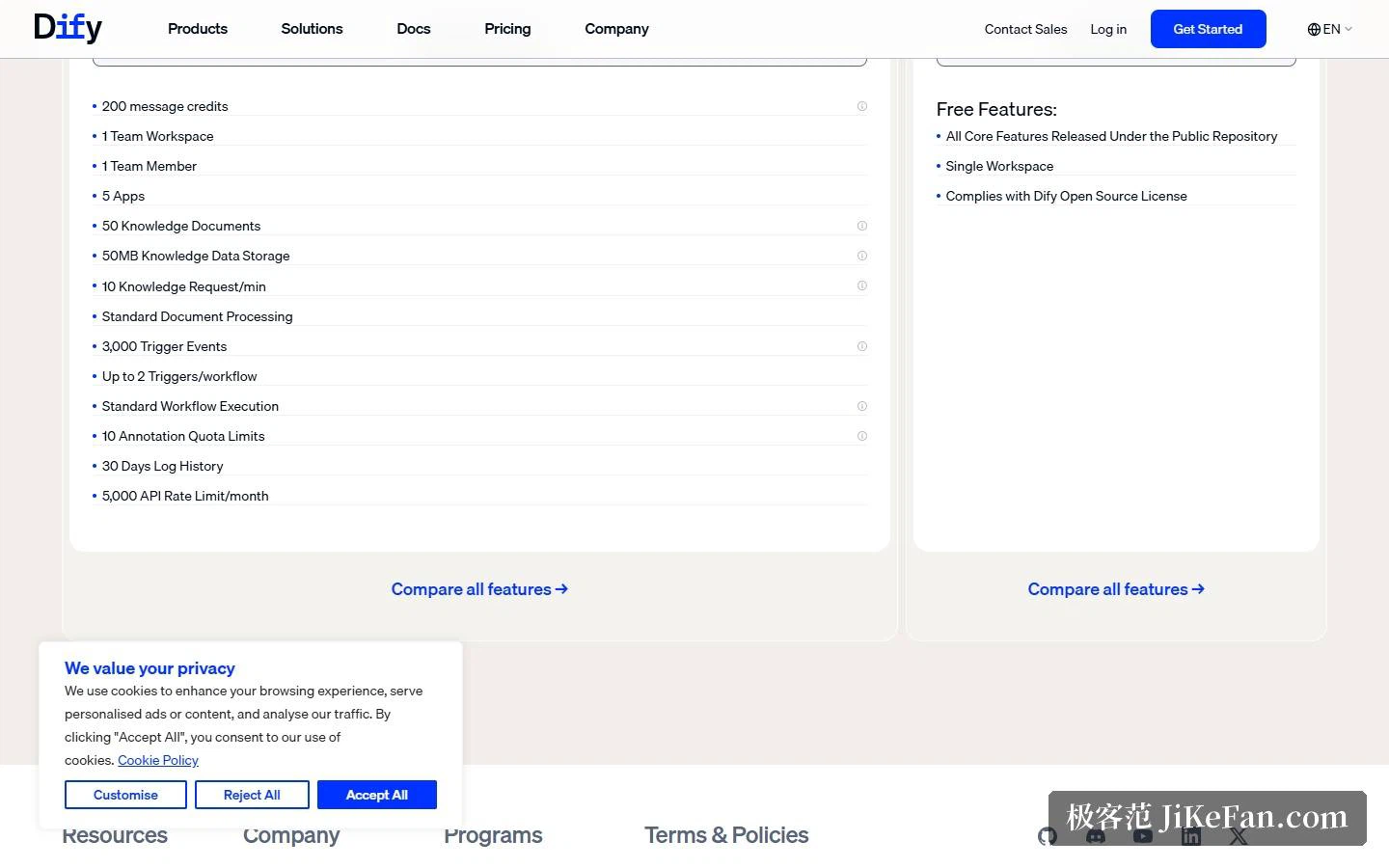
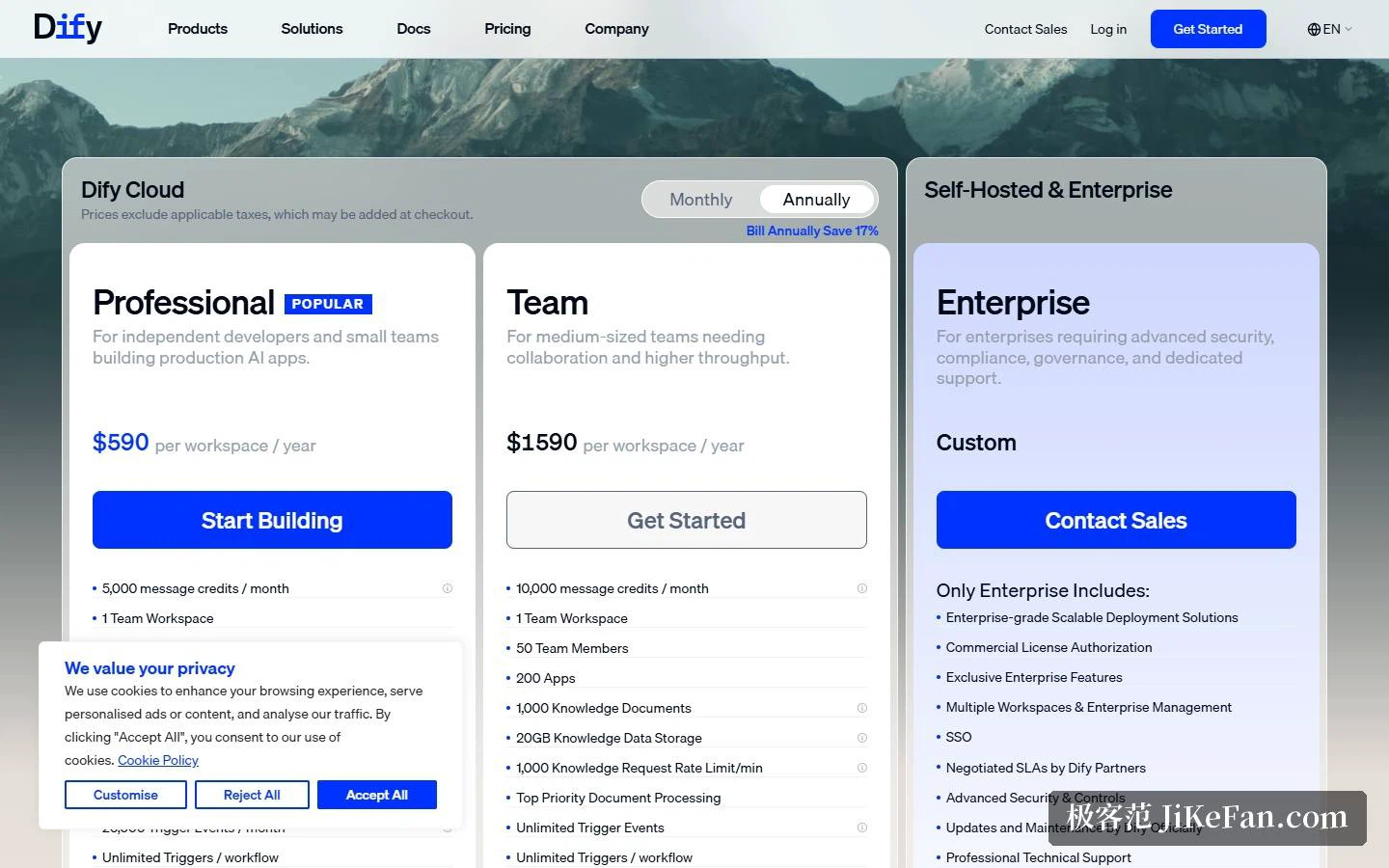
The cloud version has four tiers. Sandbox is free and gives 200 message credits, 5 apps, 50 knowledge base documents, 3000 trigger events and 30 days of logs, which is enough to prove the core works. Professional is 590 USD a year per workspace, with 5000 message credits a month, 3 members, 50 apps, 500 documents, 5GB of storage and unlimited log history; the page marks it as popular. Team is 1590 USD a year per workspace, with 10000 message credits a month, 50 members, 200 apps, 20GB of storage, unlimited trigger events and priority execution. Enterprise is quoted on request, and is where multi-workspace management, a commercial licence and official operations sit.
Annual billing is marked as saving 17 per cent, and the page notes that prices exclude tax.
Who it suits
The reference points are clear enough to sort buyers. Independent developers and small teams take Professional to push an application into production. Mid-sized teams move to Team for the collaboration allowance and the throughput priority. Companies that have to pass procurement, security and audit take the private Enterprise shape. Developers who want to study agents and RAG hands-on can lift a complete environment with one Docker command, and non-commercial projects have the free Community tier underneath.
Read the free tier's limits as a specification
The most informative part of the Sandbox tier is not the price, which is zero, but the shape of the allowances: 200 message credits, 5 apps, 50 documents, 3000 trigger events, 30 days of logs. Those five numbers describe what the vendor believes a first project is: one person, a handful of apps, a corpus small enough to read, a limited number of runs, and a log window short enough that nobody is using it as an archive. If your intended first project looks nothing like that, the free tier will tell you so faster than any trial.
The three shapes are a compliance ladder, not a price ladder
Cloud, enterprise and community differ less in what they can build than in what they can prove. SSO, RBAC, audit logs, SOC 2 Type II and ISO 27001, and the Helm chart exist for a reviewer, not for a builder. A team that chooses the community edition because the code is the same is right about the code and wrong about the paperwork: the runtime is identical, the evidence a security team asks for is not. Deciding which shape you need is therefore a question about your auditors, not about your features.
Source-available is not the same as open source
The community edition is described as source-available under an Apache-2.0 derivative licence, and that phrasing is doing real work. Reading, running and modifying the code is one thing; redistributing it, or building a competing hosted service on it, is where derivative terms usually add conditions. Anyone planning to embed it in a commercial product should read the licence text rather than assume that the Apache name settles the question.
Two honest notes
The pricing figures on the official page sit inside a scrolling animation, so the plain numbers are not present in the page text; the 590 and 1590 above were read from the annual-billing state of that component, and anyone quoting them should check the pricing page directly. Second, the licence question above is not a footnote: it changes what you may do with the free edition, so read it before a commercial commitment rather than after.
The competition between agent platforms has moved from whether you can build one to whether you dare put it into production, and a visible execution path has become the hard requirement.