
Cline: an open coding agent that plans first and lets you undo anything
Summary
An open coding agent that lives in the editor. It reads the project, proposes a plan, and only then touches files; every change leaves a checkpoint you can revert. You supply the model key, so nothing is marked up and no repository leaves your machine. Also available as a command line tool and a library.
Recommend- Name
- Cline
- Version
- 4.1.20
- Pricing
- Free
- Open source
- Open source
- Operating system
- WindowsmacOSLinux
- Website
- https://cline.bot
- Updated
- 2026-10-06 20:23
You inherit a piece of code that has been growing for years, and you decide to pull one shared function out of it. You change the callers and the types no longer line up. You fix the types and an import is missing. You add the import and a test turns red. A single refactor sends a chain reaction through a dozen files, and keeping up by hand is precisely how one detail gets dropped. It is also the reason many people, facing a large refactor, decide to leave the old code alone and work around it.
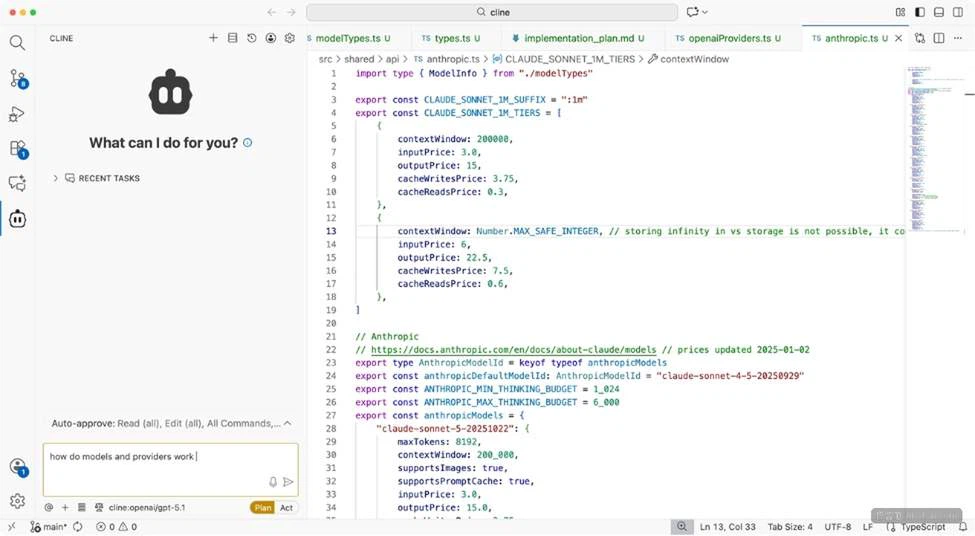
Cline takes that work over. It is not a suggestion engine that completes the next line; it is an agent that can read the codebase, break the task down, change files and run commands. It lives inside the editor, was once called Claude Dev, is fully open source under a permissive licence, and has been installed more than eight million times, with tens of thousands of watchers and hundreds of contributors behind it.
Agree on the plan before anything is written
Work is split into two stages. In the planning stage the agent reads the project structure, traces the dependencies, and lays out which files it intends to change and by what approach, so that the two of you can agree before any code moves. Only after that does it switch to acting. The direction is settled before the first line is written, which removes the familiar scene of an agent deciding on its own to tear the architecture down and start again.
During execution it runs the tests itself and watches the linter, fixing a missing import or a type mismatch as it goes rather than handing over something half finished. Development servers and test processes that stay running are watched in the background, and when one reports an error the agent picks it up immediately.
Every step can be reverted, which is what makes boldness possible
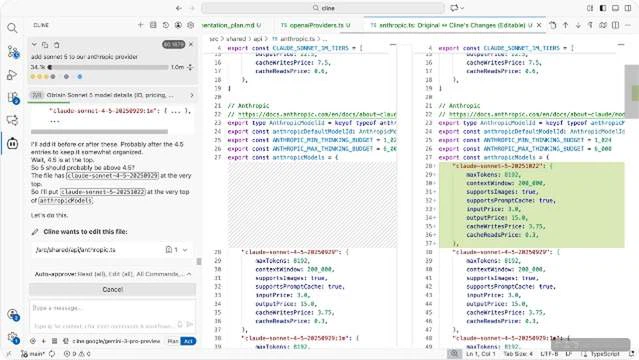
Handing a refactor to an agent requires being able to change your mind. Every file change leaves a checkpoint; the difference can be inspected in the editor, and one action restores the state before any step you choose. If the agent takes a wrong turn, what you lose is a few minutes of conversation, and the code is untouched.
Permission stays with you: writing a file and running a command each need approval, and automatic approval can be granted per command type. Run a whole task unattended if that is what you want, or review every step if it is not. The pace is yours to set.
Any model, and the code stays at home
Nothing ties the agent to one model vendor. Commercial models can be attached, and so can a model running locally on your own machine, or any service that speaks a compatible interface. You bring your own key, which means no intermediary margin and no subscription wall: which model you use and how much you spend are your decisions.
The code runs locally and the key is yours, so the contents of the repository never have to be handed to somebody else's server. For work under a confidentiality obligation that is not a detail. And when the task is small, a local model costs nothing per call, which makes the everyday case cheap without any configuration gymnastics.
From the editor out to scripts and pipelines
Beyond the editor extension there is a command line tool, a second editor integration and an open development kit. The command line version can be placed in scripts, scheduled jobs and build pipelines, so the agent runs routine checks and updates unattended; the kit lets the same agent core be embedded in somebody else's product. An open protocol for external tools is supported as well, so databases, remote APIs and a browser can be attached, with the boundary drawn by you.
Project conventions have a place too. A single rules file at the root of the repository records the coding style, the architectural agreements and the testing requirements, and the agent follows it every time it starts work. A new member of the team then gets an assistant that already knows the house rules, which is often worth more than the code it writes.
Who it suits
This is a tool for people who have large codebases to restructure and want the cost and the model choice to remain theirs. It is free and open source, and the only running cost is what the model calls cost. What it really offers is a different posture: plan first, keep every step reversible, and stay in the loop by choice rather than by necessity. That is close to what a good pair programmer provides, minus the schedule.