
AutoGPT review: build agents by describing them, 187,000 stars later
Summary
Four screens split the work: describe an agent in a sentence, drag blocks for a complex flow, watch runs and spending, and reuse what others published. A platform directory under a source-available licence sits beside a classic MIT one.
Recommend- Name
- AutoGPT
- Version
- 18.7
- Open source
- Open source
- Operating system
- WebLinuxmacOSWindows
- Website
- https://agpt.co/
- Updated
- 2026-10-06 18:37
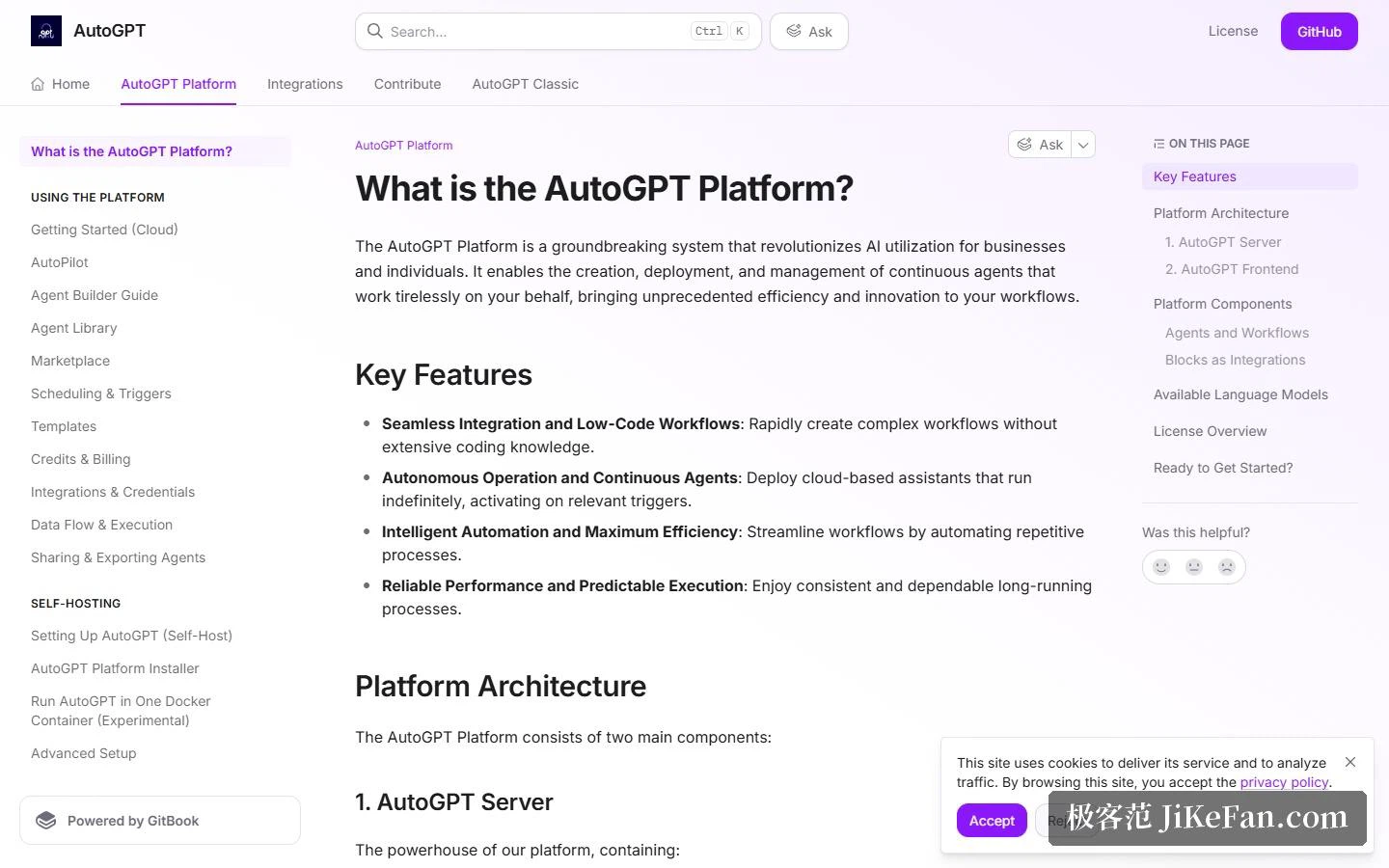
The name is far older than the product. In 2023 it went everywhere as the first autonomous GPT, a repository you cloned and configured yourself. The site today describes something else: a platform that separates creating agents, running them and reusing them into three jobs, with a front page promising 10 hours back every week while the agents do the work.

Four screens, four ways of working
The product is explained through four verbs — chat, build, browse, oversee. AutoPilot covers the talking: describe what you want the way you would brief a colleague, and the official line is that no flow chart, no prompt engineering and no interface configuration is needed, because built-in experience picks the tools, natural language adjusts the run afterwards, and the flow is recorded as you describe it. Agent Builder covers the assembly: drag blocks to compose a complex flow, with branches, loops and routing, watching inputs and outputs step by step, attaching any tool, model or interface, then saving the result, deriving variants and sharing it with a team. Agent Dashboard covers the managing: what is running, what just finished, what is waiting on a person, spending tracked per agent, per run and per day, alerts when a human is needed, and pause, edit or rerun from the same place. Marketplace covers reuse: browse agents by job title, check real run counts and ratings, add one to your own library and reshape it, all without an account — and publish your own.
Integrations arrive pre-wired
The integration section makes a modest promise: what you have gets connected, the rest is already wired. The listed span is broad — conversation and reasoning, image generation, video generation, speech synthesis, transcription, music, image editing, vision, recognition, three-dimensional work and embeddings. On the model side everything is presented as connected and keyless, and the roster runs from the largest hosted names to open and regional families, summarised in one line: more than 45 platforms, hundreds of models, zero interface keys. Outside recognition is displayed just as densely: a row of financial and technology outlets, and below it a separate set of marks for citations by governments and international bodies, with a note that each mark belongs to its publisher.
Two prices, two licences
Billing is annual and comes in two tiers. Pro costs 42.50 dollars a month with one unit of usage, aimed at an individual starting daily automation: access to nearly every major model, background execution, both the visual and the conversational way of building an agent, file awareness, end-to-end run visibility, and scheduled as well as event-driven triggers. Max costs 272.00 dollars a month with 8.5 units of usage and 5 times the file storage, plus early access to new features, an extended integration library and priority support. Paying annually saves 15 percent and cancellation is available at any time. The team tier is still marked as coming soon, with multi-user workspaces, administrator controls, centralised billing and seat management, collaboration and approvals, and security and compliance options listed as its scope.
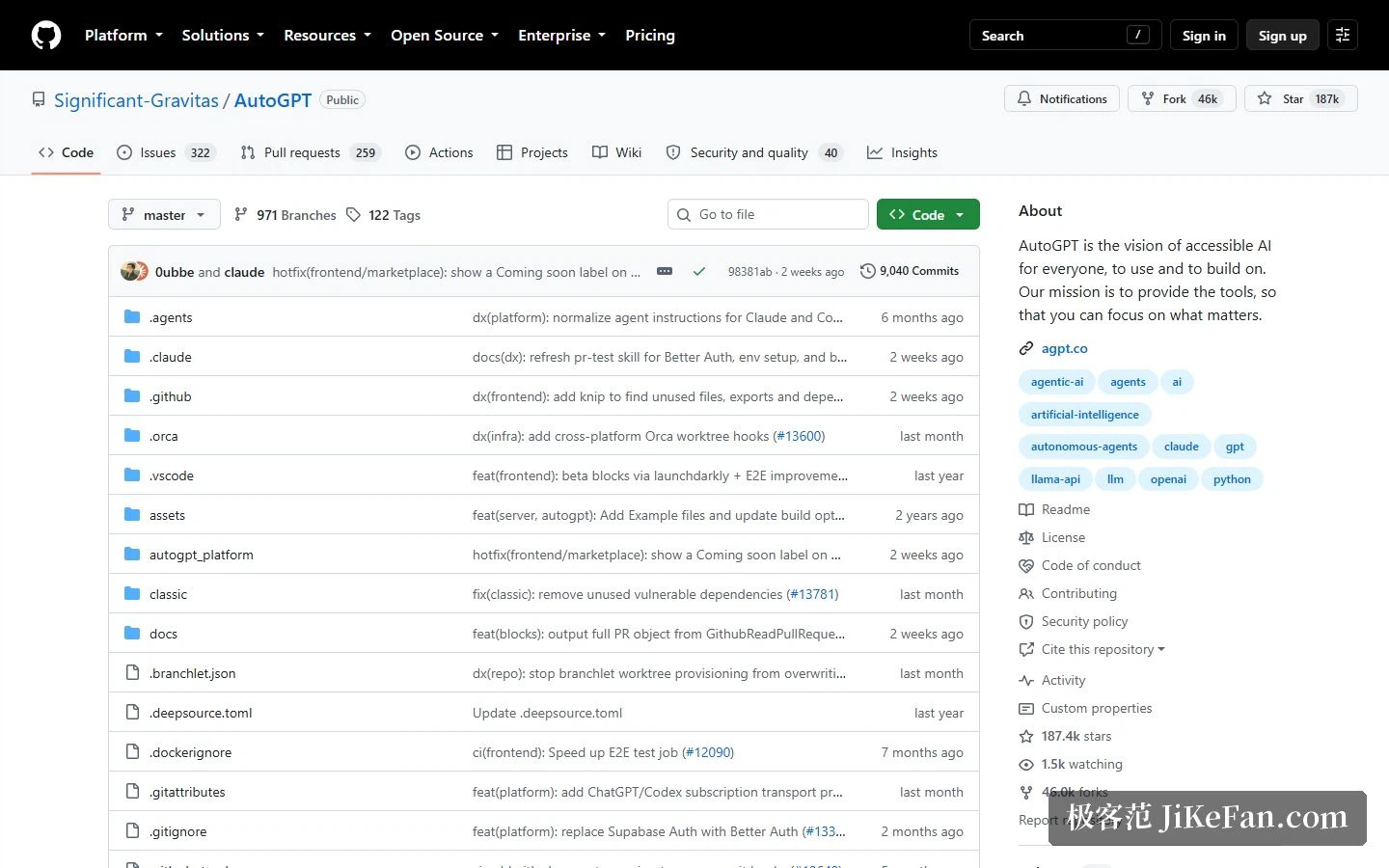
The licence needs care because it splits by directory. The platform directory — the server and front-end pair — uses Polyform Shield: free for personal and internal commercial use, but reselling it as a hosted competing service requires a licence. The classic directory and the rest of the code are MIT, and the standalone AutoGPT agent from the early days still lives inside the classic directory. Repository figures read roughly 187,000 stars, 46,000 forks, more than 800 contributors and over 9,000 commits, and the documentation adds a self-hosting chapter with an installer and a single-container mode for teams that want the data to stay on their own machines.
Who it fits
Three kinds of user line up. The individual who does not want to touch code and would rather hand off repeated work — the entry point is a sentence describing the job. The team that needs fine control over a flow — blocks with branches and loops, exportable as code. And the person who wants to inspect a ready-made solution before rebuilding it, with real run counts and ratings as a guide.
Two cautions belong here. The licence splits by directory, so check which part you are actually using before anything commercial. And the model list is a statement about being connected; account quota, rate limits and billing still follow the real back office, so a small task first is the cheapest way to learn the pace of consumption.
What separates building a workflow from hiring an agent is not technology. It is whether you dare hand a whole job over.