
CrewAI review: agents with job titles, and a control plane above them
Summary
Agents, flows and tasks form the skeleton; a control plane on top traces every model call and memory read and costs it. The framework itself is MIT, and the discovery and optimisation stages depend on platform-scale data.
Recommend- Name
- CrewAI
- Version
- v1.15.22
- Open source
- Open source
- Operating system
- WebLinuxmacOSWindows
- Website
- https://www.crewai.com/
- Updated
- 2026-10-05 22:14
Most agent frameworks hand you a library and let you decide what to do with it. This one arrives with a method attached. The front page frames it as a build-and-run layer for enterprise agents, with two claims standing side by side — business teams and engineering teams both get to build, while a platform team governs from one place. The line further down is plainer still: the backlog of agent ideas inside a company clears through one platform that can be governed centrally.
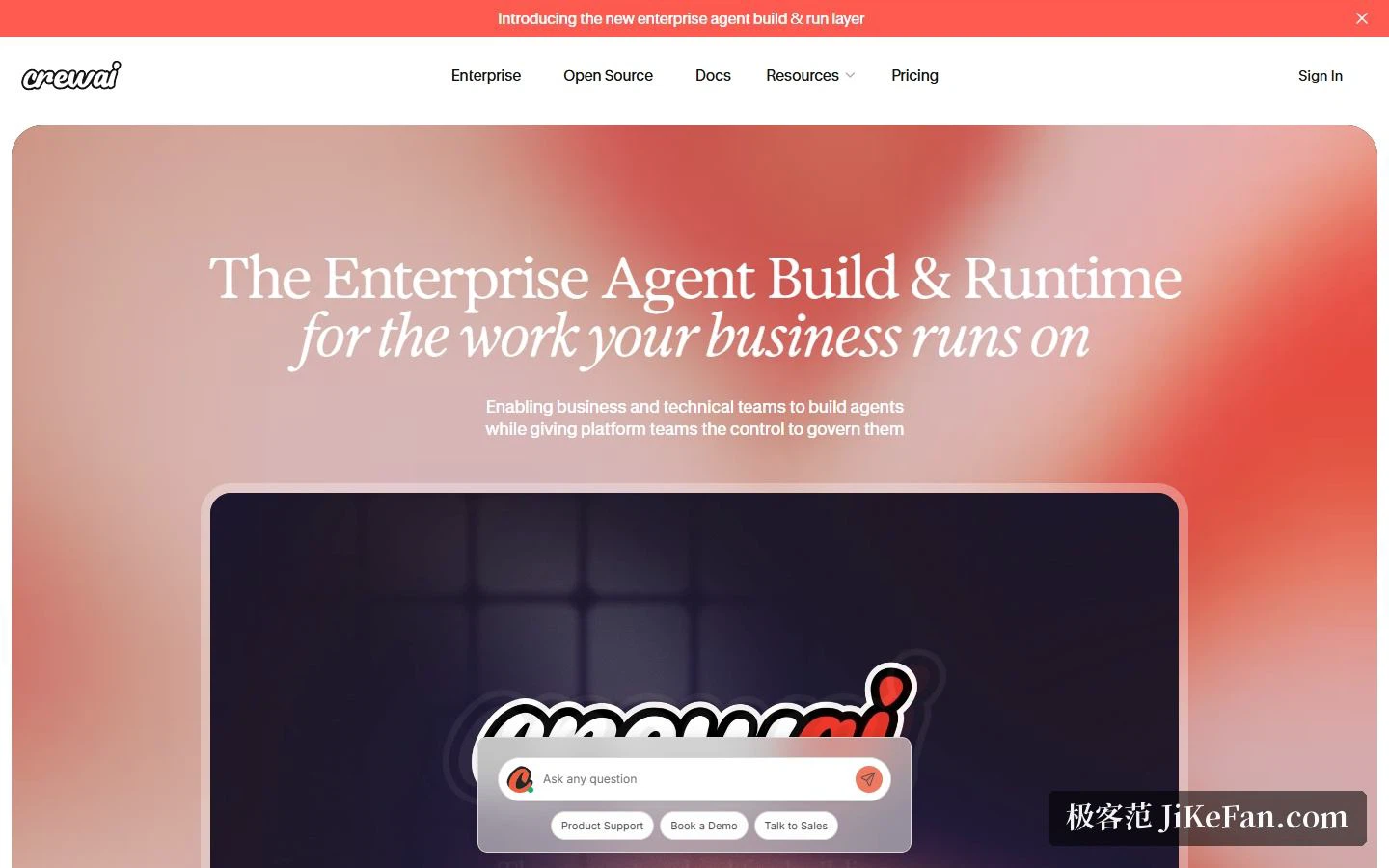
Four stages: discover, build, govern, optimise
Discover answers what should be automated: patterns observed across billions of agent runs get matched against your tickets, chats, applications and processes, producing a list of opportunities ranked by investment, value and readiness, with a shareable demonstration that helps a team agree on the order. Build answers how: a no-code visual editor that exports to Python, a code-first interface for full control, role-based division of labour between agents, and deterministic workflows, guidance the company says is drawn from 700,000 agent workflow patterns. Govern answers how to keep it in hand: a control plane sitting on the execution path of every workflow, tracing each model call, tool call and memory read in real time and costing them, plus role-based access control and append-only audit records, enterprise identity management, human approval checkpoints, and runtime redaction of sensitive data alongside policy checks. Optimise answers how it improves: every production run becomes training data, with automatic and human-guided training, runtime testing across several models, and evaluation wired into outside scoring services.
Every case study arrives with a number
The customer section is arranged as a scenario plus a measurement, which is at least candid about what is being counted. A food delivery platform enriches leads with it, over three thousand a month. An education company uses it for course design and cuts development time by 90 percent. An electronic signature vendor consolidates lead data from several internal systems and speeds first contact by 75 percent. A customer support deployment reaches 95 percent accuracy on replies. And a restaurant ordering service uses automated voice testing to compress quality checks from 74 hours down to 3 hours. The site also claims use by 65 percent of the Fortune 500 — a share that usually reflects how customers are counted, worth noting and worth verifying in your own setting.
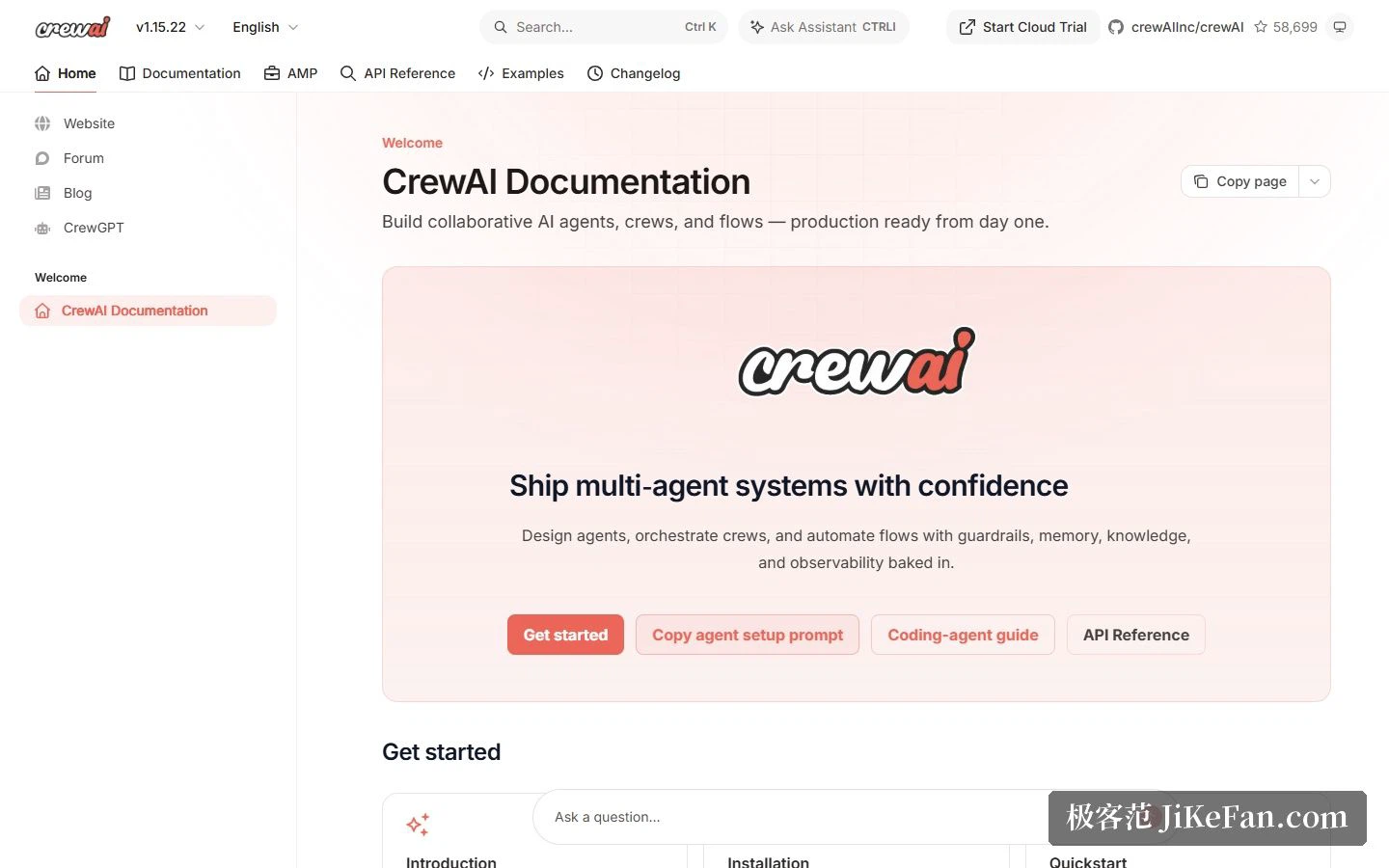
The real skeleton: agents, flows, tasks
The documentation, at version 1.15.22, arranges the essentials into three blocks. An agent is the unit of execution carrying composable tools, memory, knowledge and structured output. A flow orchestrates the starting, listening and routing steps, holding state, persisting execution and letting long jobs resume where they stopped. Tasks and processes define three ways of running work — sequential, hierarchical and a hybrid of both — with guardrails, callbacks and points at which a human is pulled in. Put plainly, the agent decides who does the job, while flows and tasks decide in what order, and what happens when a step fails. A separate section on triggers completes the event-driven side, connecting mail, team chat and customer relationship systems, with the trigger payload passed automatically into a crew or a flow. The enterprise side adds deployment automation, environment management, colleague invitations and role-based permissions. Installation stays light: a command-line tool plus one interface key is enough to start, and a new project scaffolds a JSON-first structure that keeps agent definitions and crew-level settings in separate files, with a classic layout available for those who prefer it.
Who it fits
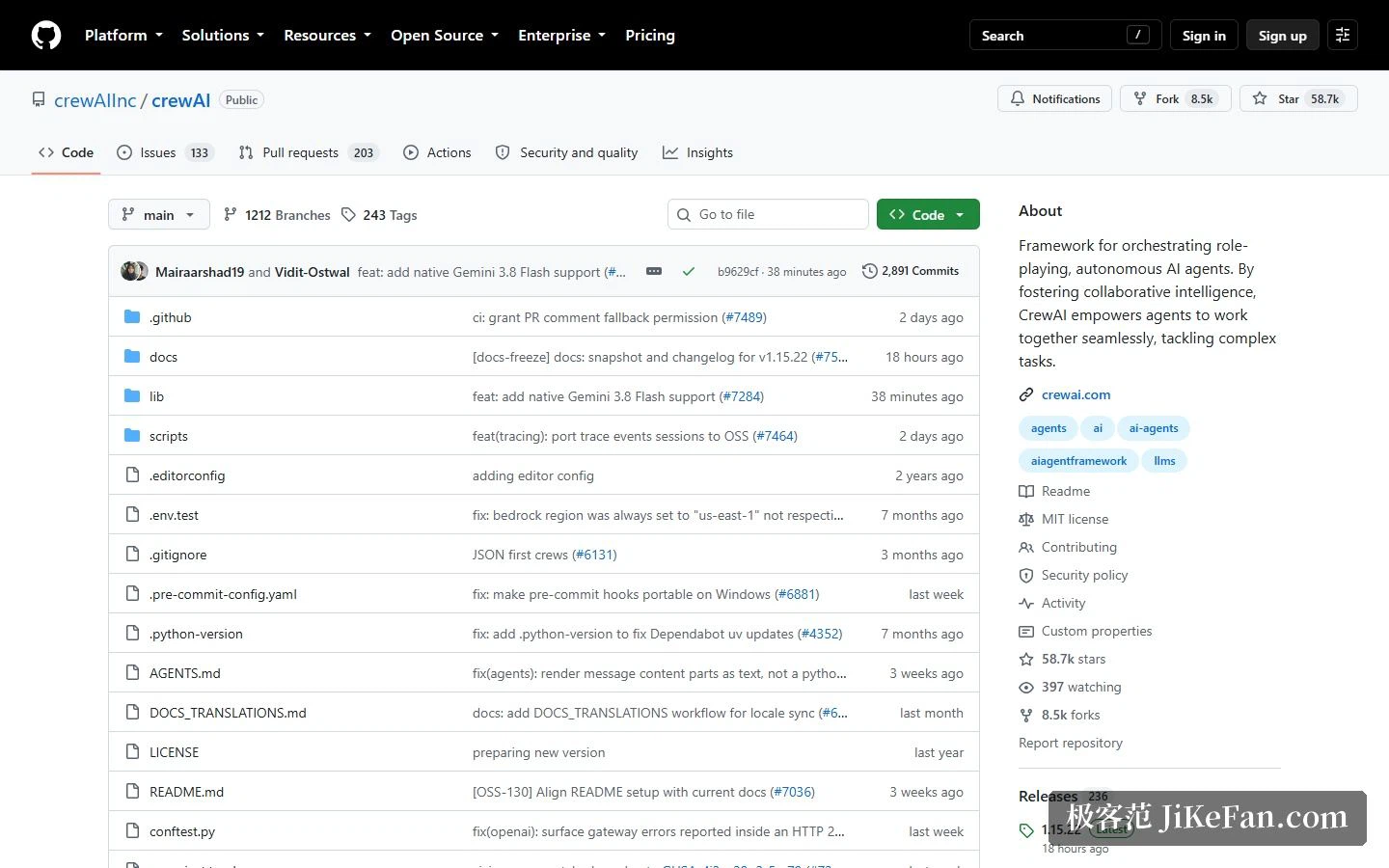
Three kinds of team line up. Engineering teams that need several specialist roles cooperating on a long chain of work — researcher, writer, reviewer is the obvious example, and the crew abstraction maps onto it directly. Platform teams that have to land agents inside a company with compliance intact, since governance, audit, approvals and redaction are product features rather than self-built patches. And developers who want to run locally first and decide about a control plane later, because the framework itself is MIT, with a repository at roughly 58.7k stars and 8.5k forks, and a readme claiming more than a hundred thousand developers certified through community courses.
Two things are worth saying out loud. Discovery and optimisation both run on data accumulated at platform scale, so an individual developer's usage will not show their value. And multi-agent work burns more tokens than a single call by construction — before wiring up an orchestra, check which steps genuinely need a separate role.
The real test of a multi-agent framework is not whether five agents can all speak. It is whether, at the seventh time they wait on each other, you have somewhere to look and see where the queue stopped.