
Anolis OS 23.5: a community Linux built for cloud native work
Summary
An open Linux distribution issued by the OpenAnolis community, compatible with the CentOS and RHEL software ecosystem, built on a 6.6 kernel with support for several domestic processor architectures and AI components included. Current release 23.5.
Recommend- Name
- Anolis OS
- Version
- 23.5
- Pricing
- Free
- Open source
- Open source
- Operating system
- Linux
- Website
- https://openanolis.cn/
- Updated
- 2026-10-16 22:01
Changing the operating system is easy. Changing the software that was compiled for the old one is the hard part.
The problem a compatible distribution solves
Replacing a server operating system is not a decision about preferences. It is a decision about whether the packages that already run will keep running. Applications compiled against a particular library set, configuration files in paths an administrator knows by heart, monitoring agents, backup scripts, vendor packages with a required distribution name in their metadata: all of it assumes the old system, and all of it breaks at once if the new one merely looks similar.
Anolis OS positions itself against exactly that problem. The community states that it is compatible with the CentOS and RHEL software ecosystem, which in practice means the package names, the directory layout and the library versions follow the conventions those systems established. Migration then becomes a matter of moving workloads rather than rebuilding them.
The distribution is issued by the OpenAnolis community and published openly. It targets cloud native workloads by design rather than as an afterthought, which shows in what ships in the base image and in how the project talks about containers and orchestration.
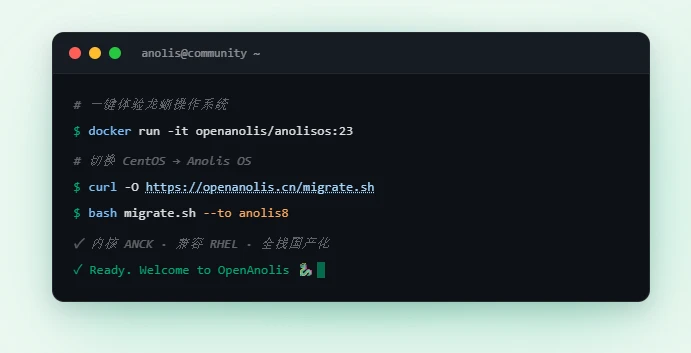
Kernel, processors and the AI components
The current release, 23.5, is built on a 6.6 series kernel. That matters for two reasons: newer hardware is recognised without backporting patches, and features that arrived in later kernel series are available without carrying a private patch set, which is what makes long term maintenance of a distribution possible at all.
Support for several domestic processor architectures is a stated feature, not a footnote. For organisations that have to run on hardware from more than one supplier, a distribution that builds for all of them removes the need to maintain parallel images and separate update channels.
AI components are included in the ecosystem. Read that claim carefully: it means the distribution carries the libraries and tooling that machine learning workloads expect, not that it makes any particular model work better. Whether it helps depends entirely on whether the workload was going to run on that hardware anyway.
Licence, fit and where to be careful
The project is released under the Mulan permissive licence, a Chinese open source licence written to be compatible with common practice and readable in Chinese. For an organisation that needs to redistribute a modified image, reading the actual terms matters more than the label permissive, as with any licence.
The honest fit is the migration case: an estate of CentOS-era servers that must keep running while the underlying system is replaced, or an environment that has to support more than one processor architecture. The poor fit is a desktop or a single small server where the distribution ecosystem offers nothing the mainstream alternatives do not.
Item | Official information |
|---|---|
Current version | 23.5 |
Issued by | OpenAnolis community |
Compatibility | CentOS and RHEL software ecosystem |
Kernel | 6.6 series |
Architectures | Several domestic processor architectures |
Licence | Mulan permissive licence |
Compatibility is not a feature on a list. It is the reason the migration can be scheduled at all.
Practical notes: test the migration on one non-critical host and compare service behaviour rather than package versions; check that monitoring and backup agents exist for every architecture in use before committing; and verify the support window for the specific release, since a distribution is only as useful as the length of time it will be patched.