
Zipware Review: Compression Without the Extra Baggage
Summary
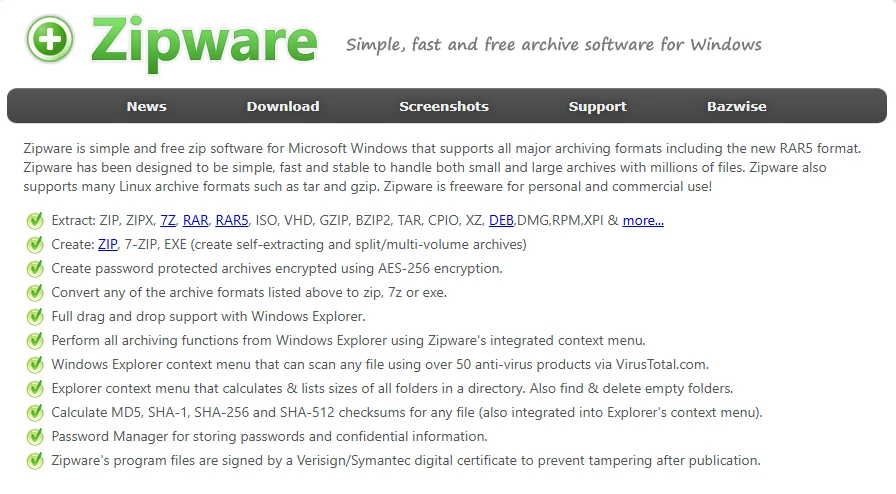
A small installer, a quick start and no attempt to sell you something else: Zipware handles the common archive formats, adds a multi engine scan to the right click menu, and stays free for business use too.
Recommend- Name
- Zipware
- Version
- 1.6
- Pricing
- Free
- Open source
- Proprietary
- Operating system
- Windows
- Website
- http://www.zipware.org/
- Updated
- 2026-10-07 21:36
Minimalism in a category that forgot it
Compression software is one of the few kinds of utility that every machine needs and almost nobody thinks about, which makes it a favourite target for bundling something else along with it. Zipware goes the other way. The installer is small, the program opens instantly, and what appears is a plain archive window with a list of files and four buttons. The format coverage, on the other hand, is not minimal at all: the common archive types are handled in both directions, self extracting packages can be produced, and password protection is available for the cases that need it. Personal and commercial use are both free of charge, which matters in an office where every added licence request has to be justified.
Two small features that earn their place
The first is a scanner wired into the right click menu. Archives arrive from suppliers, from colleagues, from a download page nobody remembers, and the contents are executable files that will run with one double click. Before extracting, the tool offers to send the contents through an online multi engine check, which is the same idea as uploading a file to a scanning service but attached to the moment you are already looking at the archive. Making that a habit removes a whole category of accidents without adding a step to the workflow.
The second is a folder size analyser. When a disk reports itself nearly full, the useful question is which directory is responsible, and the built in view answers it in a few seconds with a breakdown by folder. Neither feature belongs to compression in a strict sense, and both turn a single purpose utility into something that gets opened between other tasks. The program stays small regardless.
Two more practicalities deserve a mention. Archives in the less common formats, and split archives that arrive as a numbered set of parts, are handled without a separate step, which matters when a download from an older project turns up in a format nobody uses any more. And the interface stays out of the way during a long job: a large extraction shows progress and can be left alone, rather than demanding attention or closing itself when the work finishes.
In an office context the licence situation is the quiet advantage. Software that is free for personal use but needs a purchase order at the workplace tends to be installed only on the machine of whoever is willing to file the request, and everybody else keeps using whatever came with the system. A tool that is free in both cases gets installed everywhere, which is how a small utility ends up actually changing how a team handles files.
Zipware proves that being adequate and clean is itself a competitive position: it does not steal the scene or add an act, and doing one job smoothly is enough reason to keep it in the right click menu.
Working habits for archives
Scan unfamiliar archives before extracting, and extract into a fresh folder rather than into the working directory, because an archive that contains a hundred files at its root will scatter them across whatever it is opened in. When sending something onward, a self extracting package is the friendliest option for a recipient who has no decompression tool installed, while a plain archive is better between machines that already have one.
Anyone chasing the smallest possible file should keep a specialist in the toolbox, since the highest compression ratios come from tools built specifically for that trade. For everyday packing and unpacking, which is what most people actually do, this program is more than enough, and it does it without a toolbar, an upsell panel or a background process. That is a modest achievement and a genuinely useful one.