
Cemu Review: Bringing an Older Console Library to the Desktop
Summary
Cemu runs the previous generation console library on a modern PC at several times the original resolution, maps motion input onto a current gamepad, and became markedly faster once the project went open source.
Recommend- Name
- Cemu
- Version
- 2.6
- Pricing
- Free
- Open source
- Open source
- Operating system
- Windows
- Website
- https://cemu.info/
- Updated
- 2026-10-07 21:53
Hardware ages faster than the games on it
A console library has a practical problem that has nothing to do with software quality: the machine it runs on stops being manufactured, the optical drive wears out, and the cables no longer match any television in the house. Cemu addresses that by rebuilding the console in software. What it offers is not a nostalgic approximation but a genuine improvement in presentation: titles render at several times their original resolution, so the jagged edges that were invisible on a small screen become smooth detail on a monitor, and high resolution texture packs replace the original artwork with something that holds up at modern sizes. Controllers connect and work without a configuration ritual.
The interaction survived too
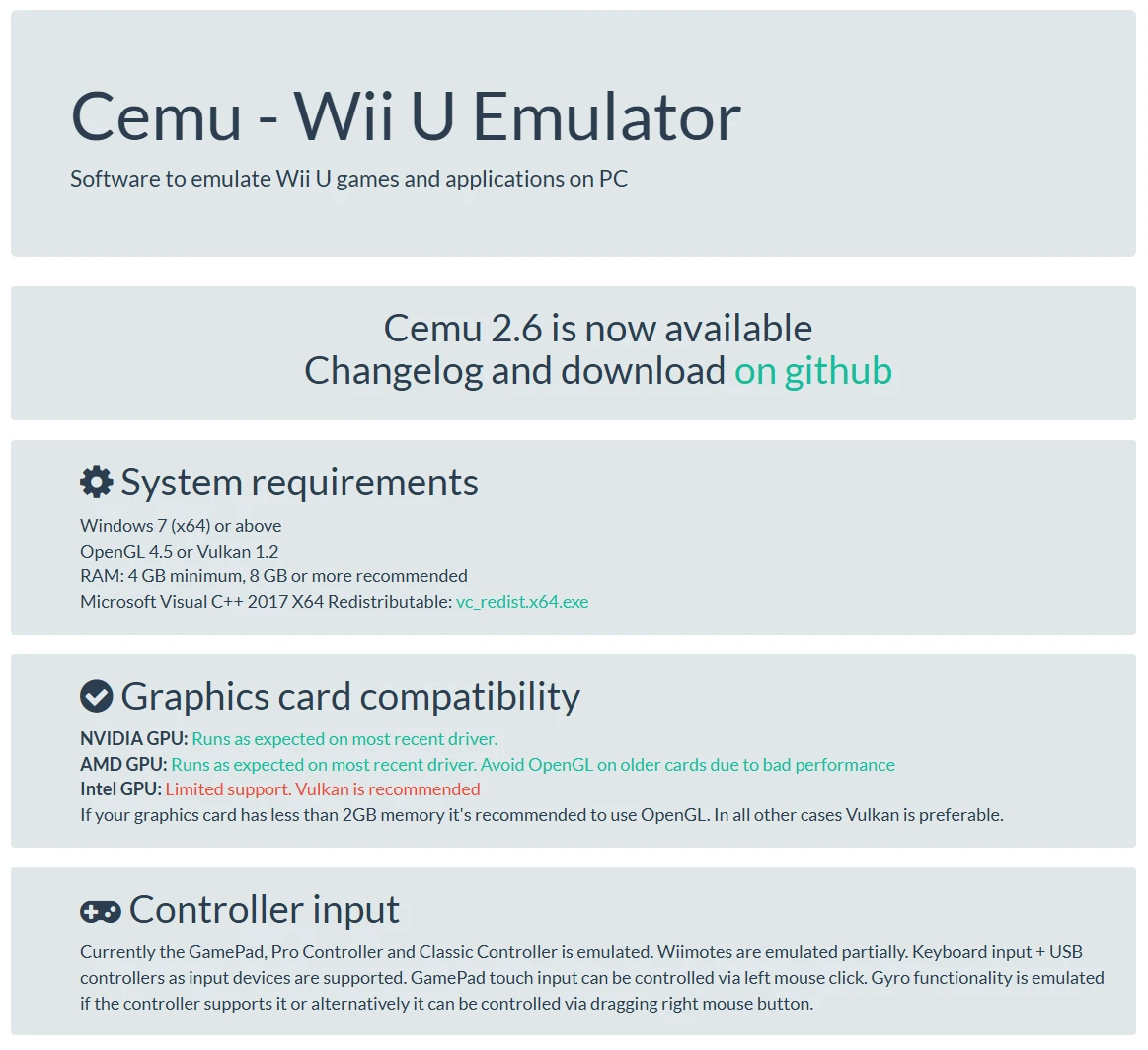
The harder part of emulating that generation is not graphics but input, because the original controller had a screen in the middle and motion sensing inside. Cemu maps the movement data onto the gyroscope of a current gamepad, which means games designed around tilting and pointing remain playable rather than becoming a list of titles that only work in theory. The second screen is rendered alongside the main one, so puzzles and inventory screens that assumed two displays still function.
The project turned a corner when it became fully open source. Development speed after that point is visible from the outside: graphical fixes and performance work land regularly, the compatibility list keeps expanding, and the overwhelming majority of the library can now be played from beginning to end. Openness also means transparency, since the code is public and progress can be inspected by anyone, which lowers the barrier for contributions in a way that closed development never could.
Two practical notes about performance. The first is that the first run of a game is the slowest, because graphical shaders have to be compiled as they are encountered; afterwards they are cached and the stutter largely disappears. The second is that resolution scaling is the setting that costs the most, so a modest machine is better served by a moderate multiplier with a stable frame rate than by a high one with visible hitches, and the difference on an ordinary monitor is smaller than the numbers suggest.
Storage matters more than people expect as well. Images are large, texture packs are larger, and a mechanical drive will make everything feel worse than the emulation itself does. Keeping the library on a solid state drive is the upgrade that produces the most visible improvement per unit of money spent on this particular hobby.
The story of Cemu is another win for the open model: a group of enthusiasts took over the flame and turned a tool into a public good. The life of older games continues because of it.
Using it responsibly
The software itself is free. The games are not, and the honest position is that an emulator is a way to run software you own, not a way to obtain software you do not. Check the compatibility list before investing an evening in a title, since a game marked as partially working can have a specific problem that ruins the experience rather than a cosmetic one. Start the graphics settings at default and change one thing at a time, because the interactions between options are where most of the confusing reports come from.
Motion heavy games need the gyroscope mapping configured once, and after that the setup is remembered per game. Ripping images from hardware you own is the path that keeps this ecosystem legitimate, and it is also what keeps the compatibility work worth doing, since a project that only serves piracy tends to lose the contributors who care about accuracy. Treat it as preservation and the tool rewards that framing.