
Youdao Translate covers 107 languages, and the web version is free
Summary
The translation platform from NetEase's Youdao: paste text, upload documents, translate web pages and audio or video, with polishing, grammar correction and an AI assistant beside the box. The mobile app covers 107 languages, and enterprise prices start at 498 yuan per person a year.
Recommend- Name
- Youdao Translate
- Version
- 4.3.47
- Open source
- Proprietary
- Operating system
- WebiOSAndroid
- Website
- https://fanyi.youdao.com/
- Updated
- 2026-10-06 21:40
The box you start from, and the assistant standing next to it
Open an English document, copy a few paragraphs, paste them into a translation box: that is where a great deal of foreign-language work begins. On the Youdao Translate home page a box like that sits beside an AI assistant, and the page introduces it in the first person and notes that 80 million people already use its translation. This is the long-running translation platform from NetEase's Youdao, and the page title states its scope plainly: text, documents, web pages, live translation.
Who belongs to the family
The web version and the desktop client share the name Youdao Translate, while the mobile app is named separately, as Youdao Translate Officer, or more simply the mobile translator. The Android listing gives version 4.3.47, updated on 3 September 2026, and shows 2862 ten-thousand downloads with a rating close to five. The official home page also carries entries for a desktop download and an enterprise edition, so the multi-device coverage is visible at a glance.
The assistant polishes and corrects, not only translates
The home page gives the assistant two worked examples. In the native-level polishing example, a sentence about having a passion for further academic achievement in finance after undergraduate studies is rewritten into a formal academic construction, replacing the conversational phrasing with something a journal would accept. The grammar example is more revealing: the result lists the problems one by one, pointing out a misspelling of common, another of challenge, and explaining that dream of fits better than dreamed of here, because the sentence describes a present aspiration rather than a past dream.

So the correction supplies the reason, not just the fix. The reading panel also lines up a DeepSeek model, an Ask AI entry, translation, sentence polishing, grammar correction and a word encyclopedia, all switchable in the same interface.
The feature list, from a single word to a whole document
The sidebar on the official site is crowded: text translation, polishing and rewriting, document translation, a mode for reducing repetition and machine-written feel, application essay review, audio and video translation, AI writing, AI slide decks, translation of papers from the arXiv preprint server, web page translation and a translation API. Beside those sit service entries for human translation, human translation assisted by AI, and conversion of PDF files to Word.
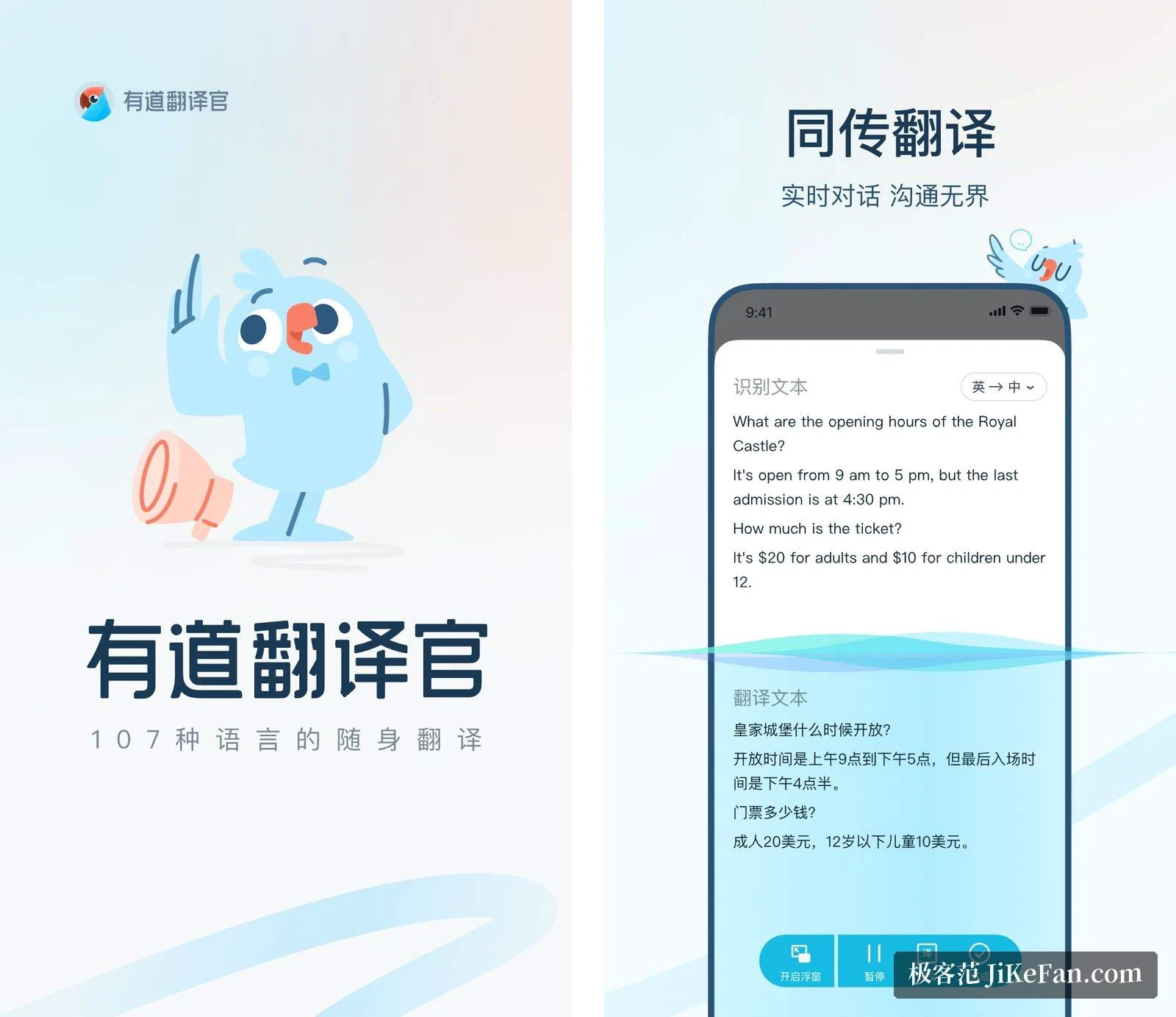
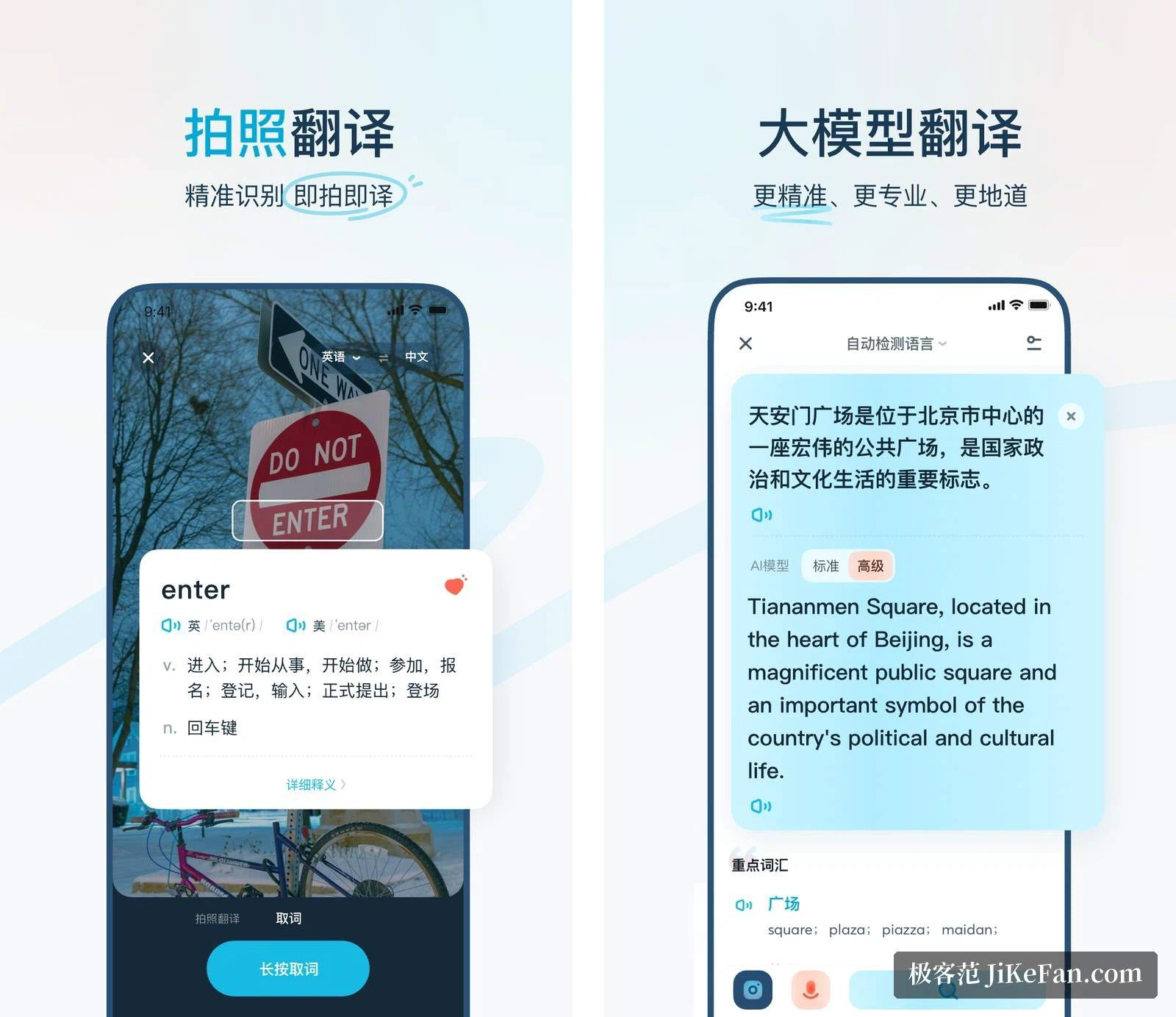
The mobile description fills in the situations you meet while travelling: photo translation that reads words through the camera and returns a translation in one shot, voice translation, simultaneous interpretation with streaming speech recognition, augmented reality translation that scans the scene, online translation and offline translation, six modes in all, plus a novelty mode for translating emoji.
107 languages and an offline mode
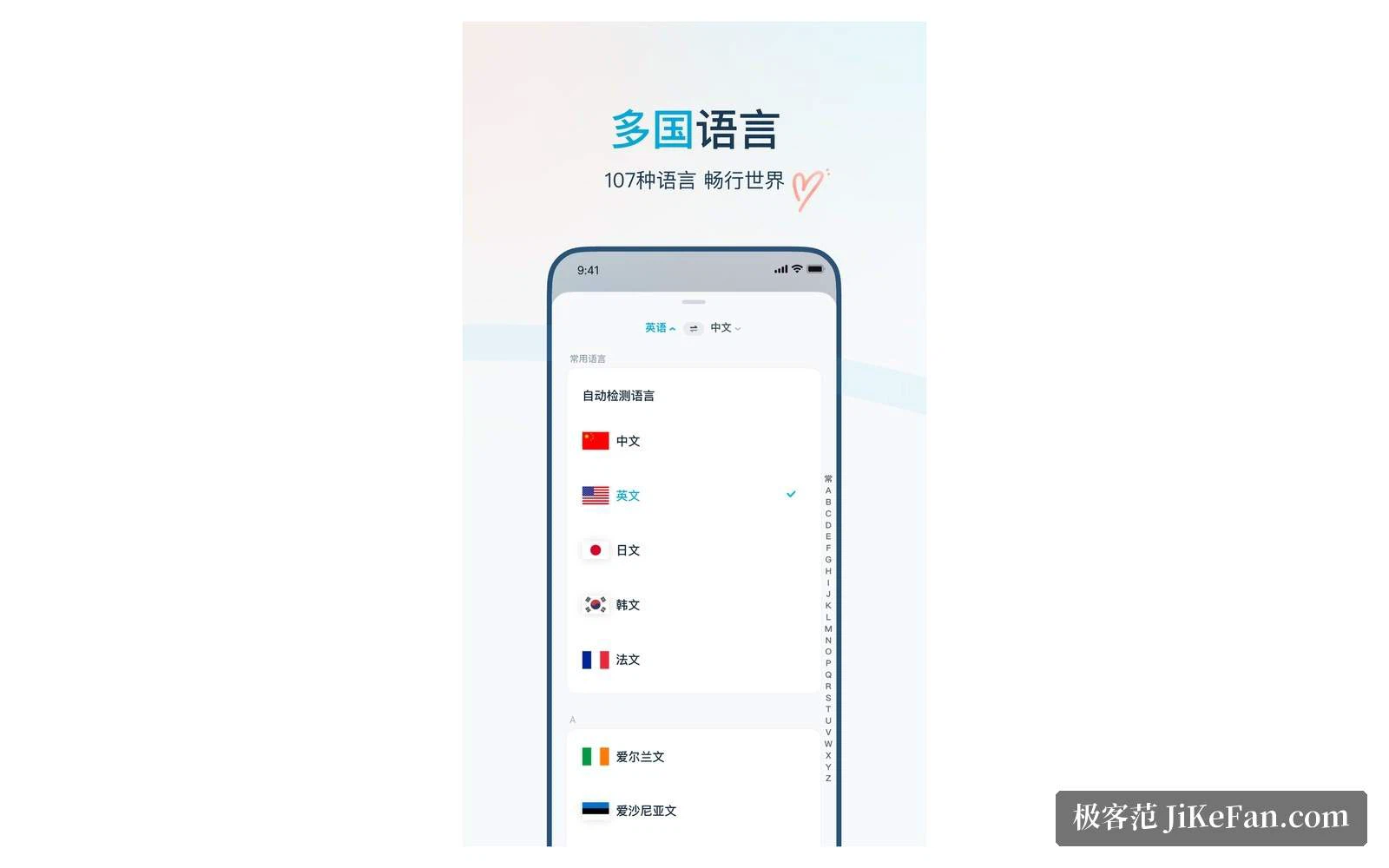
The official store listing states that the mobile app supports translation across 107 languages and covers 186 countries, and the page title repeats the figure. Chinese and English translation runs on the company's own neural machine translation engine, which the official description says is markedly more accurate than conventional machine translation.
Offline capability is the real requirement when you travel: the description says English, Japanese, Korean, French, Spanish, Portuguese, Vietnamese and others translate without a network. The enterprise entitlement table adds an oversized offline dictionary and professional offline packs, which covers commuting and roaming alike.
Enterprise and document translation are two separate offers
For teams, the enterprise page lists a single-user edition at 498 yuan per person per year, which includes 3600 ten-thousand characters of document translation and 1200 hours each of simultaneous and audio translation per person per year, and a team edition at 698 yuan per person per year with 6000 ten-thousand characters and 2400 hours, sold from 3 seats. Private deployment can be arranged separately. In the entitlement table, large-model translation is limited to 3 trial runs a day on the free tier and is unlimited for members, the same applies to the AI box and AI writing, custom glossaries grow from 100 pairs to 100000 pairs, and image translation accepts 10 images per batch.
For individuals handling whole documents there is a separate channel called DocTrans. The basic personal edition is free and lets you view one page of translated output per document, with an upload limit of 20 MB and support for Word and PDF. The member edition gives 200 ten-thousand characters a month, an upload limit of 40 MB, support for 7 document formats, sentence-by-sentence alignment, post-editing, and export to Word or PDF without a watermark. The point of translating a document rather than its text is that the layout survives: a PDF paper comes back looking like a paper, with nothing to re-typeset.
Who it suits
Students and researchers gain most directly. Reading the literature leans on paper translation and document translation, revising a draft leans on polishing and grammar correction, and terminology falls back on the offline dictionary. In business, simultaneous interpretation and audio or video translation earn their place: record a meeting, turn it into text, get the translation, all in one chain. For frequent travellers, photo and augmented reality translation are effectively designed for menus and street signs.
Two honest notes. First, neither the translation nor the polishing is completely reliable, and the key clauses and technical terms of a formal document still need a human check. Second, on the enterprise side, large-model translation, the AI box and AI writing each have a daily trial limit on the free tier, so heavy use means choosing a tier from the official entitlement table. However long the chain of tools becomes, the person who guards the language at the end is still the user.
The real progress in translation tools is the move from looking a word up for you to understanding the passage for you. What you then do with that understanding remains your own work.