
WeTransfer: send a few gigabytes without teaching anyone to sign up
Summary
WeTransfer is a browser-based file transfer service: drop files in, get a link, and the recipient downloads without registering anything. The free account allows ten transfers and three gigabytes inside a rolling thirty-day window, links last three days, and password protection or a list of allowed addresses is available without paying. Files travel at their original quality.
Recommend- Name
- WeTransfer
- Version
- web
- Pricing
- Free
- Open source
- Proprietary
- Operating system
- 网页版
- Website
- https://wetransfer.com/
- Updated
- 2026-10-06 17:12
Sending something too big for an inbox
Sooner or later everyone hits it: a folder of design files, a few gigabytes of footage, a set of exports that has to reach a client today. Mail rejects it, and a cloud drive means asking the recipient to create an account, find the folder, and accept an invitation before they can see anything. Half of those steps fail for reasons that have nothing to do with the files.
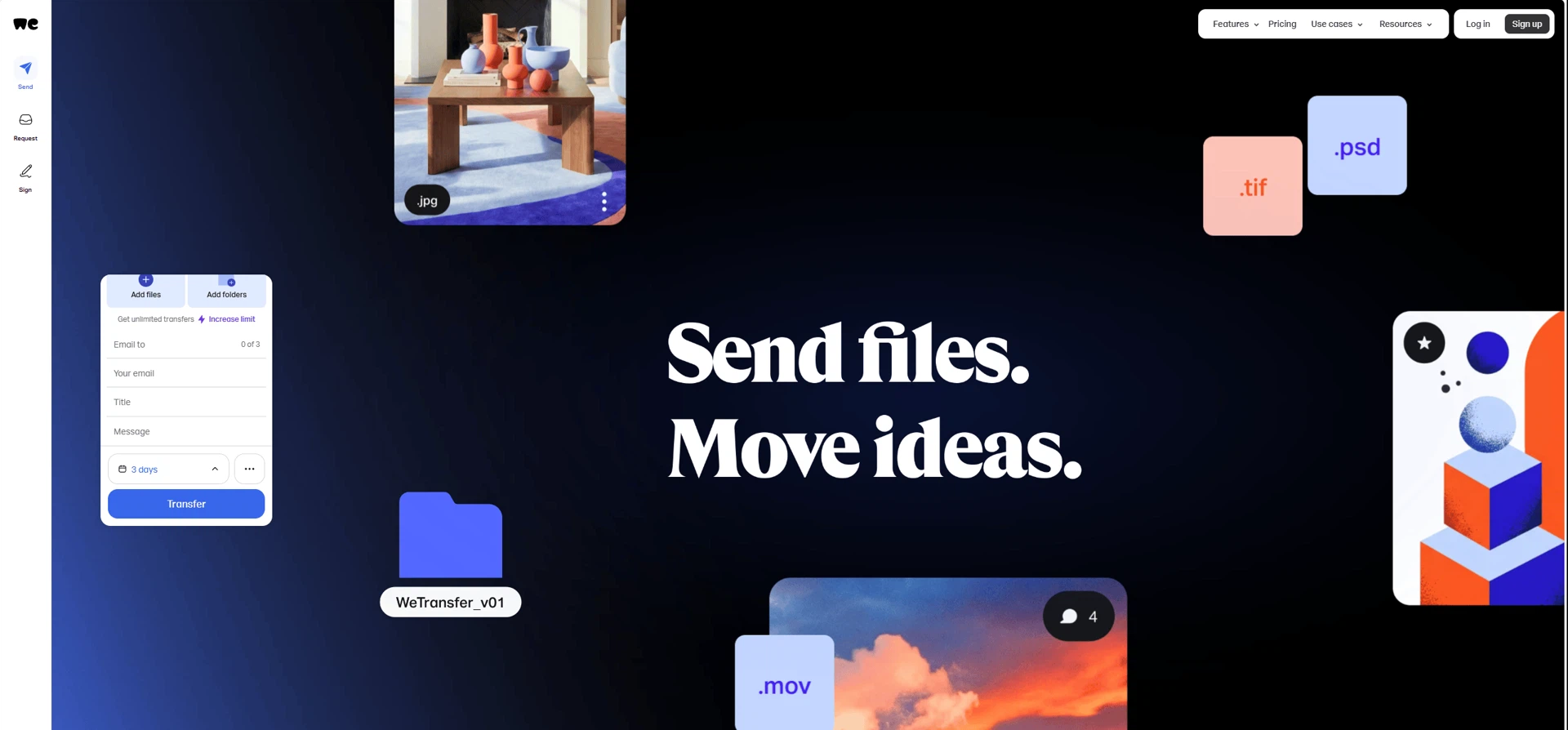
This service removes them. You open a browser, drag the files in, and get a link. The person on the other end clicks it and downloads; no account, no client, no invitation. If you would rather send it as a message, an email address is enough and the link arrives as a plain mail with the files behind it, which for most recipients is simply a very large attachment.
What the free allowance actually is
The free tier is not a monthly quota, and the difference matters. It is a rolling thirty-day window: at most ten transfers and three gigabytes in total at any moment. Capacity comes back as old transfers slide out of the window, so someone who sends twice in one week is not blocked for the rest of the month, while someone who sends a lot keeps bumping into a limit that quietly refills day by day.
A link lives for three days by default, after which the files are removed from the servers. That is the part people forget. For a delivery tied to a review cycle it is usually enough, but anything that has to be reopened a week later needs either a paid plan, which allows a custom expiry and lets you recall a transfer early, or a different approach altogether.
Quality, and the safety switches
Files are transferred at their original quality. There is no re-encoding step in the middle, so a 4K clip, a RAW frame or a layered design file arrives exactly as it left, which is not a detail anyone should have to check. When several files go together they are packed with lossless compression, so the saving comes from the packaging and never from the picture.
Security is available without paying, which is the pleasant surprise. A transfer can carry a password, and it can be restricted to a list of email addresses so that only the intended people can download it. The password then goes to them by some other channel — a message, a phone call — because putting it in the same email as the link defeats the purpose entirely.
For anything that is genuinely confidential, that combination is the minimum: a link that expires, a password that travels separately, and a recipient list that is not a mail group. Paid plans add larger per-transfer limits and early recall, which matters when a file should not have been sent in the first place.
Where it does not fit
The other side deserves saying as well. This is a delivery service, not storage: nothing here is meant to hold a project for months, and the three-day window is a feature rather than a limitation. Anyone who needs a permanent folder with permissions, versions and search is looking at a different category of tool, and using a transfer link as a substitute produces exactly the failure people complain about — a link that worked on Monday and is gone before the client opens it.
The other thing worth knowing is that the recipient installs nothing and never has to learn which service was used. On their side the whole interface is a button and a progress bar, which is what makes it work with clients, print shops and relatives alike.
For light, temporary delivery the free allowance covers more than people expect, and the interface is one of the few that needs no explanation. The thing to watch is the three days: if a client review takes longer than that, either plan for a longer window or use something built for permanence.