
uBlock Origin review: a decade of one maintainer, and it shows
Summary
Most blockers slow the browser down as lists grow. This one was built by a single maintainer to use less memory the more it blocks, and it has stayed at the top of the category for ten years.
Recommend- Name
- uBlock Origin
- Version
- 1.75.1
- Pricing
- Free
- Open source
- Open source
- Operating system
- FirefoxChromium系
- Updated
- 2026-10-08 16:35
The single-player classic of browser extensions
Open source has many good projects, but very few that one person has maintained for a decade while staying at the top of a crowded category. The filtering engine here is written from scratch rather than assembled from existing libraries, and the characteristic that follows from that is efficiency: where comparable blockers get slower as lists grow and the browser starts to feel heavy, this one is known for using less memory than the pages it is filtering. Blocking, done properly, costs almost nothing.
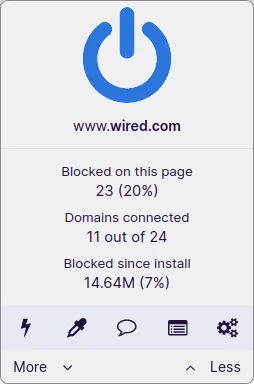
Out of the box the effect is immediate. Default lists remove trackers, advertising frames and the various overlays that exist to interrupt reading, pages load faster because fewer requests are made, and the browsing experience becomes quiet in a way that is hard to describe and impossible to give up once you have had it. The common reaction after a week is not admiration but annoyance at every other device that does not have it installed.
A ceiling high enough for professionals
The defaults are a floor, not the design. The filter syntax is expressive enough to target a single element on a single page or to apply a policy across an entire site, and the network and element pickers let you write a rule by clicking on the thing you want gone. Lists can be added, removed and written by hand, and community-maintained collections cover sites in most languages, including the regional ones that generic lists miss.
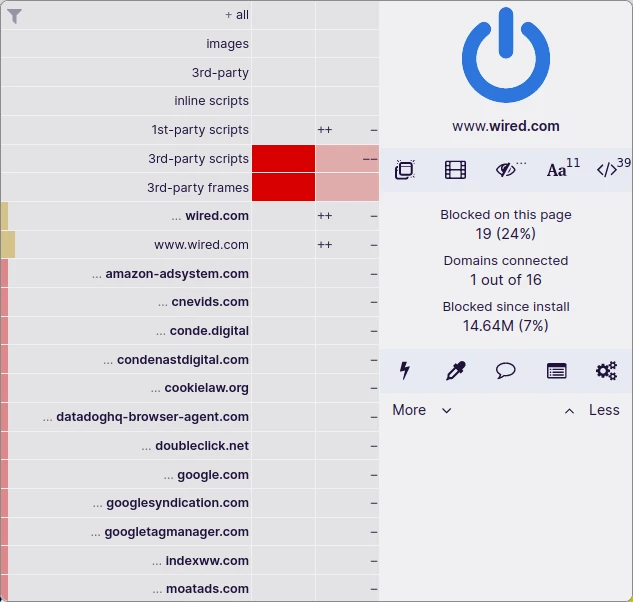
For advanced users there is a dynamic filtering panel that puts the decision at the level of the request type: block third-party scripts everywhere and allow them per site, refuse remote fonts, deny all media except on the two sites that need it. It is the closest thing the category has to a firewall, and it is powerful enough to break pages if used carelessly, which the interface does warn about.
The honest caveat is about the platform rather than the product. Under the newer extension rules in Chromium-based browsers, the full version cannot run, and a reduced build is offered that keeps the core blocking but loses some of the dynamic capability. On browsers that still support the complete extension model, such as Firefox, nothing is lost. Anyone choosing a browser partly for this feature should check the current situation rather than assume, because the details have changed more than once.
Why it is worth the small effort
Installing takes a minute and adjusting the defaults takes an afternoon at most, and the return is measured in every page you open afterwards. Beyond comfort, there is a privacy argument: the tracking infrastructure that most sites embed is not a small thing, and blocking it at the request level prevents the collection rather than hiding from it. There is also a bandwidth argument, which matters on a metered connection, and a battery argument on a laptop.
The maintenance model deserves a word, because it explains the project's character. No funding round, no expansion into adjacent products, no attempt to build a platform. One person, a public repository, and a decade of steady work, with community lists doing the breadth. It is the best argument for the open model that the browser ecosystem has produced, and it is a fragile arrangement: projects like this depend on one maintainer continuing to care.
Ten years of this project is the best footnote to individual open source effort: no funding, no expansion, one person making an extension nobody can replace. Pure interest is the strongest maintenance force there is.
Practical advice. Live with the default lists for a week before adding anything, because over-blocking is the usual beginner mistake and the symptom looks like a broken website rather than a wrong setting. Use the element picker for the one stubborn box on a site you read daily, and keep those custom rules few, since each one is a small maintenance debt. Be careful with the dynamic panel, where a wrong global rule produces a blank page and a puzzled half hour. And check which build your browser can actually run before recommending it to someone else.
One last point: if a page misbehaves, the correct first move is to disable the blocker for that site and see whether the problem persists, rather than to conclude the site is broken. That single habit prevents most of the support conversations this category generates.