
SciSpace aims to cover the whole research loop, from finding papers to drafting
Summary
One prompt box asks how it can help with your research, five starters sit beneath it, and behind them a chain of tools: search in three depths, a review with a published benchmark, chat over a PDF, drafting, diagrams, citations and a detector.
Recommend- Name
- SciSpace
- Version
- 20260917
- Pricing
- Free
- Open source
- Proprietary
- Operating system
- WebAndroidiOS
- Website
- https://scispace.com/
- Updated
- 2026-10-06 20:04
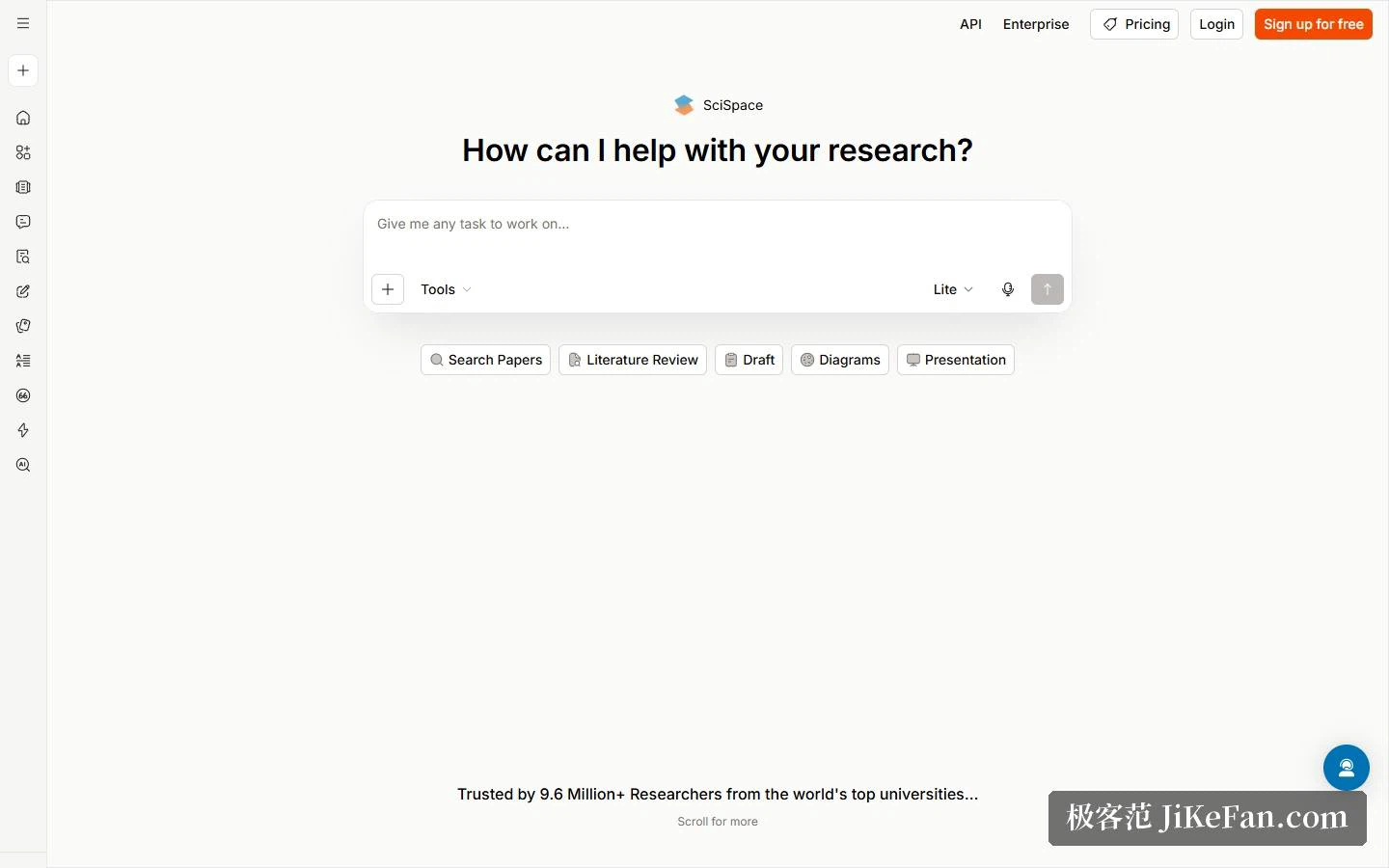
The front page is a single prompt box asking how it can help with your research, with five starters beneath it: search papers, literature review, draft, diagrams, presentation. The footer names the company and its address in California, and the page claims it is trusted by 9.6 million researchers.
Three depths of search, and a review with a published benchmark
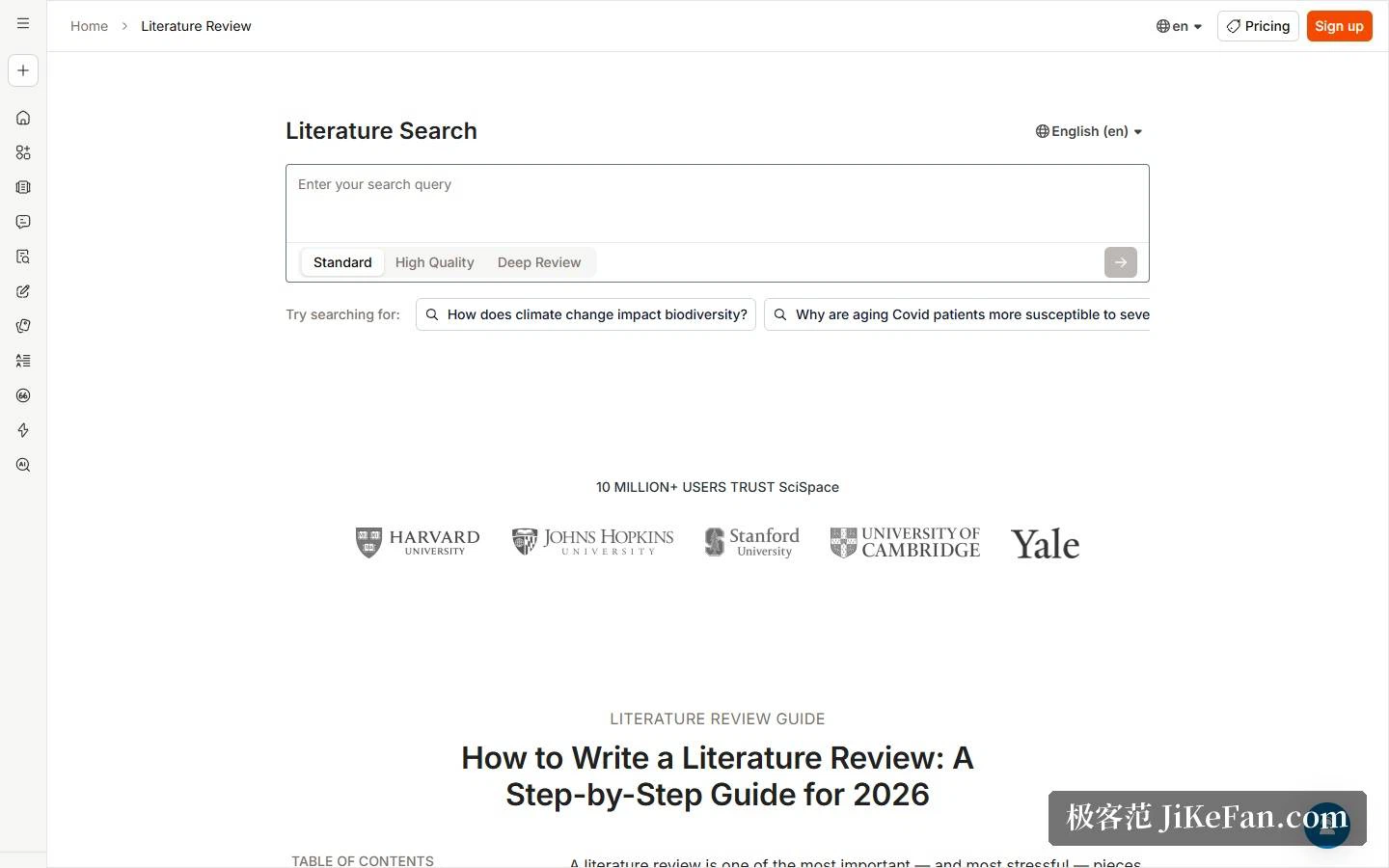
Literature search splits into standard, high quality and deep review, and the page carries a second user figure of more than 10 million alongside logos of several major universities.
The guide page comes with a white-paper benchmark: across 200 complex research questions, deep review returned an average of 26.3 highly relevant papers per run, close to double the baseline it was measured against. That is the company's own evaluation, so quote it with attribution.
A tool for each stage
The navigation lines up chat with a PDF, literature review, an AI writer, topic finding, a paraphraser, a citation generator, data extraction, an AI detector, a gallery of agents, an API and an enterprise tier as first-level entries — which is the clearest statement of intent: cover the whole loop rather than one step.
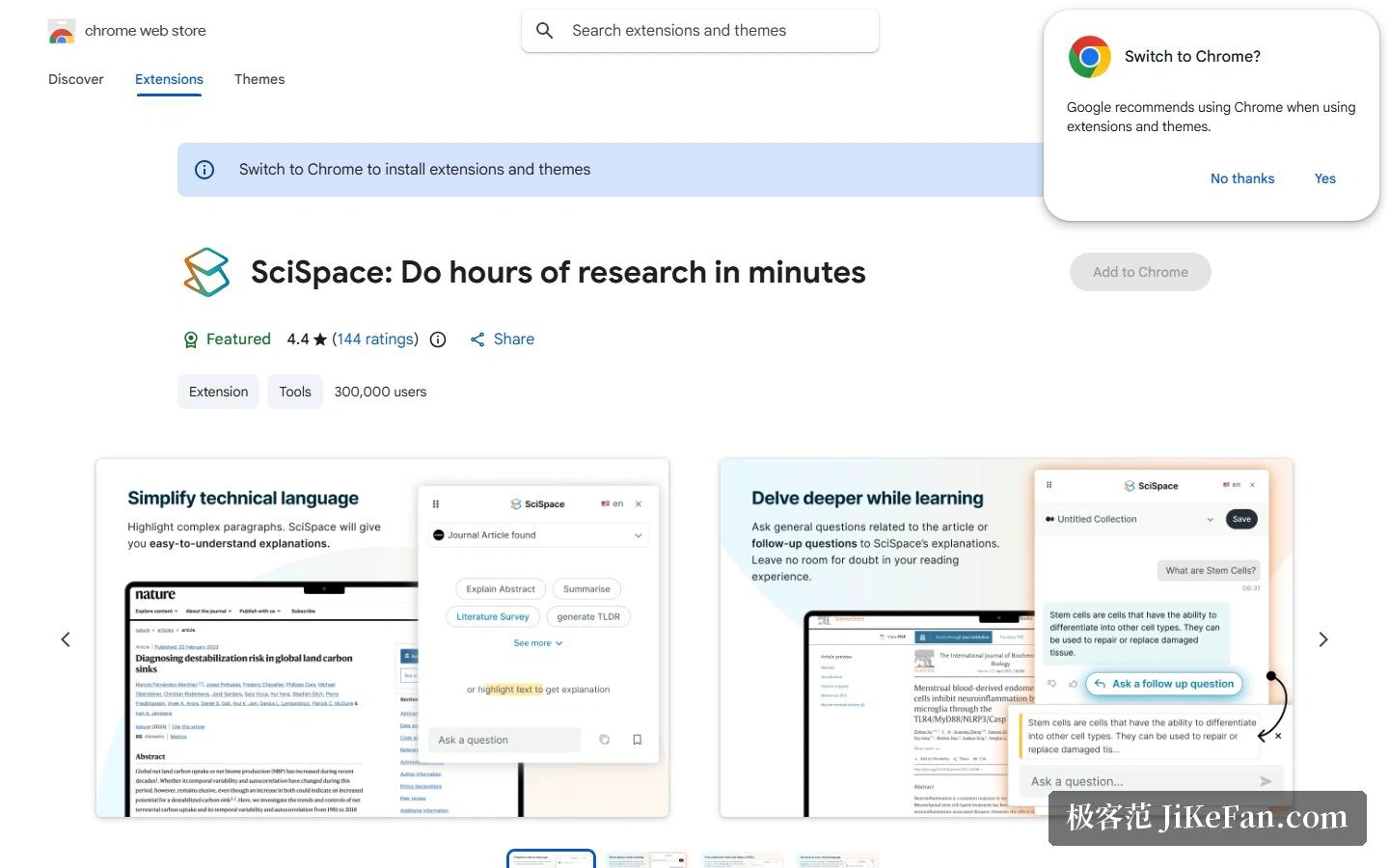
The comparison table adds the claims: answers carry citations, papers are opened as chat partners, data can be extracted, the corpus is stated as 200M+, tables can be filtered side by side, and results export to CSV, XLSX and BIBTEX. There is also a browser extension whose store listing is marked as featured with 4.4 stars, 144 reviews and 300,000 users, where every copilot answer carries a citation and a source location, and literature review reaches a library stated at 270 million papers.
Credits, discounts and the refund promise
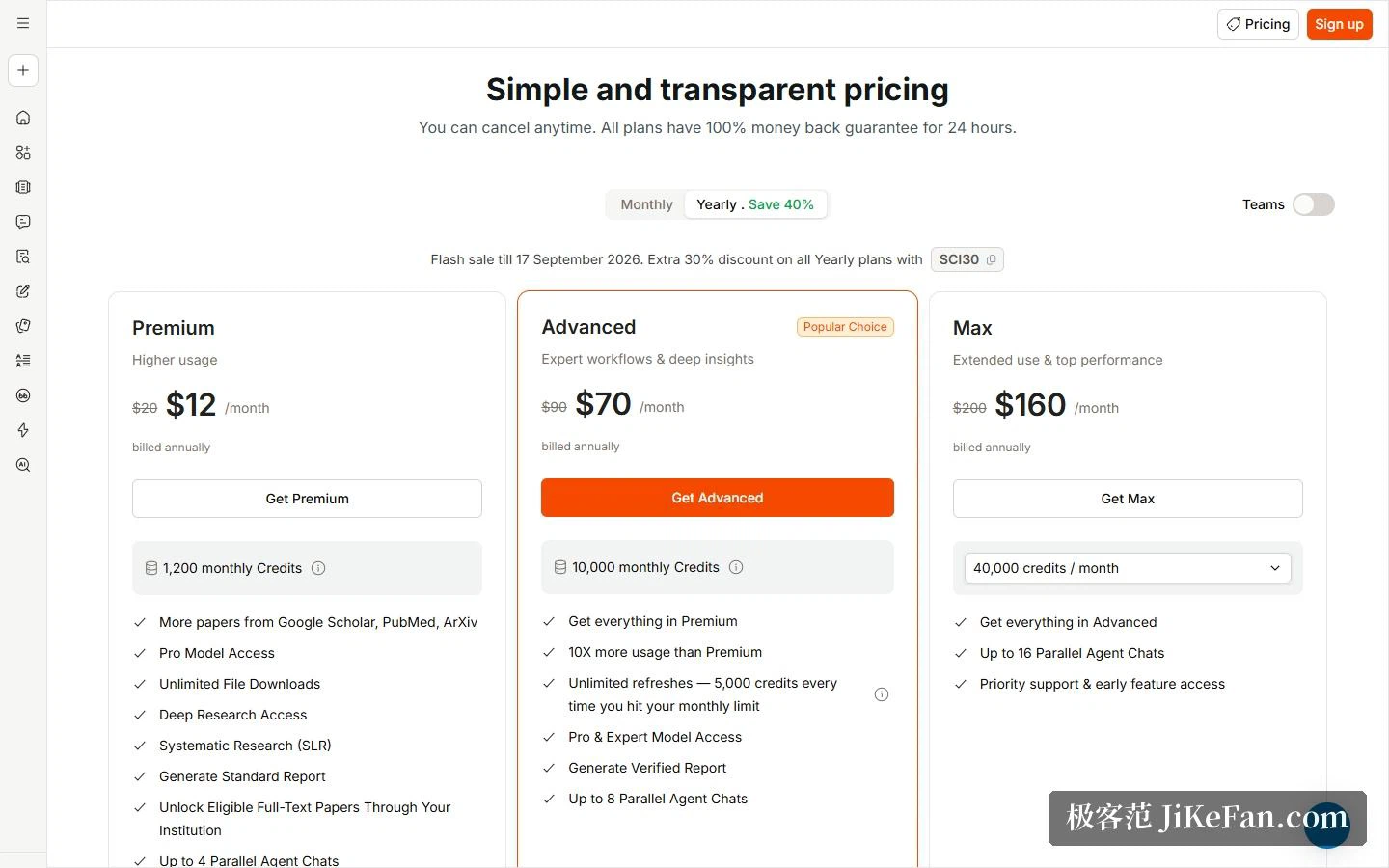
Three tiers, all metered in credits. Premium is 12 a month billed yearly against 20 list, with 1,200 credits a month, more papers drawn from the major academic indexes, pro models, unlimited downloads, systematic review support, up to 4 parallel agent conversations, plus a biomedical agent, unlimited literature reviews, unlimited chat with PDFs and unlimited AI detection. Advanced is 70 a month yearly with 10,000 credits, an automatic 5,000 top-up at the cap, pro and expert models, a verified report and 8 parallel conversations. Max is 160 a month yearly with 40,000 credits, 16 parallel conversations and priority support.
Yearly billing is marked as a 40% saving, and there is a code for a further 30% off yearly plans until 17 September 2026. Subscriptions can be cancelled at any time with a 24-hour, full refund promise. Enterprise adds administrator access, a shared credit pool and SSO with SCIM, by application.
Who it suits
Three groups: graduate students and researchers assembling a broad review, using deep review with extraction and export; students reading foreign-language papers and needing formulas and tables explained, using chat with PDF and the multilingual extension; and teams wanting search wired into a biomedical or corporate workflow, served by the biomedical agent and enterprise single sign-on.
Two honest notes. First, the site puts a human-verification wall in front of automated access while normal browsing works, so the facts here are from the pages as rendered. Second, several figures exist in two versions on the official pages — 9.6 million and more than 10 million users, a corpus of 200M+ and a library of 270 million — so cite the number together with where it appears.
What the credit meter reveals
Reading the tiers by credits rather than by feature names makes the product legible. Every tier bundles a monthly allowance, a number of parallel agent conversations, and a level of model, which means the real differentiator is not what the tools do but how many questions a month you are allowed to ask them. Someone writing one review a year sits comfortably in the entry tier; a lab running several projects at once is buying throughput, not features.
The other thing the pricing page says, indirectly, is that the company expects comparison shopping: a discount code with an expiry date, a percentage saving for paying up front, and a refund window short enough to test the claim. That is the behaviour of a crowded category, and it is worth exploiting while it lasts.
Once a literature review has a benchmark, choosing an AI research tool becomes something you can compare with numbers.