
Consensus puts a dial on the literature, so you can see how divided the evidence is
Summary
Ask a yes-or-no research question and a meter shows how far the published evidence agrees. Deep search builds the strategy for you: expanding keywords, hunting opposing claims, walking the citation graph across 220 million peer-reviewed papers.
Recommend- Name
- Consensus
- Version
- 2.2
- Pricing
- Free
- Open source
- Proprietary
- Operating system
- Web
- Website
- https://consensus.app/
- Updated
- 2026-10-05 05:03
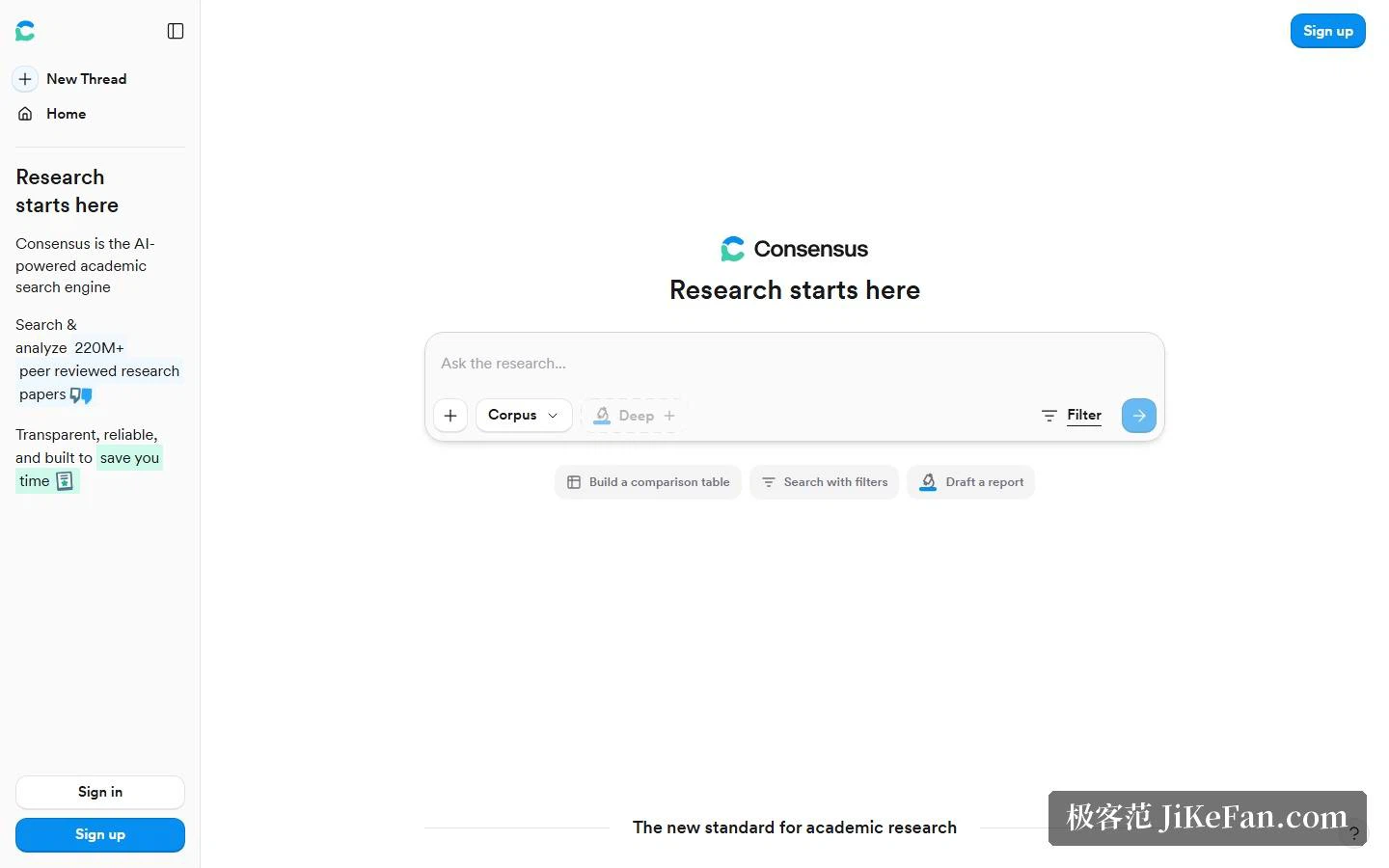
The homepage is clean to the point of being one search box, labelled as an AI-powered academic search engine, with a line above it promising search and analysis across 220M+ peer-reviewed research papers. Under the box sit three openers: build a comparison table, search with filters, draft a report. One caveat worth carrying: the paper count appears as both 220M+ and, in body copy, 250M+, so quote it with the place you found it.
Deep search does the strategy work
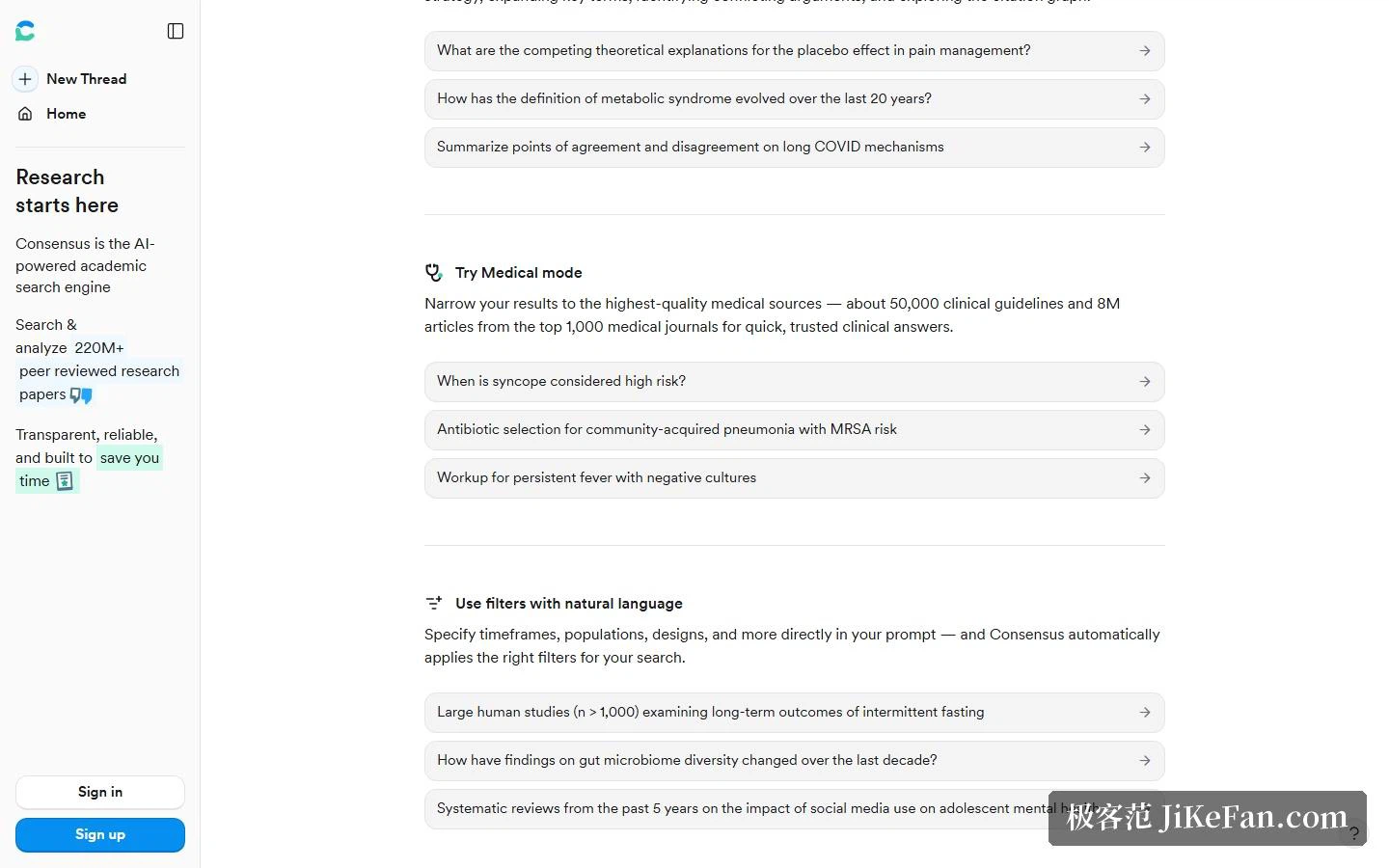
Deep search is described as building a comprehensive strategy by itself: expanding keywords, identifying opposing arguments, and exploring the citation graph. The official examples run from competing theories of the placebo effect to twenty years of argument over how metabolic syndrome should be defined.
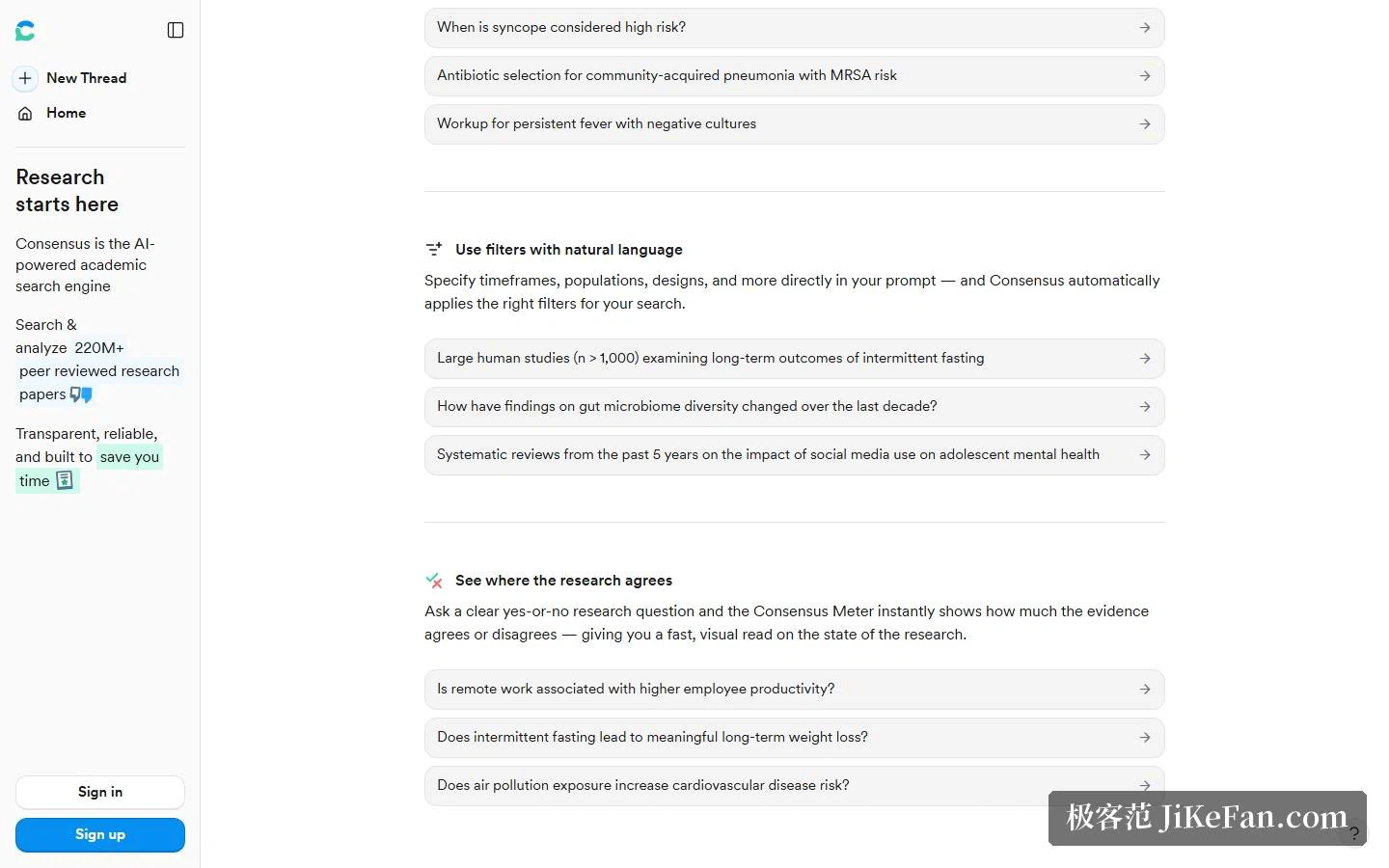
Filters take natural language. Time range, population and study design go into the question and the system applies them, so a constraint like large human studies with a sample size over 1,000 becomes a click rather than a menu hunt.
Two ways of asking what the field thinks
Medical mode narrows results to high-quality medical sources: around 50,000 clinical guidelines and 8 million articles drawn from the top 1,000 medical journals, with example questions covering risk stratification in fainting and antibiotic choice in community-acquired pneumonia.
The meter answers a different question. Pose something yes-or-no and a dial shows how far the evidence agrees or splits — remote work and productivity, intermittent fasting and weight loss are the examples given. It is a visual answer to a question reviewers normally hold in their heads.
Three tiers, with API and MCP on the paid ones
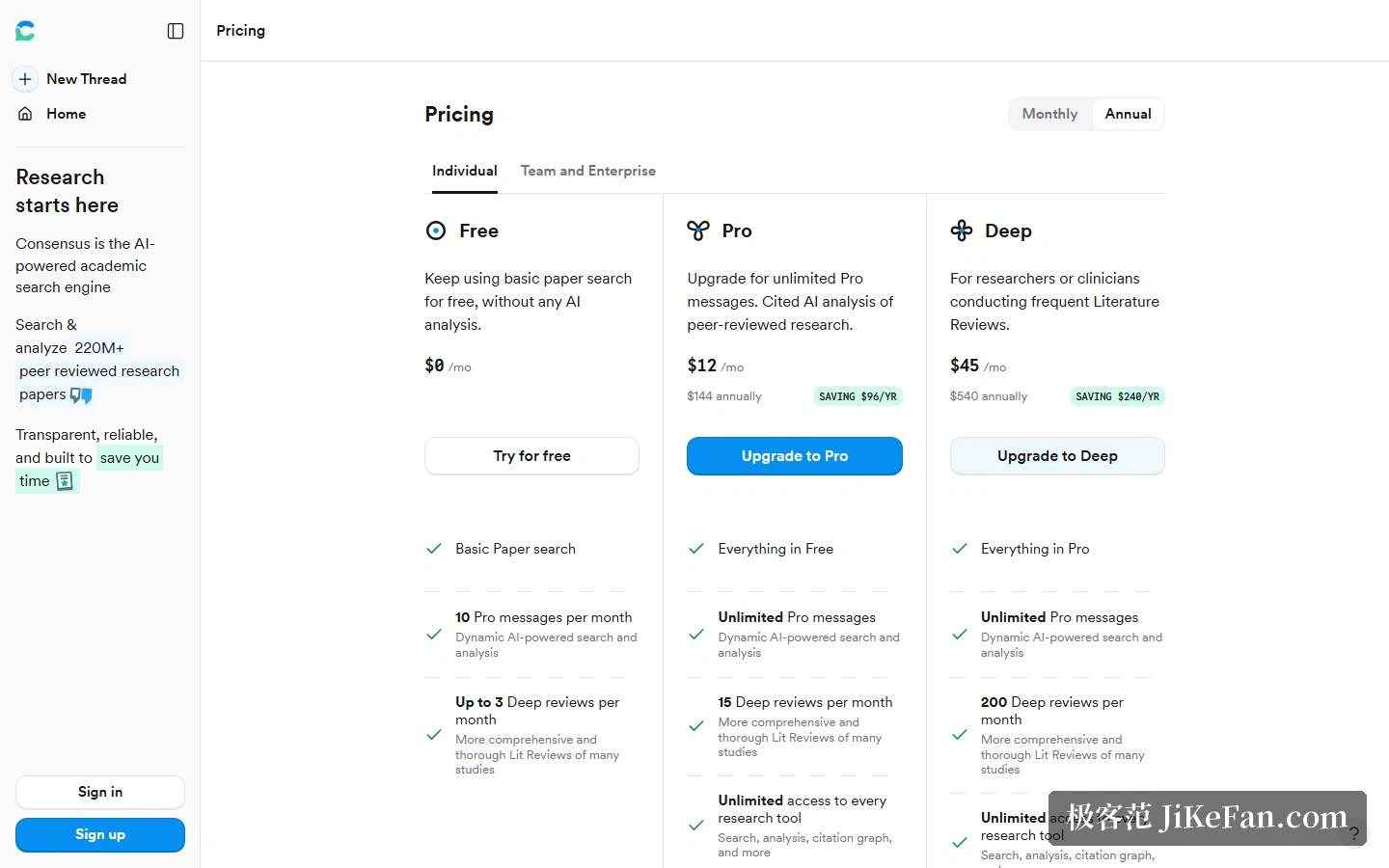
Free costs nothing and keeps basic paper search plus 10 Pro messages a month. Pro is 12 a month, or 144 a year for a 96 saving, and unlocks unlimited Pro messages, 15 deep reviews a month and 500 API and MCP calls. Deep is 45 a month, or 540 a year for a 240 saving, with 200 deep reviews a month and 2,000 API and MCP calls. Overage runs at 0.05 per call, capped at 1,000 a month on Pro and 10,000 on Deep. Students and teachers with a school address, and clinicians with a US provider number, get up to 40% off.
Who it suits
Three kinds of people: medical students and clinicians who need a quick read on what the evidence says, using medical mode and the meter together; researchers putting together a full review, with deep search and natural-language filters; and developers who want academic search inside an automated pipeline, since API and MCP calls are written into the tiers. More than 170 university libraries are listed as partners, so institutional backing and a personal free tier coexist.
What the framing does well is separate two jobs that usually blur: finding papers, and knowing how contested a finding is. What it does not do is judge the quality of the studies behind the votes, which is why the dial is a starting point for reading rather than a verdict.
Two honest notes. First, the site returns only a script shell to plain scraping while browsing works normally; the facts here come from the pages as rendered. Second, the user count appears as both 10 million and 5 million+ in different places, so cite the location along with the number.
Three starters instead of a blank box
The three openers under the search box are quietly the most useful part of the design, because they name the three things people actually do with a paper corpus: compare, constrain, and write up. A comparison table is what you build when deciding between options; filters are what you reach for when the question has a population or a study design in it; a drafted report is the first draft of a literature section that you then correct. Naming them spares the first-time user the blank-page problem that a single search field usually creates.
The free plan's 10 Pro messages a month are worth reading as a demo allowance: enough to try the meter on a couple of questions and feel how it reads, not enough to run a project.
Once a search engine learns to vote, how disputed an article is becomes a reading you can simply look at.