
Poe: build your own bot from a sentence, then charge per message
Summary
One account switches between models from several companies, and a written description is enough to build a bot of your own. Creators can then set a price per message and keep the revenue.
Recommend- Name
- Poe
- Version
- 5.18
- Open source
- Proprietary
- Operating system
- WebiOSAndroidmacOSWindows
- Website
- https://poe.com
- Updated
- 2026-10-28 22:00
An aggregator built by the question-and-answer community Quora: one account collects models from several companies into the same window, lets you build a bot of your own out of a few sentences, and lets you charge for it once it exists.
The name stands for platform for open exploration. It appeared on iOS as an invitation-only affair at the end of 2022, opened to the public in February 2023, and picked up a web version and desktop clients afterwards. According to the help centre, the bots are powered by third-party companies running large models, and the platform's job is to gather those abilities behind one interface — no separate account per vendor, no pile of keys to manage.
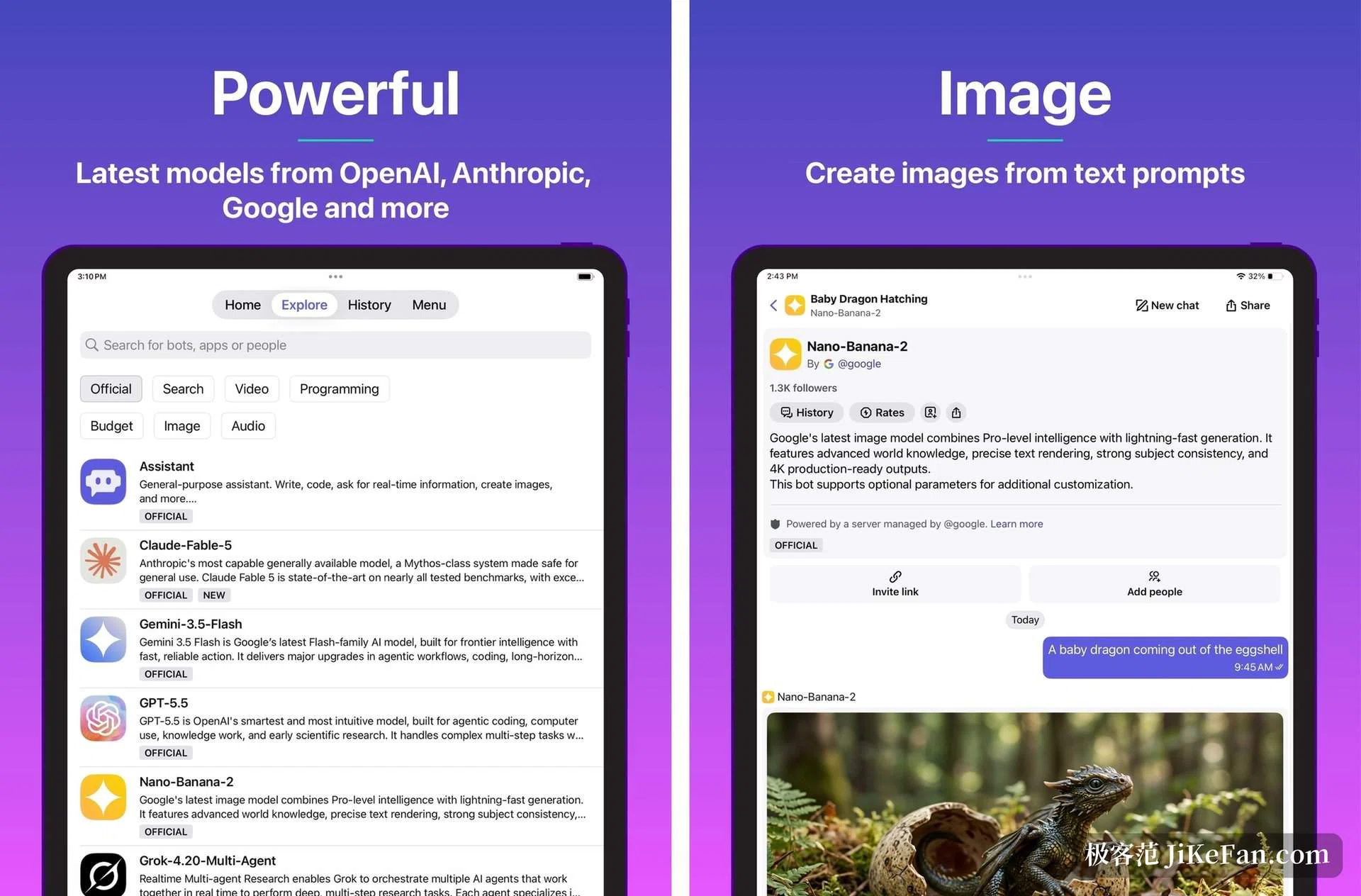
The use people mention most is asking several bots at once. Mention two or three in a conversation and their answers sit side by side, which removes the copying and pasting. Officially the reachable models cover text, image, video and audio and number more than two hundred; generation sits in the same application rather than another window.
More than a million bots, most of them built by users
The store description says user-built bots have passed a million and are still growing. That number is worth a second thought: these are not features a vendor decided you need, but things other people assembled from prompts, scripts or backend code — a study planner here, a résumé rewriter there, one with a Python runtime wired in.
Browsing happens on an explore page, filterable by search, video, coding, image and audio, and searchable by person as well as by app. Every bot has a page saying who maintains it, how many follow it and roughly what a conversation costs in credits; official ones carry a badge, new arrivals are marked as new. Anything in the list can be remixed, meaning you start from someone else's bot and build your own version.
Three kinds of bot, from one sentence to one server
The ways of building are ranked by how much technology they demand. A prompt bot needs no code at all: one system instruction plus a base model, good for a character, a question answerer or a simple tool. A script bot also needs no code: describe the need in plain language and the built-in creator writes the program, chaining several models into a multi-step flow. A server bot does need code, because you deploy the backend yourself and handle external interfaces and custom logic, with messages forwarded to your machine.
The middle tier deserves a paragraph. According to the creator documentation you explain the idea conversationally, the built-in creator writes the code, and a working bot exists within minutes; the infrastructure runs on the platform's side, so there is no server to administer. It does more than a single prompt, it can chain several models, and the threshold stays low. Above that, server bots suit cases that need outside data, custom reasoning or multi-step jobs — the platform takes on client distribution, sign-in, billing and global scaling, and the developer looks after the logic. There is also a more application-shaped route: a description produces an interactive visual interface whose underlying code stays open to the user for manual adjustment.
Once it exists, it can charge by the message
The creator programme is the link between a bot and income. Creators set a price per message, and each message a user sends pays out at that price. Set it low and more people come; set it high and some are shut out, and the balance is the creator's call. Earnings are visible per bot on the creator page. Beyond per-message pricing there is a referral reward: when a user subscribes through your bot, the creator receives a share.
The published list of eligible regions runs to more than twenty and includes Hong Kong, China alongside Japan, Singapore, the United Kingdom and the United States. For developers there is also a monetisation interface that prices dynamically by input length, output length or computational complexity — authorise an estimate first, settle at actual usage afterwards — currently labelled as a test. Third-party trackers estimate that the platform already pays out creator revenue in the tens of millions of dollars a year.
Credits: the free allowance, and what changed in March 2026
Usage is measured in credits. Every bot states roughly what a conversation costs, and cheap and expensive are clearly separated; a single chat can also be given a budget, with a warning before the limit and no further spending without confirmation.
Non-paying users receive an allowance every day that resets after twenty-four hours and cannot be saved for tomorrow. That allowance changed around the end of March 2026: according to several third-party trackers and reporting in Hong Kong media, the daily figure fell from roughly three thousand credits to roughly three hundred, a drop of about nine tenths. The help centre no longer states a daily number, keeping only the three rules — granted daily, cleared after a day, not cumulative. By the third-party conversion, three hundred credits covers somewhere between a dozen and thirty short questions, and a high-end model or an image runs through it quickly. Occasional users can simply buy credits, at a reference price of about thirty dollars per million.
On subscriptions, as of September 2026 the paid tiers run from under five dollars a month up to about two hundred and fifty, with roughly a sixth off for a year. The cheaper tiers grant credits by the day, the higher ones a monthly pool.
Group chat and the desktop
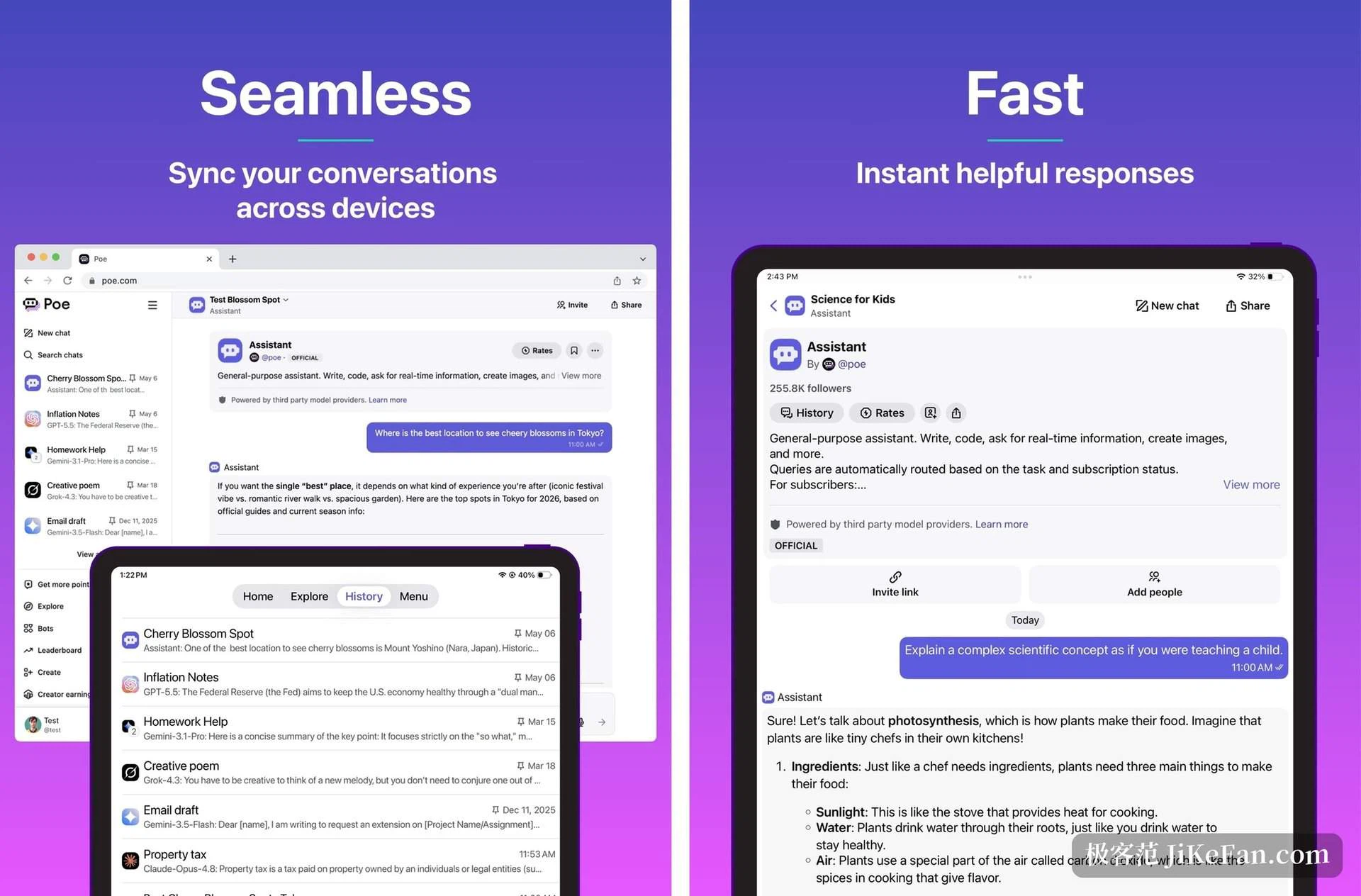
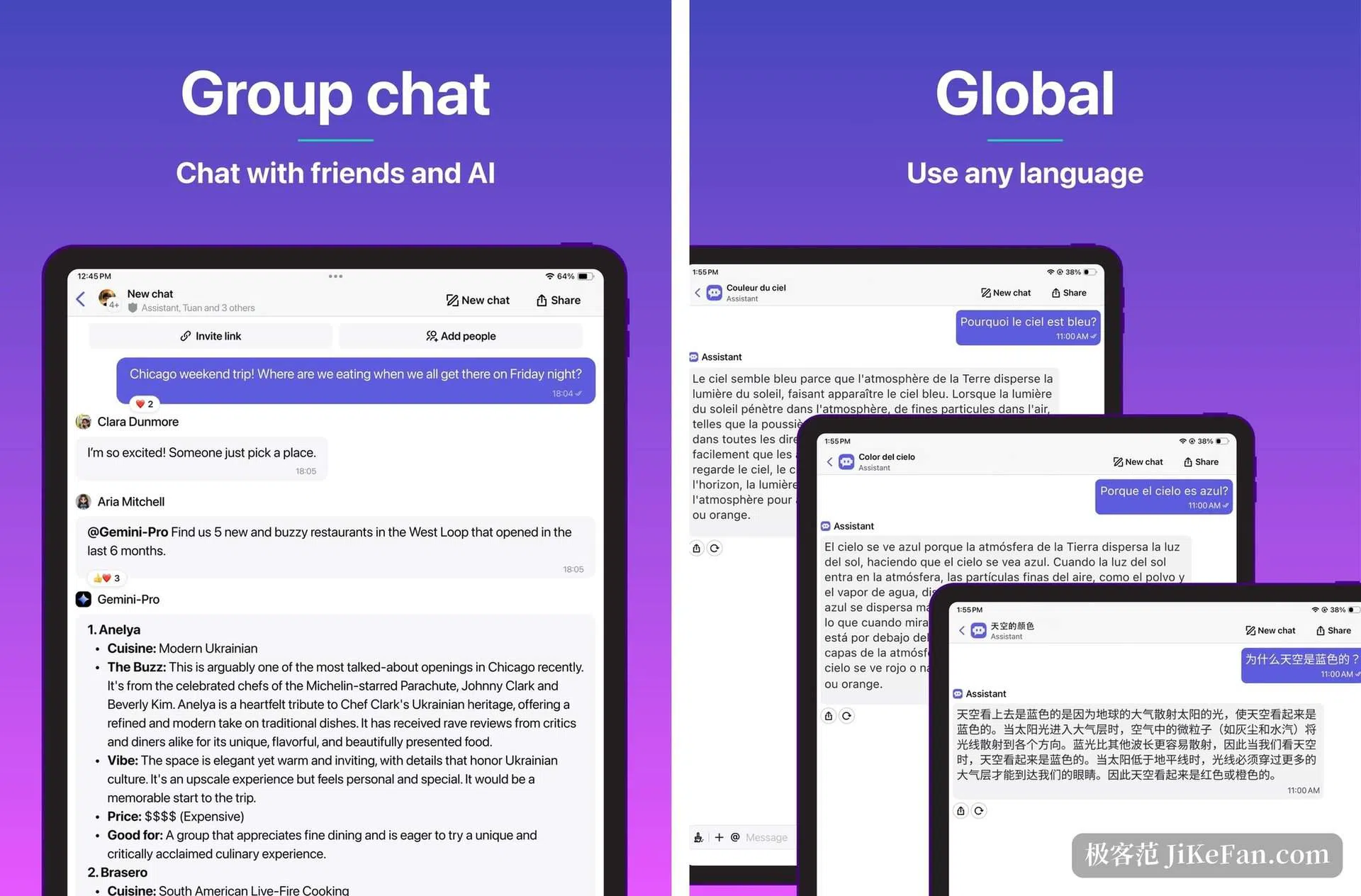
Group chat arrived in November 2025: up to two hundred people in one group, humans and models working in the same conversation, more than two hundred models callable and user-built bots welcome. History syncs across devices in real time, on web, iOS, Android, macOS and Windows. The official note says the feature took six months to build and will keep changing.
Who it suits
Anyone with a scattered idea and very little appetite for engineering is the group that feels the benefit most. A few years ago this required a server, a model provider's interface and a front end written by hand; now a clear description produces a shareable bot and the coding goes to the platform.
People already using several vendors save the window-switching and the separate subscriptions. And for creators who want their bot used and actually paid for, per-message pricing with a referral reward is a real door in — distribution, sign-in, billing and scaling belong to the platform, leaving the creator one job: how the bot answers.
The foundation is an aggregation layer that puts models from several sources in one window; what keeps people is what sits behind it — letting someone who does not write code produce a bot, and letting a good bot earn by the message. If you want to try building one without first learning deployment and interfaces, this is a reasonable place to start.