
MotrixNext: A Downloader That Stopped Three Years Ago, Rewritten
Summary
A full rewrite of a download manager that had been dormant for three years: every common protocol in one window, up to sixty-four connections per task, selective torrent downloads, and a lighter runtime that starts faster and uses far less memory.
Recommend- Name
- MotrixNext
- Version
- 3.9.9
- Pricing
- Free
- Open source
- Open source
- Operating system
- WindowsmacOSLinux
- Updated
- 2026-10-18 22:00
What happens when a good tool stops
There is a particular kind of decay that hits open-source desktop software. Nothing breaks on the day the maintainer walks away; it breaks slowly, over years, in ways that are individually small. The bundled runtime ages, and with it the browser engine inside it, so pages and services that were fine start refusing to load. System-level changes arrive that the old packaging never anticipated. The interface still looks correct, the downloads mostly finish, and one day a link simply does not work and there is nobody to ask. Three years of that is enough to turn a widely recommended tool into a relic.
This project is the successor to one of those. The decision taken at the start was not to patch the old codebase but to write it again from nothing, keeping only what made it worth using: every protocol in one window, a clean interface, and source that anyone can read. Everything underneath was replaced.
A different engine under the same idea
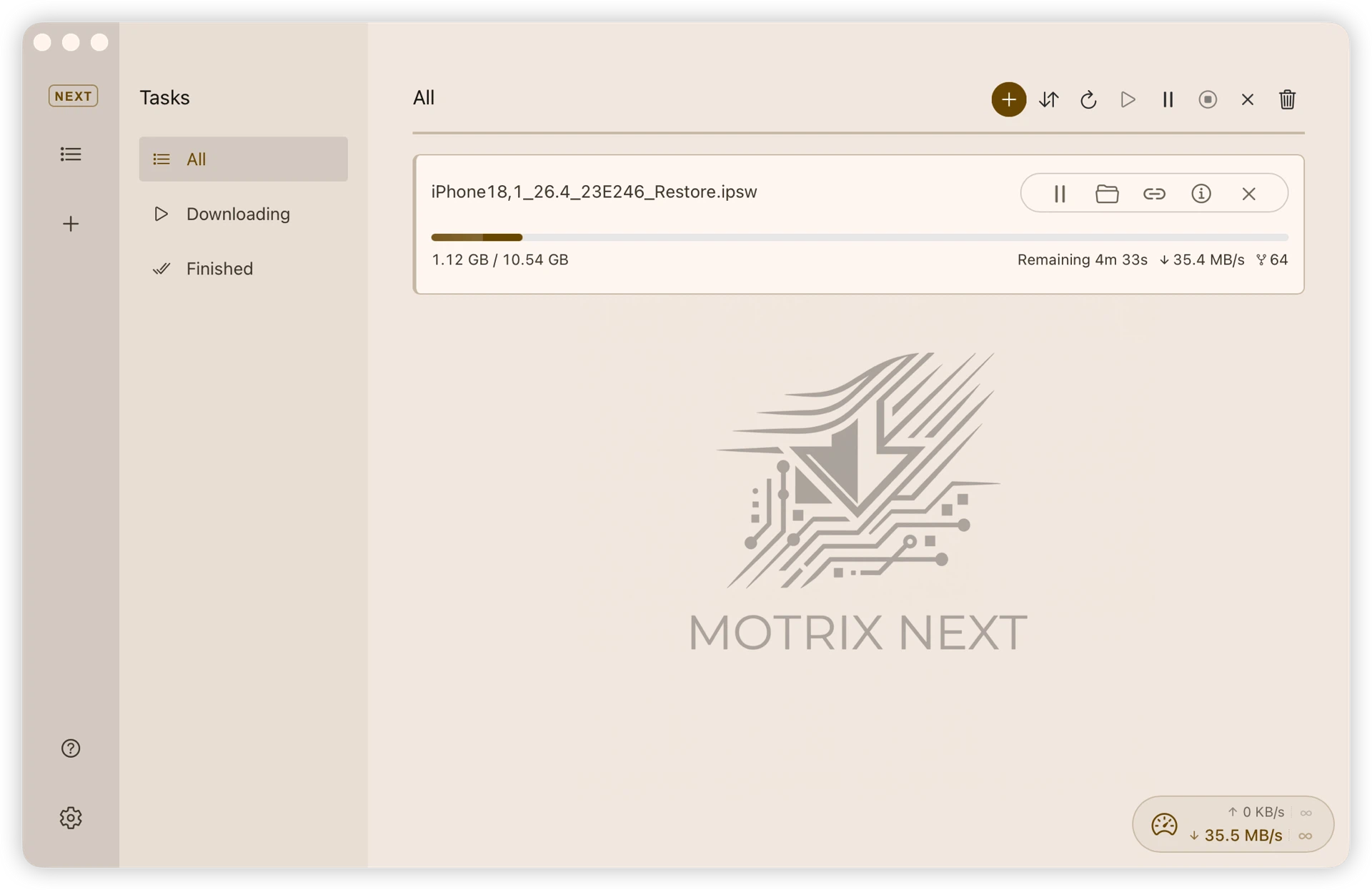
The download core moved from the long-established engine the old version used to a branch of it optimised for modern networks. What that core offers has not changed, and the list is the reason people install a dedicated downloader at all. HTTP and HTTPS, FTP, BitTorrent, magnet links and ED2K are all handled in one place, so the question of which tool to open for a given link stops arising. A single task can open up to sixty-four connections, ten tasks can run at once, and the difference against a browser's built-in download is not marginal — it is the difference between using the connection and saturating it.
BitTorrent is treated as a first-class protocol rather than an afterthought. Inside a torrent, individual files can be selected, so a fifty-gigabyte package does not have to be pulled down to obtain the two files inside it that were actually wanted. The advanced machinery is present as well — distributed hash tables, peer exchange, encrypted connections — which is the distinction between a client that speaks the protocol and one that speaks a reduced version of it.
Why the footprint changed so much
The old version was packaged the way most desktop applications of its generation were: by shipping an entire browser engine inside the installer. That approach made cross-platform development cheap and made the resulting program heavy — a download manager idling in the background at several hundred megabytes of memory is hard to defend when the actual work is moving bytes. The rewrite uses the web view the operating system already provides, with the heavy lifting moved to a compiled core. Startup is visibly quicker, and memory use drops by an amount that is noticeable on a machine that is already busy.
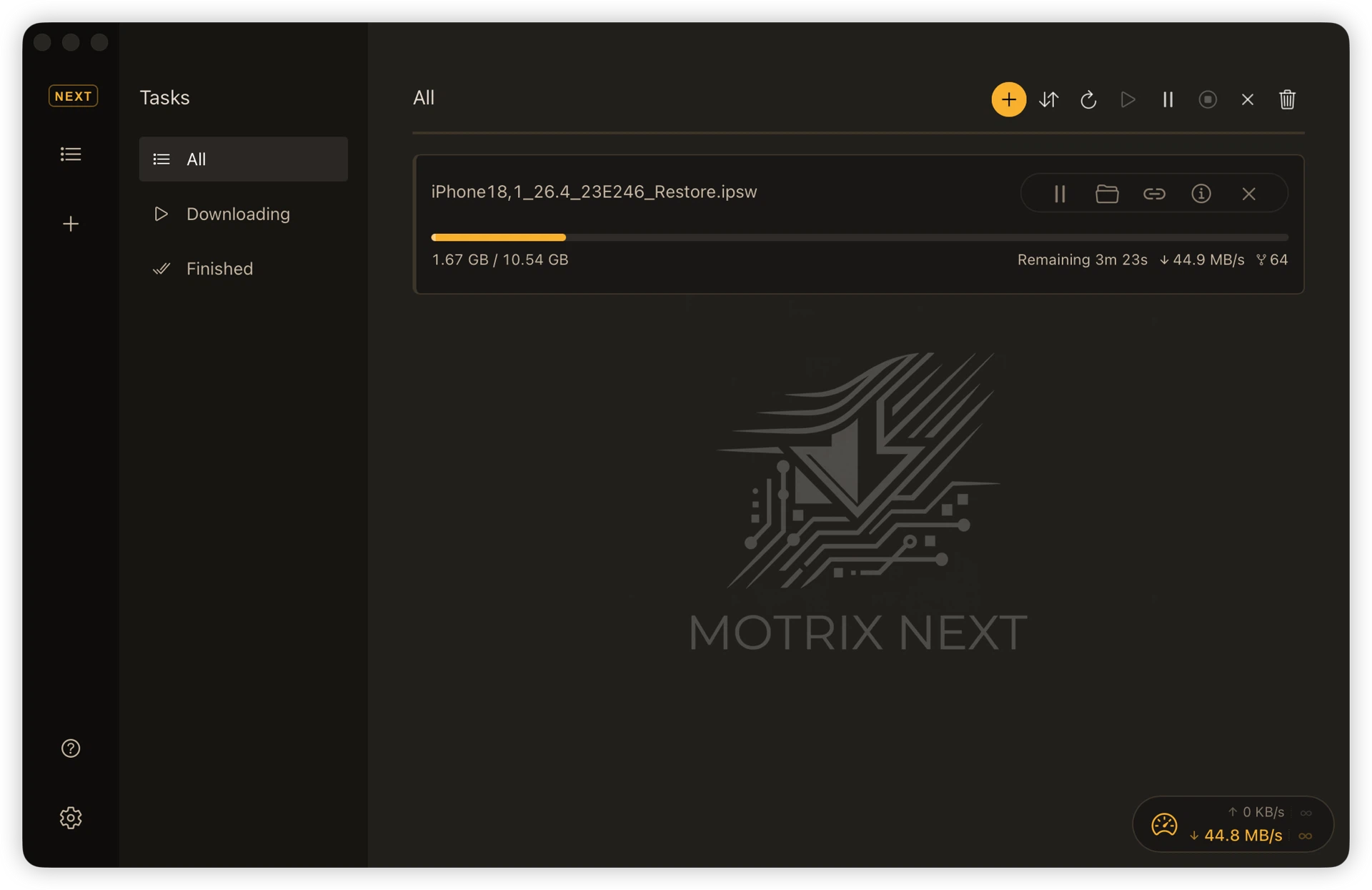
The interface was rebuilt on a modern front-end stack at the same time: the visual language is current, and light and dark themes both exist rather than being promised. What was deliberately not changed is the interaction. Creating a task, pasting a link, choosing where the file goes — the sequence is the same as before, which matters because the people most likely to try this are the people who used its predecessor for years and have no interest in relearning it.
The one thing it does not do
It does not watch the browser. The class of tool this competes with often includes a component that inspects pages and offers to take over any media or file it finds there, which is genuinely convenient. This one has no such feature: it is a manager, not a sniffer. You obtain the link, you hand it over, it uses the whole connection to fetch it.
That is a real limitation and it is fair to call it one, because for some people automatic capture is the feature they came for. What it buys in exchange is scope: no injected components, no browser integration to break with every update of the browser, and a program whose behaviour is entirely predictable because it only does what it was told. For anyone whose downloads come from torrents, from links copied out of a page, or from a queue assembled in advance, the missing sniffer costs nothing at all.
Who it is for
People who used the predecessor and missed it, and who will find the same workflow with none of the compatibility problems. People who download torrents and magnet links regularly, and who would rather not keep a separate client installed just for that. People who work across Windows, macOS and Linux and want one behaviour everywhere instead of three different tools. And people who object on principle to paying for a downloader, which is not an unreasonable position for a program whose entire job is to move bytes efficiently. The source is open and the program is free, so that objection disappears entirely.
This is not another entrant in a crowded category; it is the return of a specific tool that stopped, rebuilt on a foundation that will not rot quite so fast. Every protocol in one window, torrents handled properly, a footprint that no longer embarrasses the machine it runs on, and the same interaction as before. The absence of browser capture is the price, and for the audience that matters here, it is a price worth paying.
The honest summary
Two decisions carry the whole project: rewrite rather than patch, and take the heavy runtime out of the package. Both are engineering decisions rather than features, and both are the reason the result feels current while doing exactly what its predecessor did. The limits are equally plain — no automatic capture from pages, a core inherited from an existing engine rather than invented here, and a dependency on the pace of one rewrite rather than a decade of accumulated fixes. For someone who needs a downloader that handles every protocol with the full bandwidth available and does not cost memory or money, that combination is difficult to argue with.