
Hyprland: an independent Wayland compositor with plugin support in 0.56.2
Summary
Hyprland is an independent, highly customisable dynamic tiling compositor for Wayland. The project puts smooth animation and light response side by side, and adds live configuration reload, plugin extensions and a socket interface.
Recommend- Name
- Hyprland
- Version
- 0.56.2
- Pricing
- Free
- Open source
- Open source
- Operating system
- Linux
- Website
- https://hypr.land/
- Updated
- 2026-10-11 20:30
A desktop boils down to one trade-off: make it beautiful and make it answer instantly, or keep only one of the two.
A tiling compositor built on its own
Hyprland is an independent, highly customisable Wayland compositor. The official front page puts several things side by side: newer Wayland features, dynamic tiling, rich visual effects and powerful plugins, all while staying lightweight and responsive. For a compositor those goals pull against each other, so the order in which the page makes its case already shows where its priorities sit.
Dynamic tiling is the base. The project says windows are arranged automatically out of the box, with several layouts that can be tuned in detail, and further layouts can arrive as plugins. Compared with placing windows by hand, the gain is that screen space is not wasted and existing windows do not shift every time a new one opens.
Independence matters less as a slogan than as a maintenance boundary. A compositor that is not a module inside a larger desktop can adopt Wayland features at its own pace, and that is exactly why its configuration may change from one release to the next. Release notes therefore belong to the documentation rather than to an appendix.
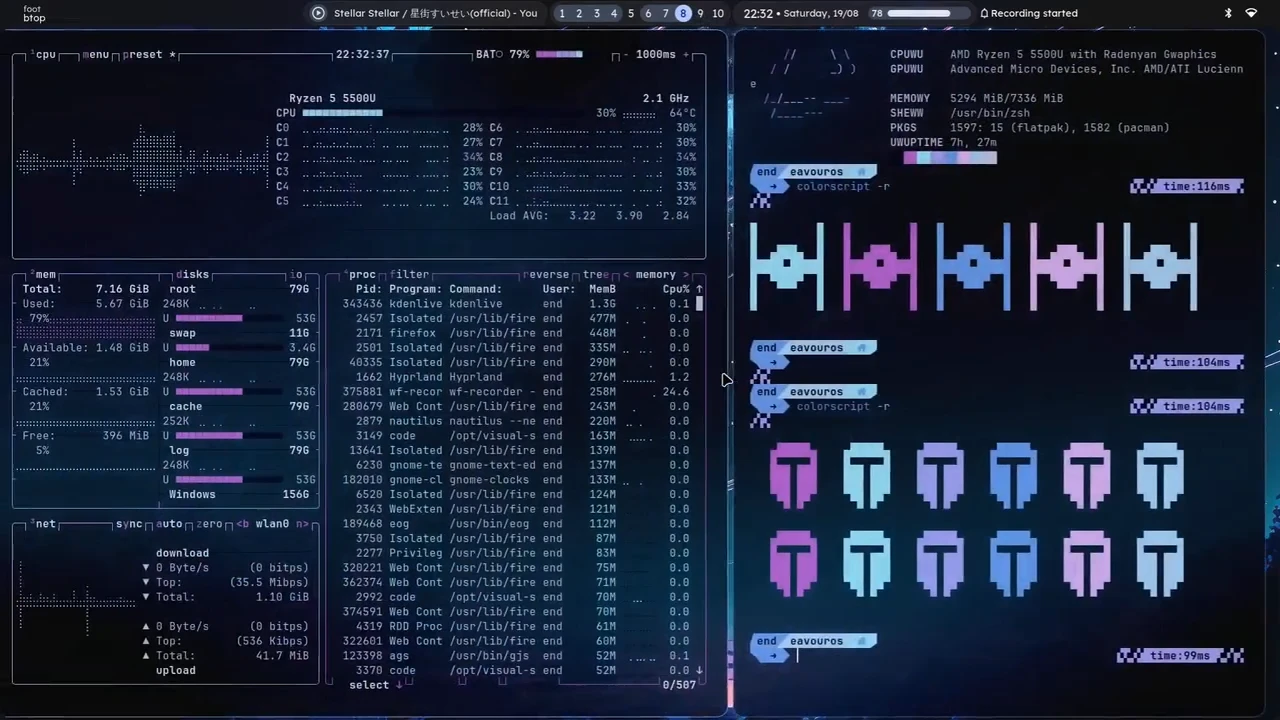
The two ends: motion and configuration
Motion comes first in the feature list: smooth transitions and pleasing animations, followed immediately by a note that performance and responsiveness are there too. The sentence implies that the visual side is not paid for with fluidity, which is exactly where many comparable setups lose their footing.
The configuration side is just as concrete. Configuration files reload while the compositor runs, so an edit takes effect at once; the format is easy to pick up and ships with sensible defaults. Input covers application-scoped global shortcuts and touchpad gestures. Window handling adds groups, which gather several windows into one set that switches together, and special workspaces, which hold a separate layer of content on demand.
The first hour is the real test for this kind of tool. Nothing opens with a wizard, and a fresh install behaves like a plain tiling window manager until someone writes rules for gaps, borders and the applications that should float. Once those rules exist the setup becomes portable, because the whole state is a handful of text files that can be copied to another machine or kept in a repository like any other configuration.
Item | Official notes |
|---|---|
Scope | an independent dynamic tiling compositor for Wayland |
Layouts | several tunable layouts, extendable by plugins |
Motion | smooth transitions and animation while keeping performance |
Configuration | files reload while the compositor is running |
Interface | socket based inter-process communication, plus C++ bindings |
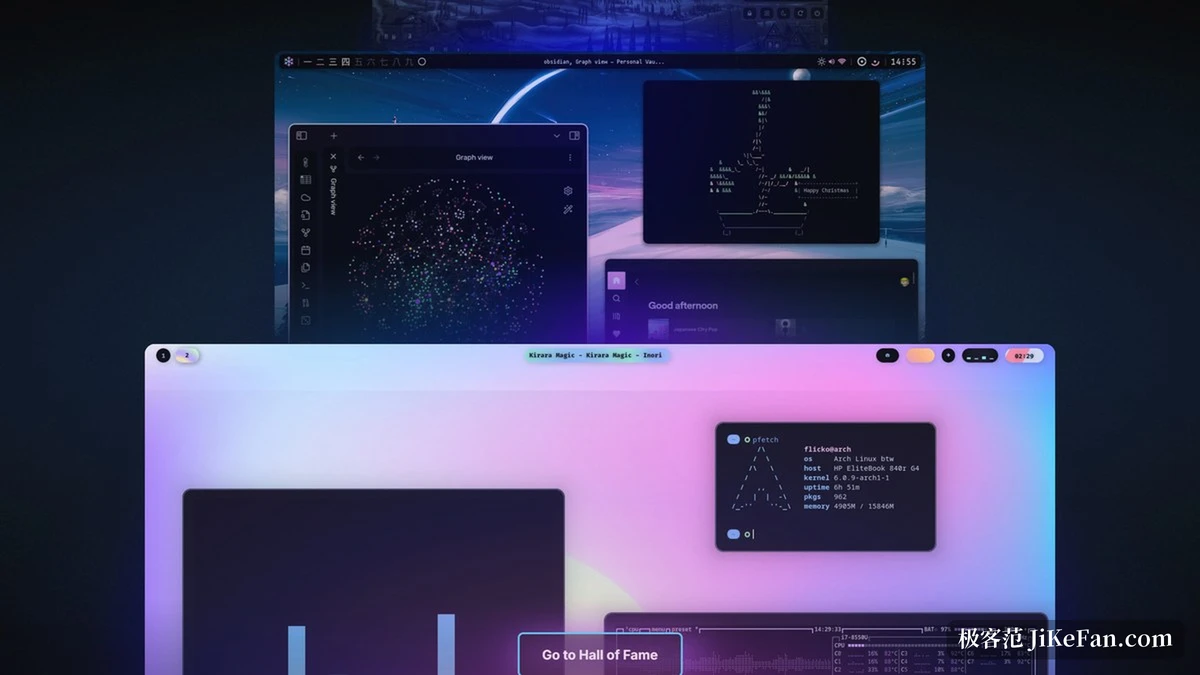
Plugins, scripting and versions
Plugins are maintained by the project and the community together. The official path is to change behaviour with an extension, or to write one using the C++ bindings and the socket interface. The site also publishes lists of plugins, bindings and related applications, and the depth of the ecosystem can largely be read off those lists. The configuration system is changing track as well: release notes record that 0.55 introduced a Lua-based configuration, 0.56 thickens that scripting layer and gives hyprctl an interactive command line.
On versions, the release record lists 0.56.2 as current, published on 5 August 2026, after 0.56.1, 0.56.0, 0.55.4 and 0.55.0. The code is open source under BSD-3-Clause, with the licence file in the repository root, so redistribution and integration are comparatively relaxed.
That licence also shapes how the project reaches users. Permissive terms make it easy for a distribution to ship the compositor as a normal package, and they let other projects borrow parts of it without negotiating anything. The cost is that plugins written against an interface can break when that interface moves, which is why following two or three releases behind is a reasonable habit for a working machine.
A desktop that hands over its interfaces and its scripting is a desktop a user can actually shape.
A few practical notes. Get the default configuration working smoothly before changing layouts and shortcuts, so a broken setup is easy to trace. Install plugins after the configuration has settled, which keeps the source of a problem visible. The older configuration format still works, so moving to Lua can wait for the next time the configuration is tidied up anyway.