
EmEditor: opening a log file measured in gigabytes
Summary
A Windows text editor built around memory mapping, so a plain-text file of many gigabytes opens in seconds and stays scrollable. Regular-expression replacement, multiple selections, column mode and built-in macros come along with it.
Recommend- Name
- EmEditor
- Version
- 26.2.8
- Pricing
- Paid
- Open source
- Proprietary
- Operating system
- Windows
- Website
- https://www.emeditor.com/
- Updated
- 2026-10-22 22:00
An editor whose distinguishing ability is not a feature list but a file size. Everything else it does follows from being able to open a plain-text file that would crash most of the competition.
The file that refuses to open
Take a log file of half a gigabyte and try it in the text editor that ships with the system. Either it freezes outright or it loads halfway and the process dies with memory exhausted. Try it in a modern editor built on web technology and the experience is different but not better: scrolling lags behind the scrollbar, the search box takes seconds to respond, and a progress indicator in the corner never quite finishes. Most editors were designed on the assumption that documents stay small, and the assumption was reasonable until the data stopped cooperating.
In practice large plain-text files are everywhere. A database export of a whole table as comma-separated values. A month of server logs from a busy service. Genomic output. An audit trail that nobody dares to truncate. Opening one of these is not an exotic requirement, it is a Tuesday afternoon task for anyone working in operations or data analysis, and it is precisely the task that ordinary editors handle worst.
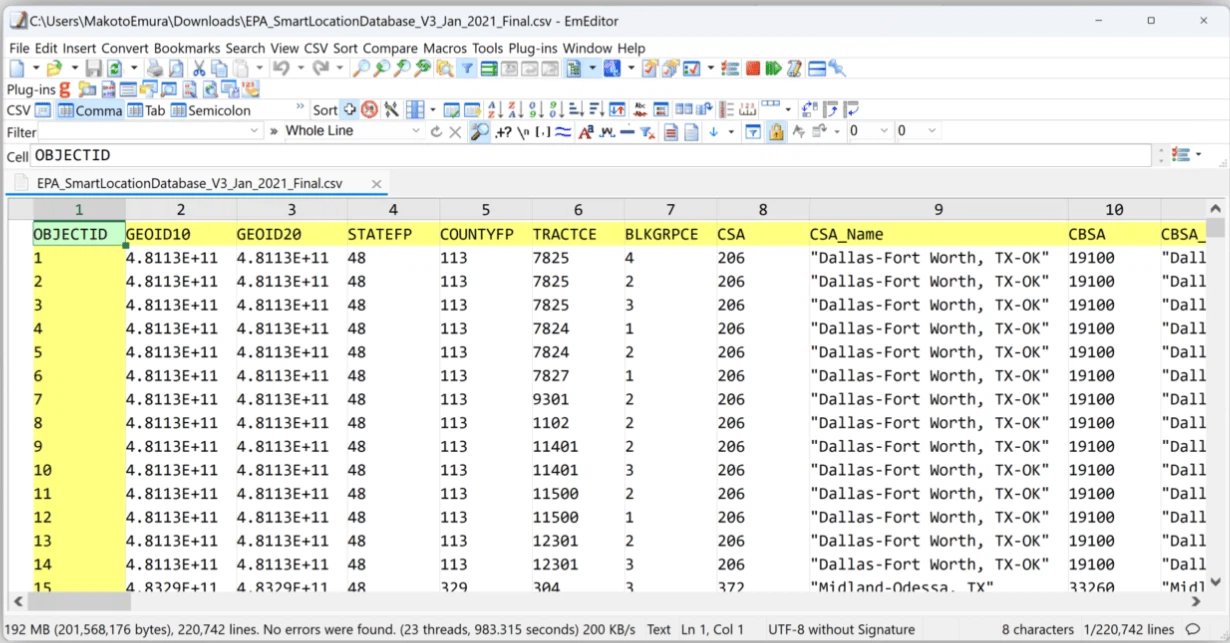
Memory mapping instead of loading
The mechanism behind the difference is not clever parsing but restraint. Rather than reading the entire file into memory and building a document model from it, the program maps the file into the address space and reads the parts it actually needs. A file of tens of gigabytes can therefore be on screen within seconds, and scrolling to the end does not require having loaded everything before it. Every operation that follows, searching, replacing, jumping to a line number, is designed around that constraint rather than around an in-memory buffer.
This is the part that is genuinely difficult to copy, and it is why alternatives are scarce. An editor can add a feature in a release; changing the fundamental representation of a document is a rewrite. The result is a tool whose headline capability is easy to state and hard to match, and whose weakness is equally clear: on a five-kilobyte configuration file it offers no advantage whatsoever over anything else.
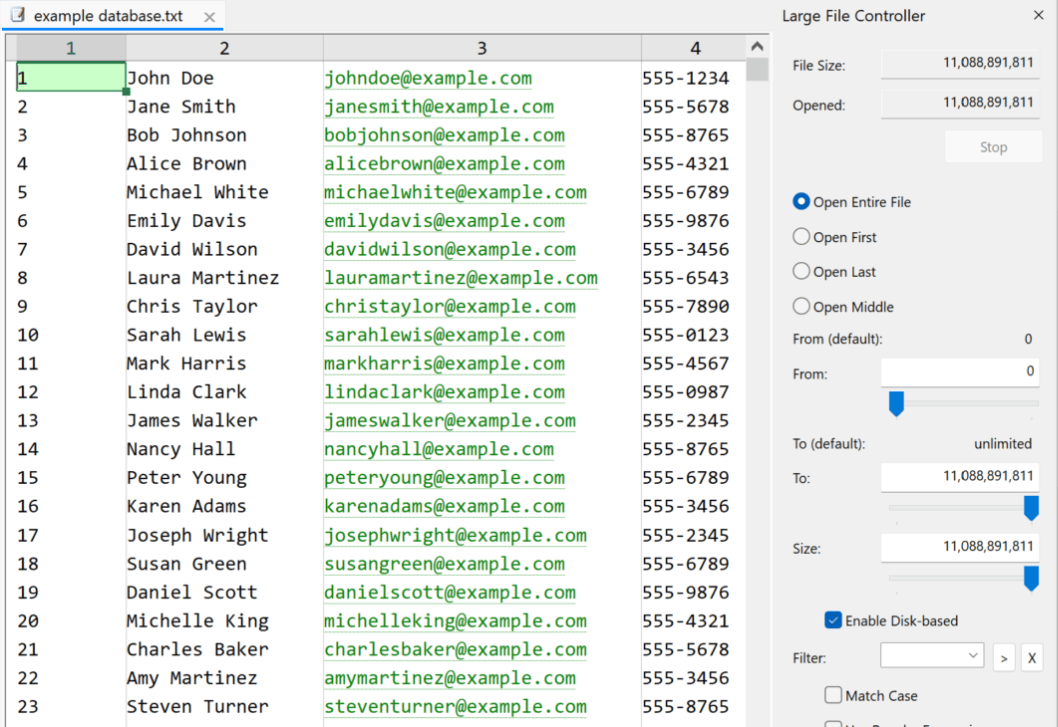
What else it does, once the file is open
Regular-expression search and replace is fast in a way that feels disproportionate. Running a pattern across ten gigabytes of text is the operation where most editors simply give up, either refusing the request or producing a result after a wait long enough that you have moved on to another task. Here it returns. For anyone who has ever tried to extract every distinct error message from a month of logs, this is the difference between an approach that works and an approach that has to be abandoned.
Multiple selections allow several disconnected places in the same document to be edited at once, which turns a repetitive correction into a single action. Structured formats such as comma-separated data, query language and markup get dedicated highlighting and a column mode that treats vertical blocks of text as a unit, which is what makes hand-editing a malformed export practical. Built-in macros, written in one of the scripting languages the program embeds, automate whatever remains repetitive. And a detail that only matters after the tenth open document: the tab bar can be arranged vertically, and with dozens of files open a vertical strip is far easier to scan than a row of shrinking tabs.
A deliberately narrow audience
The program is commercial and runs only on Windows, and it does not try to be a platform. There is no extension marketplace, no attempt at a fashionable interface, no ambition to become the place where you also manage repositories and terminals. The audience is correspondingly specific: operations engineers, database administrators, data analysts, people doing binary and protocol investigation. What they share is a working day in which a text file is not a document but a dataset, and in which the tool that cannot open the dataset is simply not a candidate.
Judged as a general-purpose editor it is one option among many. Judged by the question of whether a forty-gigabyte log can be opened at all, the list of answers is very short.