
Elicit runs the literature review and hands back evidence with sentence-level citations
Summary
Search 138 million papers and 545,000 clinical trials, then have the agent assemble a report, a table or a slide deck in which every claim carries a citation back to the sentence it came from.
Recommend- Name
- Elicit
- Version
- 1.38
- Pricing
- Free
- Open source
- Proprietary
- Operating system
- Web
- Website
- https://elicit.com/
- Updated
- 2026-10-06 10:22
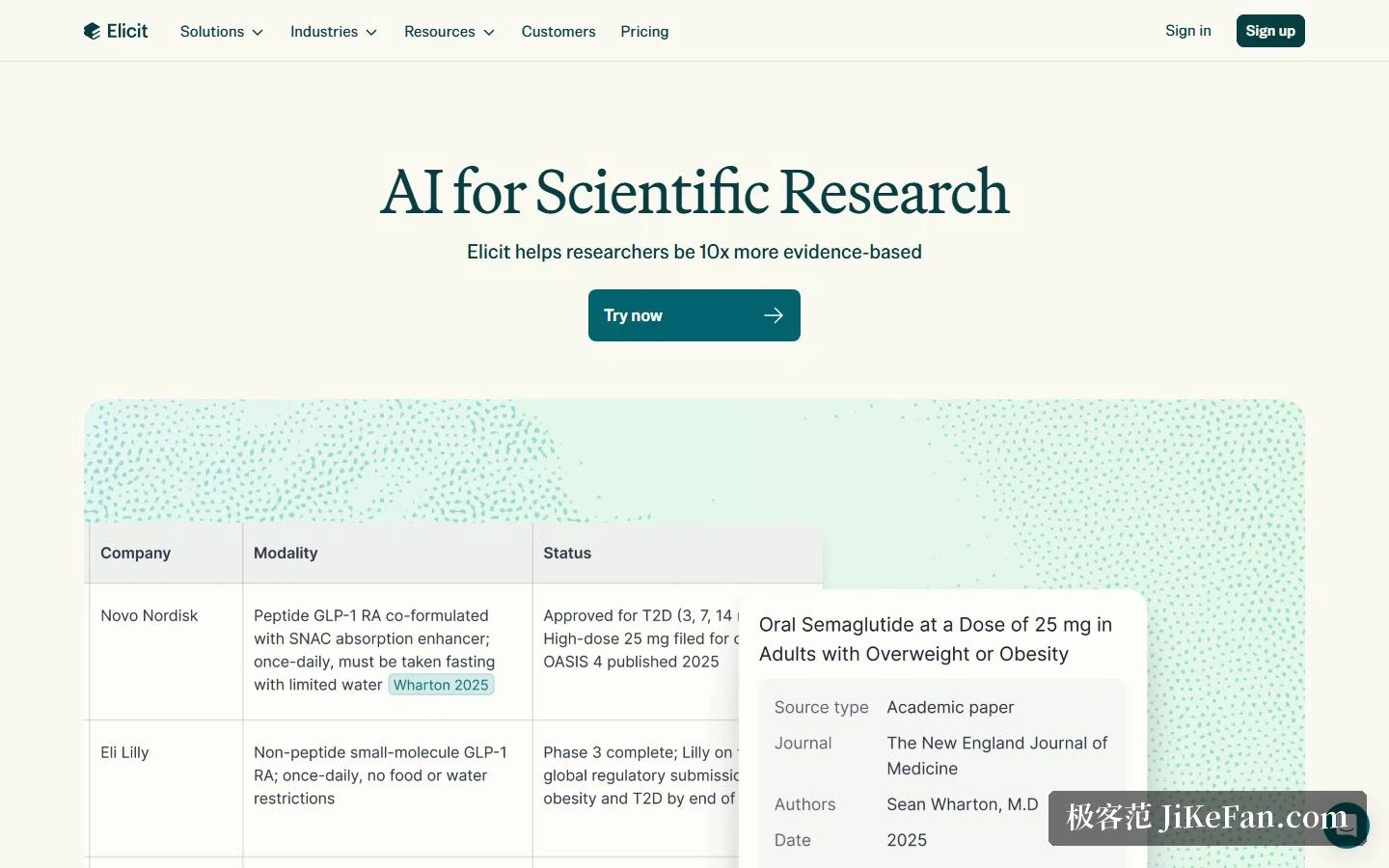
The front page opens with a serif line reading AI for scientific research and a subtitle promising to make researchers ten times more evidence-based. Below the navigation sits a sample drug-research table — company, molecule type, approval status — with a paper citation hanging off every cell. The footer carries the copyright line, and the page claims it is trusted by more than 5 million researchers.
An agent that collects evidence and produces the artefact
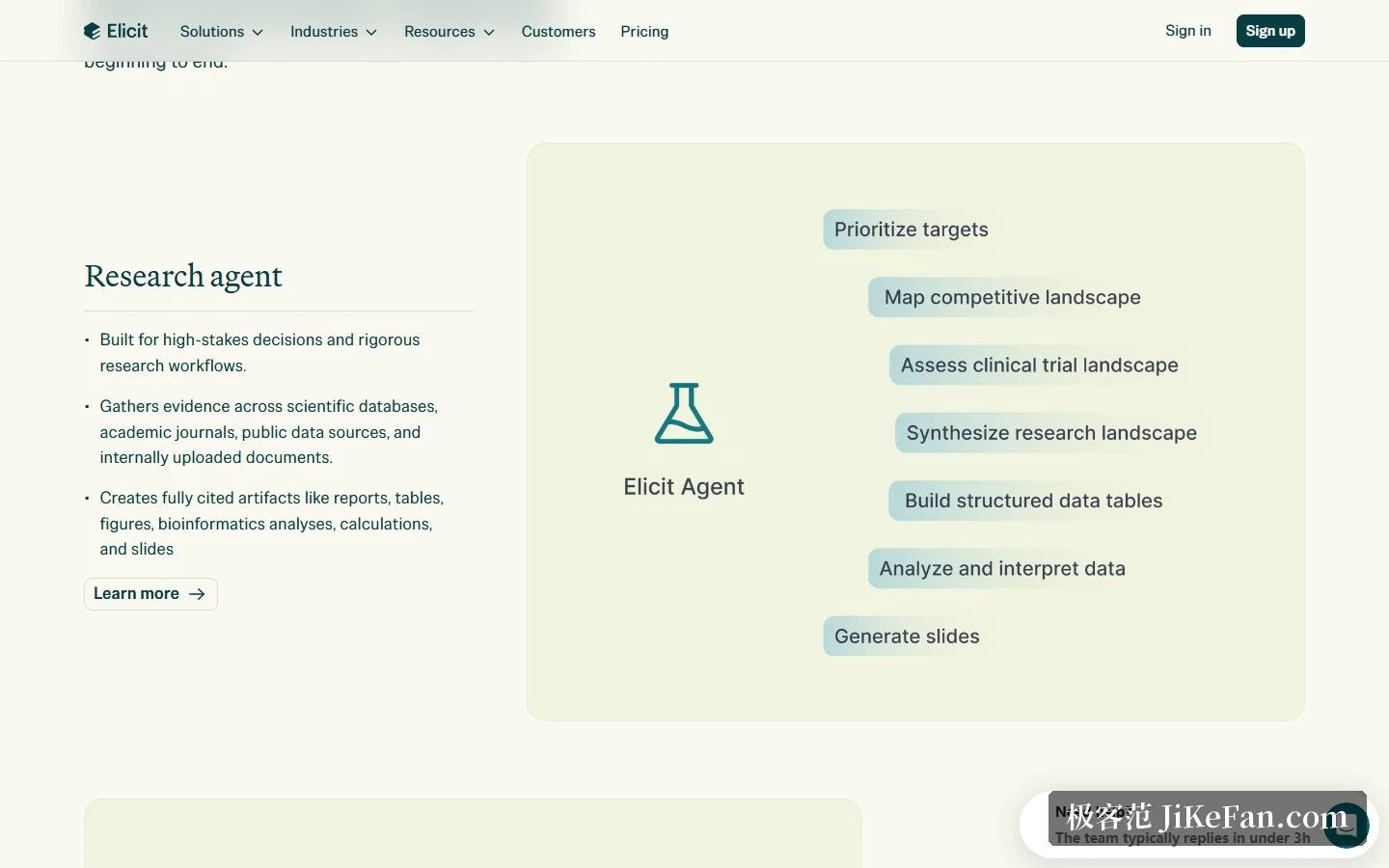
The research agent is pitched at high-stakes decisions and rigorous workflows. It gathers evidence across scientific databases, journals, public data sets and documents you upload yourself, then builds deliverables with citations attached throughout: reports, tables, figures, bioinformatics analyses, calculations and slide decks. In the example, the task labels run from target prioritisation through competitive landscape and clinical trial landscape all the way to generating slides.
Scale, accuracy and the transparency claim
The search figures are stated plainly: more than 138 million academic papers and 545,000 clinical trials, searched semantically so you do not need to guess every keyword, and the company's own blog records beating five other retrieval systems on a biomedical question-answering benchmark. Three differences are then listed. Scale: up to 1,000 relevant papers and up to 20,000 data points in one pass. Accuracy: a validated process behind the extraction. Transparency: every AI-generated assertion carries a sentence-level citation to the original source.
The slowest part of a systematic review, automated
Screening and data extraction can both be automated, and researchers have reported saving up to 80% of the time. On 994 Cochrane reviews, the published evaluation reports 95% search recall, 97% abstract screening, 99% full-text screening and 96% extraction. The case studies are more specific still: a standards body's review extracted 1,502 of 1,511 data points correctly, a 99.4% accuracy rate with 11 times the evidence volume, while a biotech company pulled data from 1,600 papers ten times faster. Library and alerts then turn a single search into a standing collection and a watching brief.
Pricing moves with usage
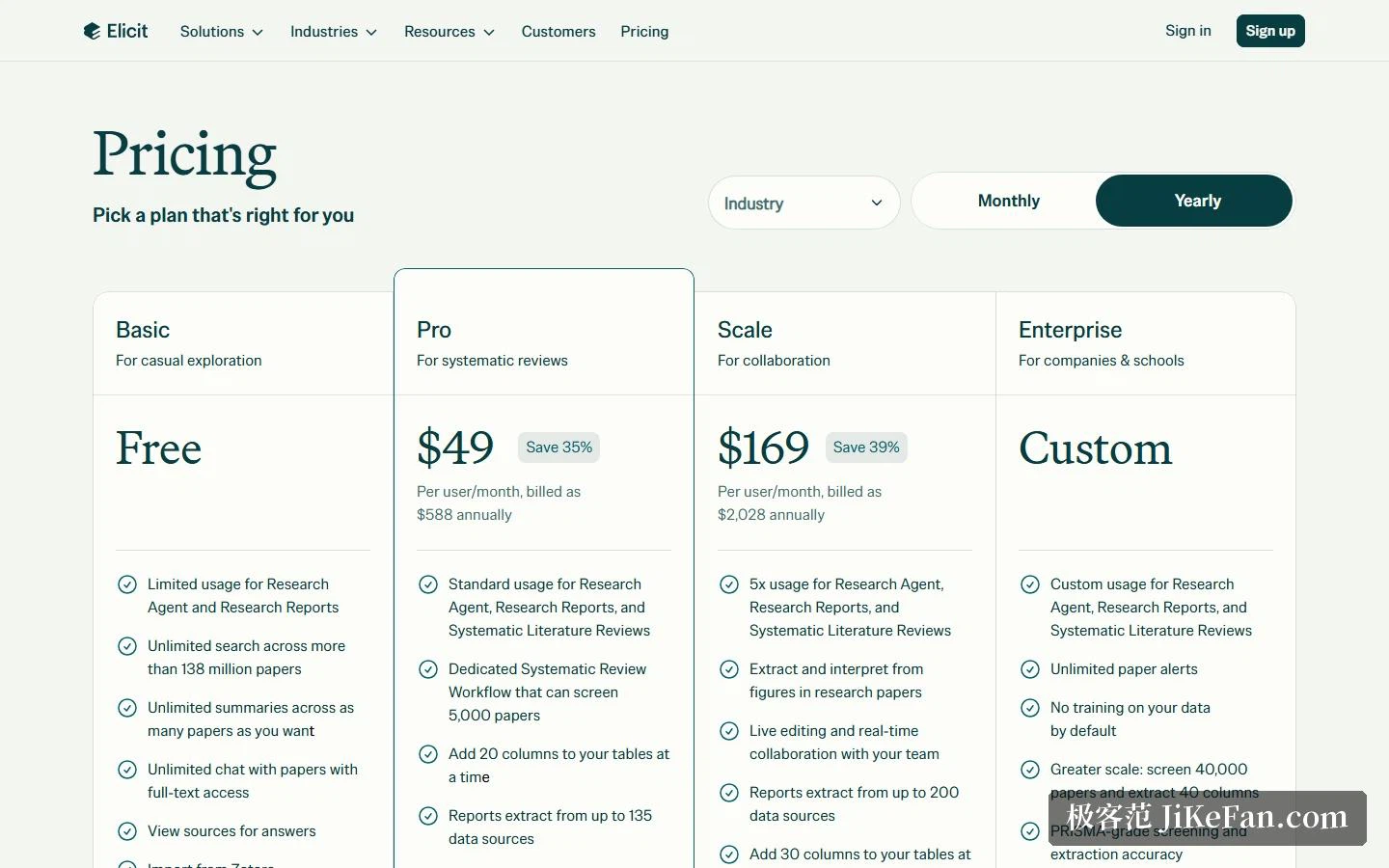
Four tiers. Basic is free: limited use of the agent and reports, unlimited search across the full corpus, unlimited summaries, unlimited chat with papers you have full-text access to, source viewing and reference-manager import. Pro is 49 per user per month, or 588 billed yearly for a 35% saving, and adds a systematic review workflow that screens 5,000 papers, 20-column tables, 135 data sources and API access. Scale is 169 a month with real-time collaboration and 200 data sources. Enterprise is quoted individually, does not train on customer data by default, and supports single sign-on and SAML.
Who it suits
Three audiences follow. Researchers running literature reviews and systematic reviews, for whom screening, extraction and the PRISMA 2020 reporting standard all have an official position. Industry researchers who need to turn evidence into reports and slides, with sector pages and sample reports for pharmaceuticals, medical devices, policy and consumer goods. And heavy readers who want to keep a field under watch, using the library for reuse and alerts for the subscription.
Two honest notes. First, the site returns 403 to plain scripted scraping while normal browsing works, so the facts here were taken from the official pages and pricing table. Second, most capability numbers are the company's own benchmarks and customer cases — the 99.4% extraction figure among them — so cite them with attribution and then verify at small scale on your own task.
Where the free tier stops being enough
Reading the four tiers together tells you what the product thinks its value is. Search, summaries and chat with open-access papers are unlimited even on the free plan — the corpus is the loss leader. What is metered is the part that produces an artefact: the agent, the reports, the screening of thousands of papers, the wide tables, the data sources. So the free tier is enough to explore a field and not enough to finish a review, which is a fair line for anyone deciding whether the tool earns its place.
And on citation granularity, one thing worth being clear about: a sentence-level link tells you the claim is traceable, not that the study behind it was any good. Judging design, bias and relevance stays with the reviewer, which is exactly why the transparency claim is about verification rather than about correctness.
Once citations reach the sentence, an AI-written review finally looks like something that can be checked line by line.