
DeepSeek Harness: an open agent runtime where everything, even the model, is a plugin
Version 20260902
Summary
An open agent runtime in which models, tools, skills, sessions, sandboxes, storage and even the interface are plugins sitting at the same level, with no privileged core. Model independent, with an append-only log of every run and four ready-made modes from a full coding agent down to a minimal shell. Free and open source.
Recommend- Name
- DeepSeek Harness
- Version
- 20260902
- Pricing
- Free
- Open source
- Open source
- Operating system
- WindowsmacOSLinux
- Updated
- 2026-10-05 21:46
A large model can explain a sorting algorithm, draft a migration plan and argue about naming conventions. Ask it to open a directory, read the files, run the tests and fix what fails, and the conversation stops being a conversation and becomes a project. Something has to hand the model an environment, a set of tools, a way to see what happened, and a rule for when to stop.
That something is an agent runtime, and it is the layer this project occupies. It is not another model. It is the scaffolding that lets a model understand where it is, act on it, and keep acting until the work is finished.
Two ways to fail, and the gap between them
The usual choices are equally unsatisfying. Drop the model into a closed framework and something will eventually go wrong, at which point the framework shows a spinner and no explanation of which step stalled. Build the orchestration yourself and every capability has to be wired by hand, which works until the day you want to change one part of it and discover that the whole arrangement assumed the old shape.
This runtime is aimed at that gap. Its central claim is unusual in how literally it is implemented: the model is a plugin, and so is everything else.
Everything is a plugin, nothing has privileges
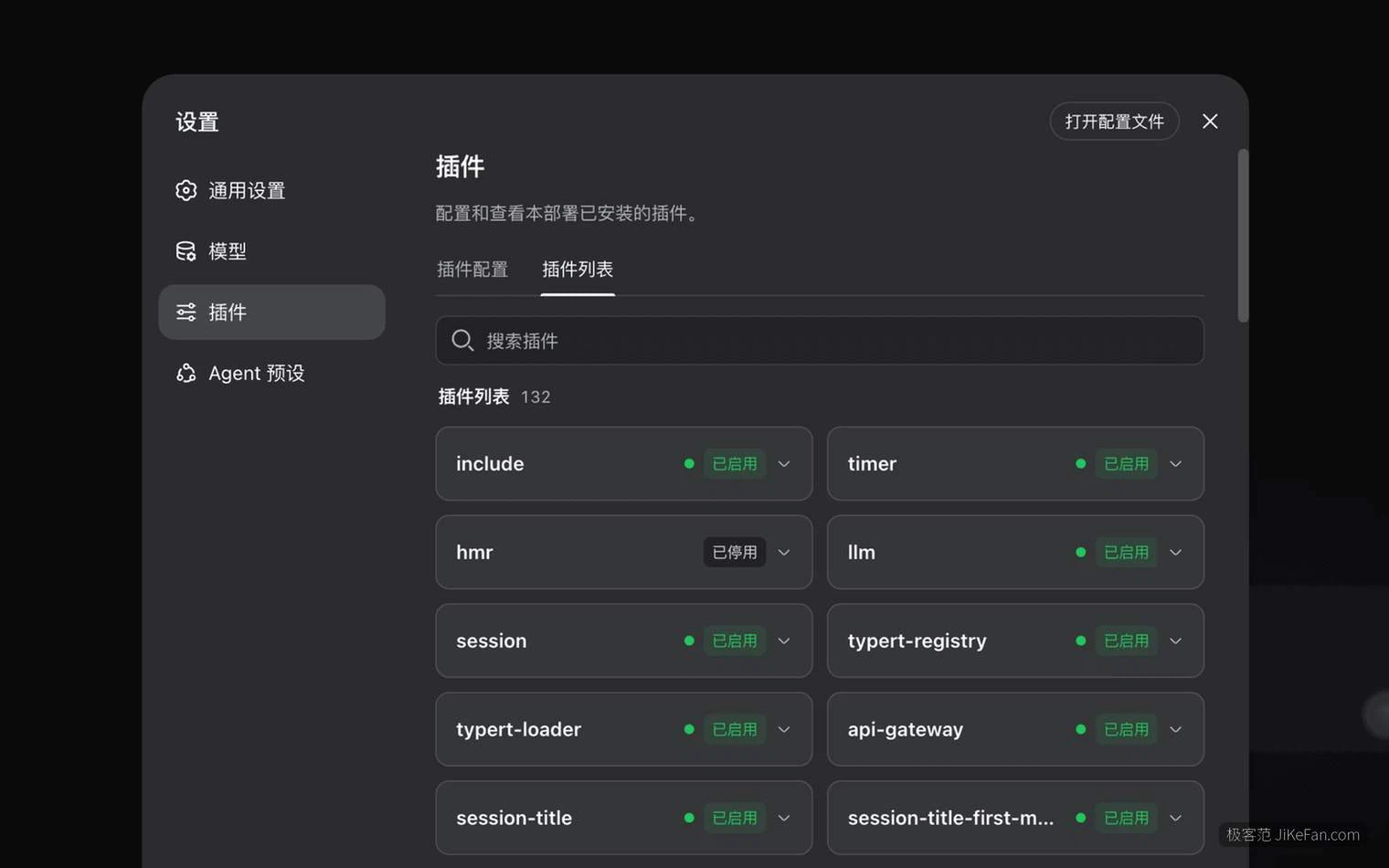
Models, tools, skills, sessions, sandboxes, storage, the agent loop, the scheduler and even the interface all sit at the same level of authority. There is no privileged core that the rest of the system reports to. Underneath sits a small plugin kernel whose only job is loading and unloading components and resolving what depends on what; it holds no agent capability of its own.
The consequence is practical rather than philosophical. Replacing a stage does not mean editing source. It means changing a line of configuration. The loop that decides what the agent does next is itself a component, so a different loop can be substituted without forking the framework. Instead of forking a project to reshape it, you reassemble it from the outside.
Not married to one provider
Nothing in the design assumes a particular model. The vendor's own models are the obvious starting point, but dozens of external providers can be attached, and a sub-agent can even be delegated to an agent belonging to a different supplier. Swapping the brain behind the same tooling is a configuration matter, which is the whole point of treating the model as just another component.
The project is published under a permissive open licence, appeared as a developer preview in the summer of 2026, and gathered a large following in a short time. A browser interface can be brought up with a single command once a runtime is present, and a portable build exists for people who would rather not configure anything locally.
Every run leaves a trail
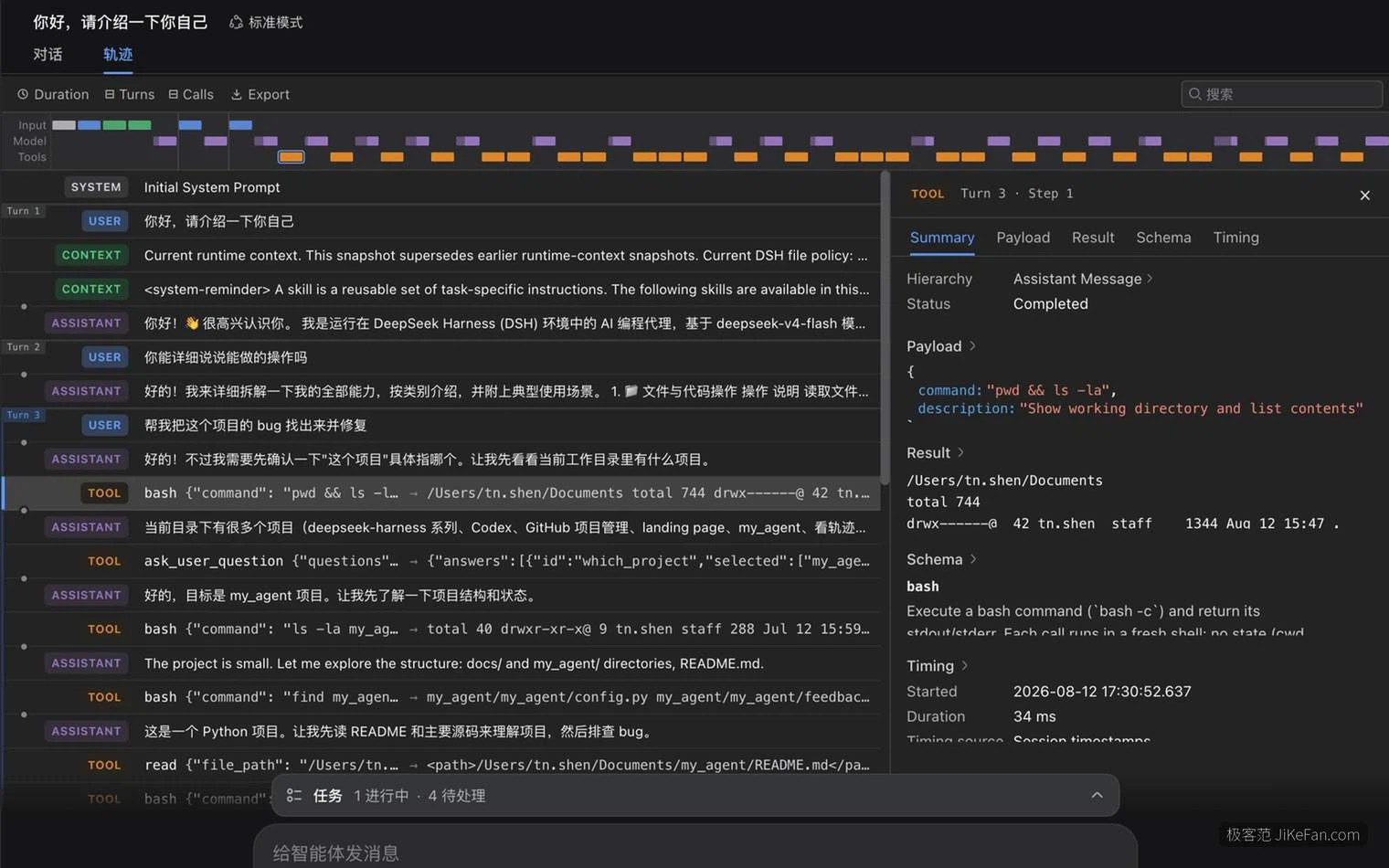
The deepest problem with a closed agent framework is that it cannot be inspected. Here everything the model was shown is written into an append-only session log: the system prompt, the chain of reasoning, each tool call with its result, the scheduling of sub-agents, every piece of context that was injected along the way.
A dedicated view lists those entries by origin, so a run can be replayed in order and the question of where exactly it went wrong can be answered rather than guessed. For anyone hoping to put an agent into production, that is not a convenience; it is the price of admission.
Four modes, from complete to almost empty
A standard mode provides a full coding agent: editing files, a shell, search, skills and sub-agents. A second mode exposes the tools as a software development kit so the model can compose several steps inside one short program instead of a long chain of separate calls. A minimal mode keeps only a persistent shell and a single text editing tool, which is exactly what a benchmark of the smallest possible environment needs. A fourth mode exists to inspect the runtime itself, try plugins in memory, and then assemble a new mode of your own from what survived the experiment.
Read together, the modes describe a spectrum rather than a product tier. The same runtime can be a busy colleague or a laboratory bench, and moving between the two is a matter of picking different parts.
Worth an afternoon
The project is free and open source. Its interest is not that it does something no other agent can do, but that it takes apart the machinery every agent needs and makes each part replaceable. If you have ever wanted to know why an agent stalled at step nine, or wanted to change the shape of the loop rather than work around it, an afternoon with this one is time well spent.