
AutoCAD Review: The Format Consensus Behind Every Drawing
Summary
Engineering collaboration runs on drawings, and drawings run on a format. AutoCAD has held its position half on capability and half on ecosystem: its native format is the shared language between design offices, contractors and review bodies, and layer, block and reference management is mature to the point of instinct.
Recommend- Name
- AutoCAD
- Version
- 20260922
- Pricing
- Paid
- Open source
- Proprietary
- Operating system
- WindowsmacOSWebMobile
- Updated
- 2026-10-07 16:31
The consensus a drawing format carries
Engineering collaboration is built on drawings, and the collaboration only works because everyone opens the same file and sees the same lines. That sounds like a trivial statement until you consider what it takes to guarantee it across a design office, a contractor, a client and an inspection body, each running different software versions on different machines in different cities. A shared format is the invisible infrastructure underneath all of it, and switching costs are measured not in licence fees but in the number of organisations that would have to agree to switch at once.
AutoCAD has held its position for exactly that reason, half capability and half ecosystem. Its native format became the working language of drawing exchange, which means the value is not only in what the program can draw but in the fact that everyone else can open it. For a firm, that is a hiring argument as much as a technical one: the pool of people who already know the tool is large, and training someone in a different program means training them in a different vocabulary than the one their collaborators speak.
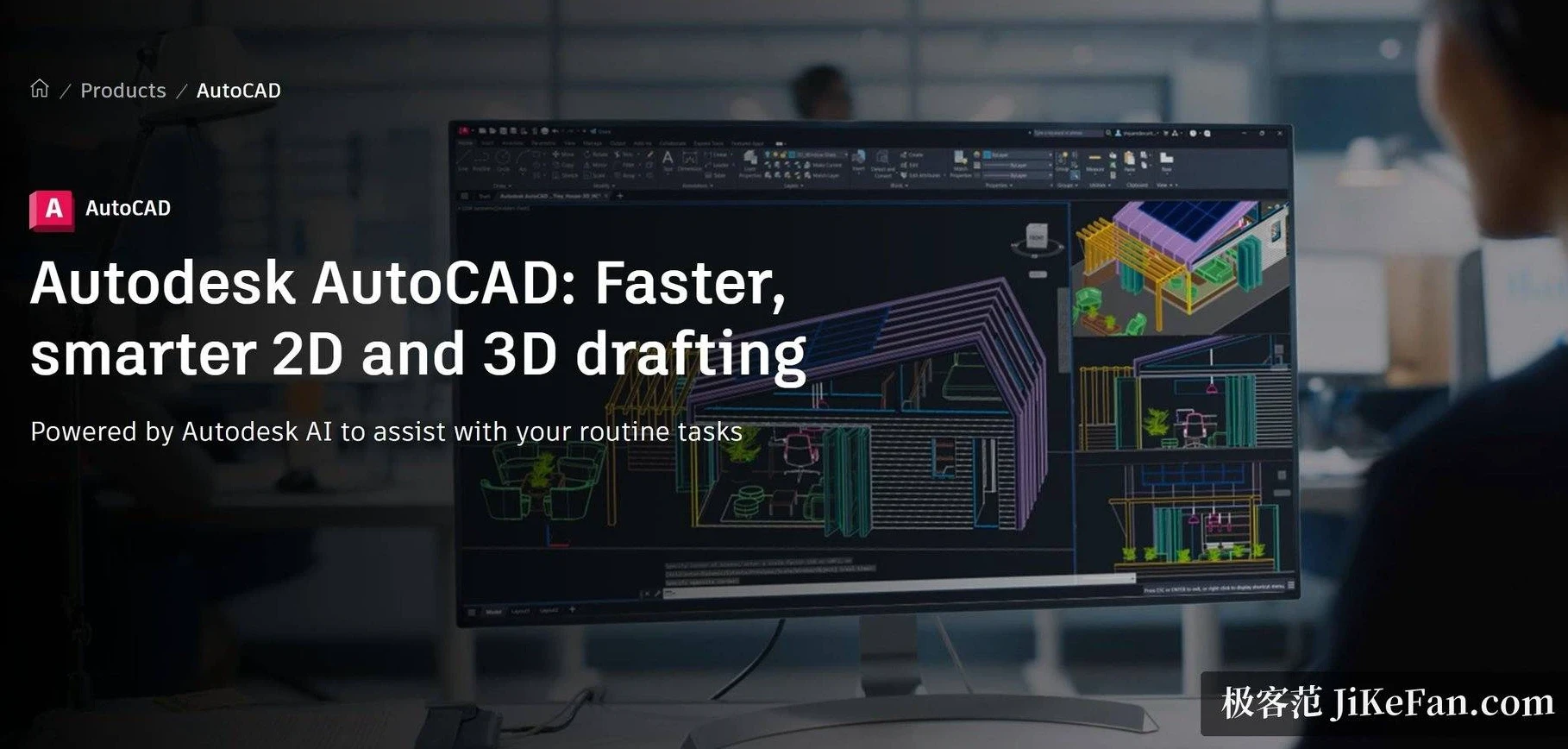
The functional foundation underneath is genuinely mature. Two dimensional drafting with a precise annotation system is where the program earned its reputation, and layer management, blocks and external references are handled at a depth that experienced users stop noticing, because the model has become habit.
From a general base to trade specific toolsets
On top of that general base, the subscription includes toolsets aimed at different trades, and this is where the program stops being one thing. The architectural set brings walls, doors, windows and room annotation. The mechanical set brings standardised part libraries and bills of materials. The electrical set has its own conventions for circuits and panel layout. Each is a layer of domain vocabulary over the same core, which is why a firm can hire across disciplines without buying four unrelated products.
Three dimensional work covers modelling and visualisation, and cloud collaboration lets drawings move between devices and between roles without a file transfer ritual. Recent versions have woven assistance into the drawing process itself, so repeated elements are recognised and placed with less manual effort, which is a modest improvement in a task measured in thousands of repetitions.
Licensing is a yearly subscription, and students and educational institutions can apply for an educational licence. That last point is worth stating plainly, because it is how the format consensus renews itself: the people learning the vocabulary today are the ones specifying it in ten years.
A note on cost, because it is the honest objection. A yearly subscription for a drafting seat is real money, and for someone who draws occasionally it is hard to justify. The counterweight is that the format access is the product: paying for this is paying to be legible to everyone you work with. Firms that treat it as infrastructure rather than as software tend to make the right call.
The standing of AutoCAD was not earned by a single feature but by decades of format consensus and trained people: learning it means learning to speak with an entire industry.
How to learn it without wasting a year
For someone entering the field, layer management and annotation standards should come before anything showy. They are the difference between a drawing that communicates and one that merely looks finished, and they are also the part that colleagues judge immediately. After that, blocks and external references repay the effort many times over, because they are how a drawing stays maintainable when it grows.
For teams, standardise the version and the template files. Version drift between collaborators produces the kind of small inconsistencies that cost hours to find and minutes to fix once located. Lightweight viewing and simple markup are served well by the web and mobile versions, while serious drafting still belongs on the desktop. The more standard the tool, the lower the cost of handing work over, and in this industry handover is the work.