
ClearURLs: it cuts the tracking tail off a link before you share it
Summary
An open source browser extension that leans on a community maintained rule library to strip tracking parameters out of addresses in the background. It cleans a whole list at once, copies a clean link straight from the context menu, blocks link auditing and redirection hops, and sits there so lightly that you forget it is running.
Recommend- Name
- ClearURLs
- Version
- 1.27.3
- Pricing
- Free
- Open source
- Open source
- Operating system
- WindowsmacOSLinux
- Website
- https://docs.clearurls.xyz
- Updated
- 2026-10-06 14:22
The little tail on a link should have been cut long ago
Copy the address of a product and send it to somebody, and the bar is usually dragging a long string of characters nobody can read: a channel of origin, an advertisement number, a click identifier. None of these fields has anything to do with the content of the page. Their only job is to record where you came from and what you touched. One small tail looks harmless, but gathered together they can be assembled into a fairly complete picture of where a person goes. ClearURLs is an open source browser extension that quietly strips these tracking parameters out of addresses in the background, so a link goes back to the shape it was meant to have, the record of what you did keeps one channel fewer, and what you pass on is short enough to read.
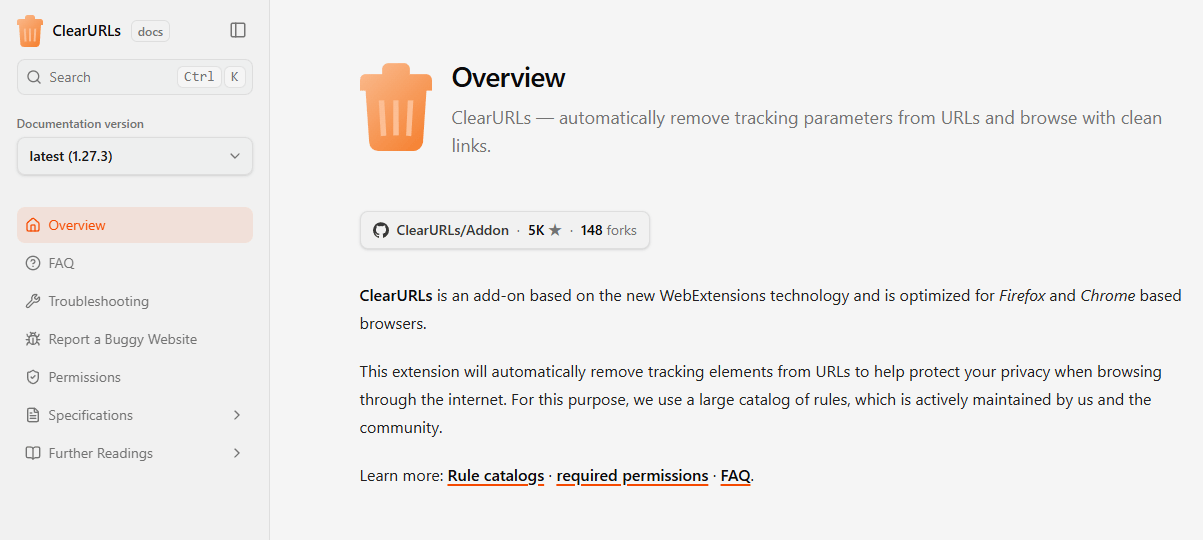
Cleaning driven by a library of rules
Inside sits a catalogue of rules maintained by the developer together with the community, and it covers the way a great many familiar sites write their tracking fields: the long recommendation codes on shopping links, the channel marks on news links, the redirections that social sites put in the way. When a rule matches, the cleaning happens quietly before the page loads, with nothing for the user to press. The library is kept up to date, and a new pattern can be sent in through the community. Beyond taking parameters apart, it also blocks the domains that serve a great deal of advertising, stops the auditing of links and the injection of tracking through history interfaces, which are the quieter methods, and points a link that would have gone through a tracking service straight at its real destination, which saves a detour in the route and gets the page open sooner.
Cleaning in bulk, and copying in a hurry
A small tool in the toolbar takes a whole list at once: paste in several addresses full of parameters and a tidy set of clean ones comes back, so people who handle links by the dozen for promotion or operations no longer delete fields by hand. The menu behind the right button has an entry of its own, so copying a link copies the cleaned version directly and what is passed on is short and does not hand over the place you came from. A statistics panel counts how many requests have been cleaned altogether, which gives the small satisfaction of having done a good turn in passing.
Light, open, and possible to check
The whole extension is published under a permissive open licence, the source sits in the official repository, and the files of rules are open to inspection, so what it does and what it does not do can both be verified. It takes very little in the way of resources and sits in the background with almost no presence at all. One thing is worth knowing: on a few sites a particular parameter is carrying a function of the page, a session identifier being the usual example, and in an individual case the page may have to be opened again after cleaning. When that happens, the rule for that site can be switched off in the settings. As of September 2026 the project and the versions carried on by its community still maintain the rules, users of one of the major browsers are served normally, and the other family is going through a change in the way extensions work, so its next releases are the thing to watch.
Who ends up keeping it installed
Anyone who sends links to other people for a living will notice the difference within a day, because the addresses stop being three lines long. Anyone who would rather not be followed from page to page gets the quieter benefit, which is that the record has fewer places to join up. It is not a shield against everything, and it was never meant to be: what it removes is the part that travels in the address itself, in plain sight, which happens to be the part most people never look at.