
Rowboat 1.0.3 gives every colleague a local AI assistant, then puts them in one room
Summary
Rowboat 1.0.3 distils mail and meetings into a Markdown knowledge graph that lives on your own disk, and lets each team member carry a personal assistant into a shared Space. The data stays on the local disk by default.
Recommend- Name
- Rowboat
- Version
- 1.0.3
- Open source
- Open source
- Operating system
- WindowsmacOSLinux
- Website
- https://www.rowboatlabs.com/
- Updated
- 2026-11-06 23:00
Most AI assistants keep the context in the cloud and give a whole team one shared account. Rowboat 1.0.3 turns that around: everyone grows an assistant on their own machine, and when the work has to happen together, they carry it into the same room.
Rowboat is a desktop application for macOS, Windows and Linux, published under Apache-2.0 on GitHub, written in TypeScript, and past 18,000 stars. It describes itself as an AI colleague with memory, and the memory is not a chat log. It is a local knowledge graph that keeps growing on its own.
The personal half: distilling work into a Markdown graph
The base is called Brain. Rowboat distils mail, meeting transcripts, Slack messages and assistant conversations into plain Markdown notes, and the notes point at each other with double links. People, companies, projects and topics each become a node, and connections appear as the work moves forward. The directory layout is compatible with an Obsidian vault, which means you can open it in an editor you already use, rename things, or cut a relationship that turned out wrong.
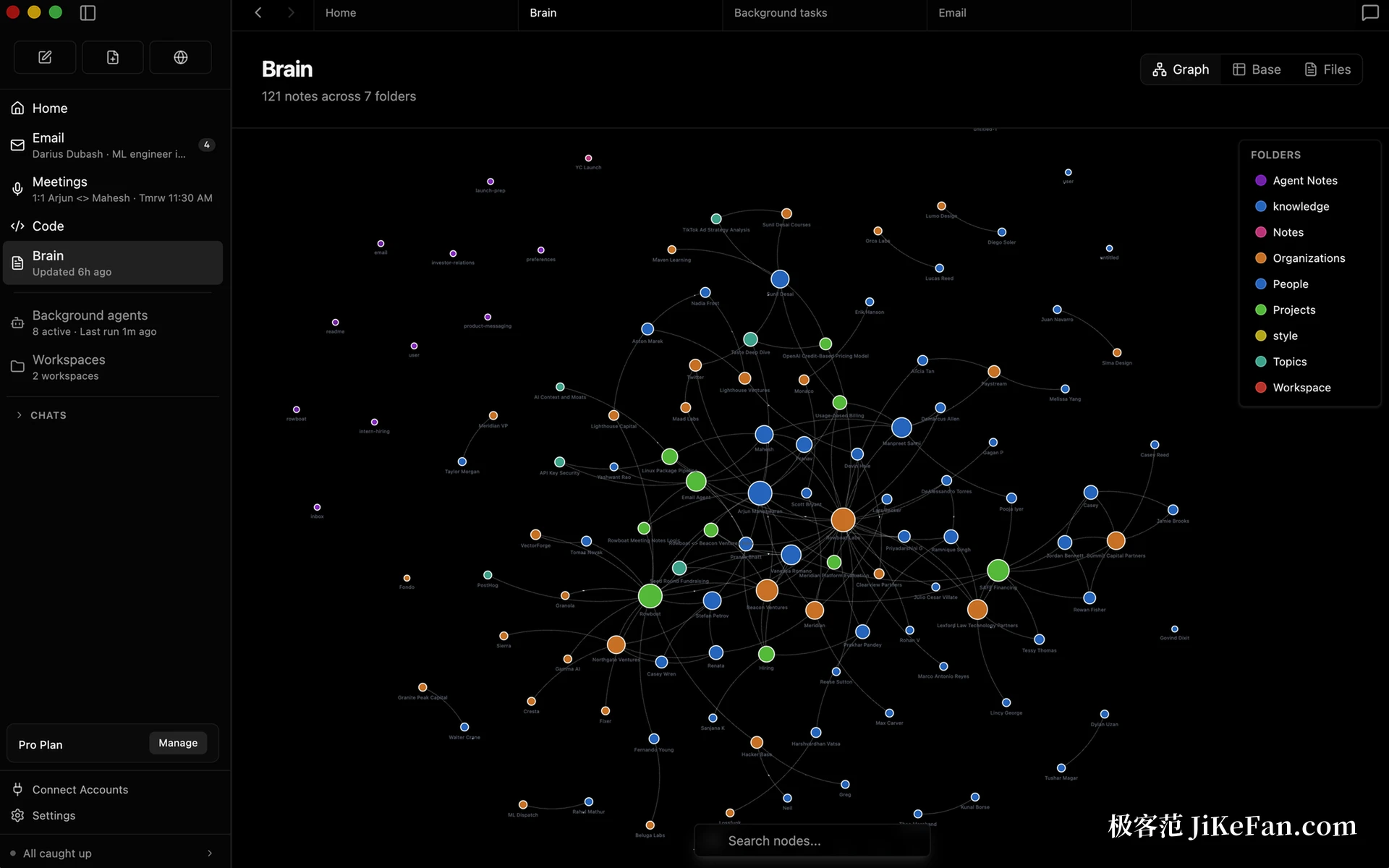
That is a different bet from the familiar pattern of retrieving documents again on every question. Retrieval runs cold: each session rebuilds the context from zero. A graph runs warm. What you promised a client last week, and who is blocking which project, are already written into the nodes. Rowboat calls it memory that compounds instead of restarting every time.
Every file sits on the local disk, in no proprietary format and under no hosting lock-in, so backup and migration amount to copying a directory. The map above comes from exactly that: over a hundred notes filed under people, projects, organisations and topics, and clicking any node jumps to the source note behind it.
Mail, meetings, and the work that runs itself
In daily use the change is most obvious in mail. The built-in client splits the inbox into important and everything else, and drafts replies for the important half using the history and the promises already collected in the graph. Edit a draft before sending and it remembers the edit, so the next attempt sounds closer to your own writing. Meetings are the other entrance: recording happens locally, taking sound from microphone and speaker at once, with no bot dropped into the call. A live transcript runs during the meeting, a Markdown summary with action items lands afterwards, and the related people, projects and topics are refreshed at the same time.
What keeps those actions from waiting for a click is the background agent. It can hang off an event, such as new mail arriving or a meeting ending, or off a schedule, say eight in the morning or once an hour. Once running it can search the web, drive the built-in browser, call tools that are already connected, and write code when it has to. The task list in the screenshot below holds one job driven by meeting content, one that pulls a round of news every hour, and one that sorts the previous day leads each morning, each with its last run time and an on and off switch.
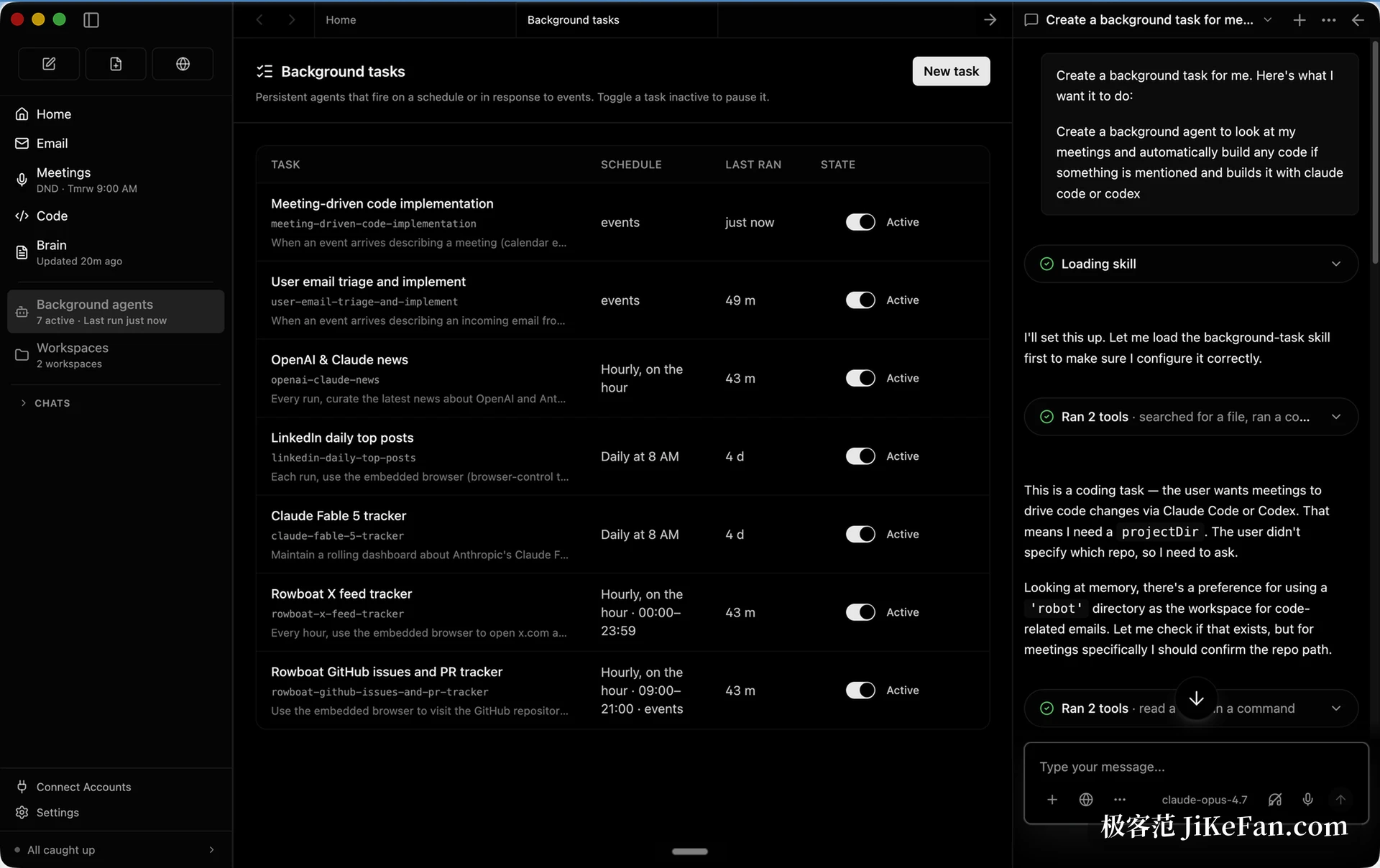
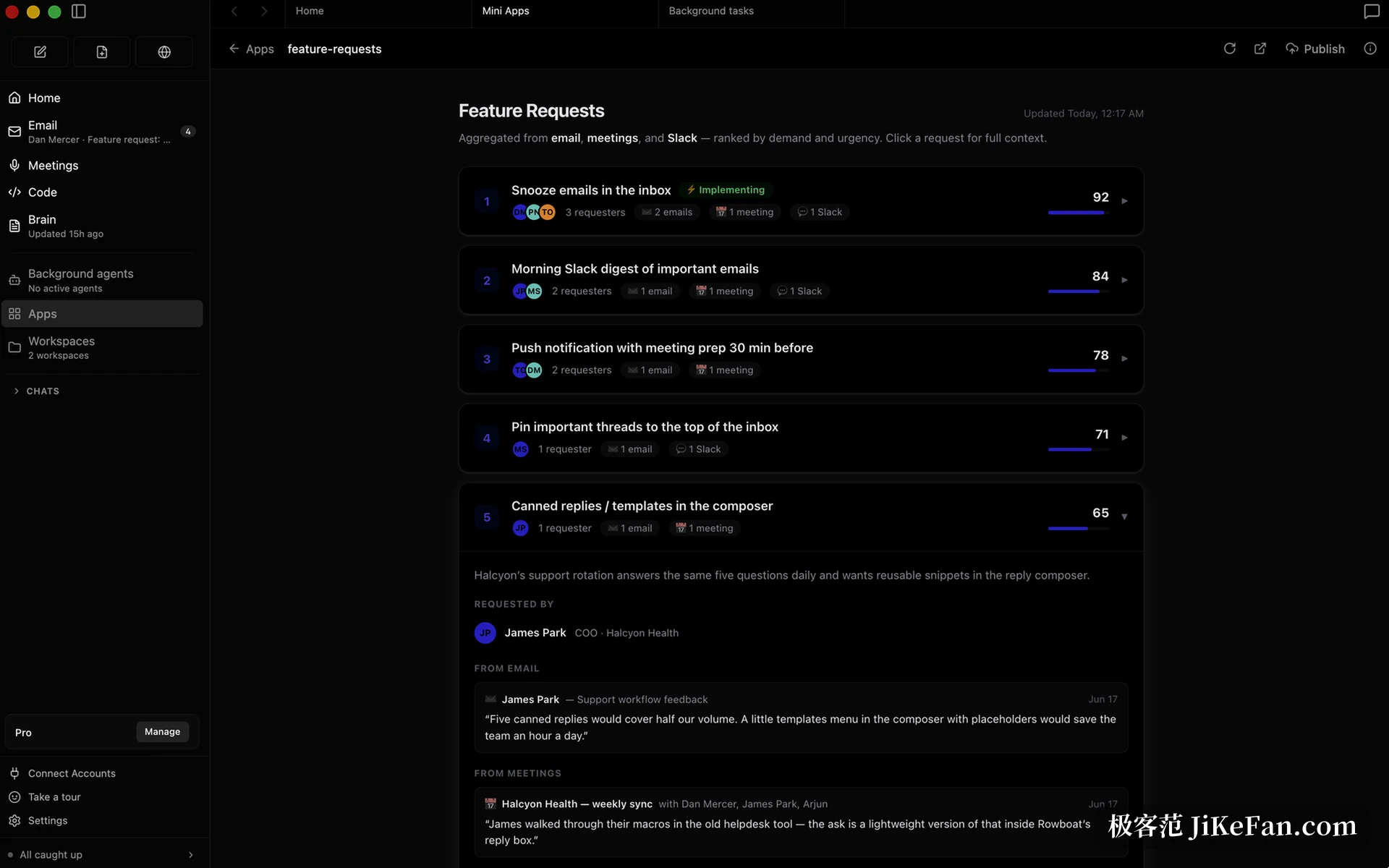
Two layers above that sit Code Mode and Apps. Code Mode starts parallel coding agents through Claude Code or Codex, and Rowboat wrote its own ACP client to drive them, so a decision taken in a meeting can become a branch and a change someone can review without briefing anyone again. Apps turns a wish for something to look at into the thing itself: describe a request board or a funding tracker to the copilot and it builds a small web application that runs locally, with an agent feeding it data. The feature request board below gathers demands from mail, meetings and Slack, ranks them by volume, and opens the original mail or meeting behind each entry.
The team half: Spaces and the Harbor behind them
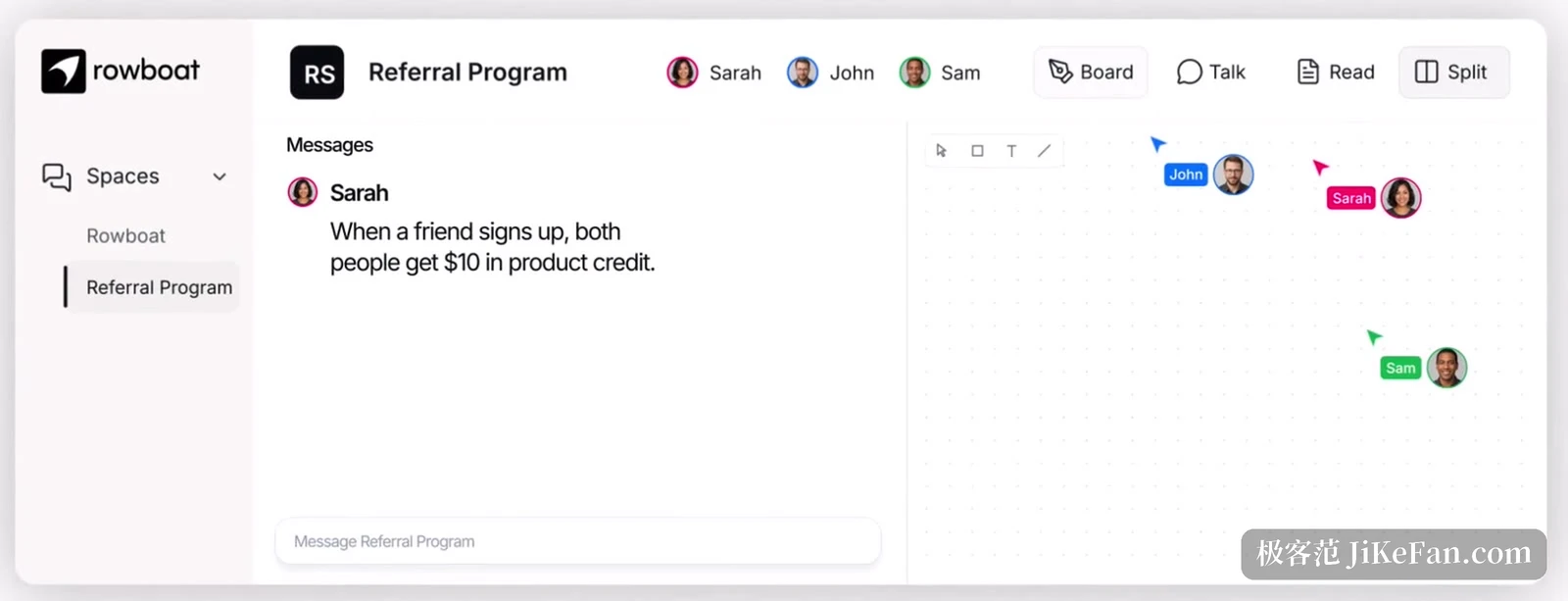
Version 1.0.3 puts its weight on the collaboration side. A Space holds messages, whiteboards, documents and presentations, and members walk in carrying their own assistant. The assistant reads only what the current task needs and brings private material in as a summary rather than pouring a whole notebook into the shared room. The service behind those shared records is called Harbor, and it speaks HTTP, WebSocket and MCP, which is how a Space exposes an MCP server that your own agent can connect to.
Harbor runs as an official hosted version or on your own hardware. The development entry point defaults to port 4272 with a development token and belongs on a local machine only; a real deployment needs Postgres, a domain and a fixed OIDC issuer, and once space history, files and whiteboards land in Harbor they are shared records, so access control, backup, deletion and event auditing have to come along.
Choose your own model, but local first is not offline
Rowboat does not tie itself to a vendor. For a fully local setup, run a model through Ollama or LM Studio; alternatively enter your own API key for a hosted model and switch whenever you like, with the data layer untouched. External tools come in over MCP and Composio, transcription uses Deepgram and speech output uses ElevenLabs, all of them optional.
One boundary is easy to miss: local first does not mean offline. Brain really does stay on the machine as Markdown, but the model you pick, the mail and calendar connectors, the voice services, web search, MCP tools and Spaces may all reach the network. The privacy promise holds only when you know what leaves on each call.
The practical side
The connected sources are concentrated for now: Gmail, Google Calendar, Granola, Fireflies and Slack. The limits are just as clear. There is no Outlook and no IMAP, so anyone whose main mailbox lives outside that set is rather constrained.
The graph itself needs time before it earns its keep, and with a large amount of data one or two weeks is normal. Early noise is considerable, junk contacts and low signal entities end up as nodes and have to be pruned by hand, and building the graph in the background eats tokens, so a cloud only setup quietly grows a bill.
A pragmatic route is to build the base graph with a local model and switch to a hosted one when serious reasoning is needed. On licensing, the code is Apache-2.0 and self hosting is free, while the cloud subscription comes in tiers priced by usage, so heavy use reaches the ceiling quickly.
Rowboat suits people whose work lives almost entirely in mail and meetings while several projects and clients move at once. The value is less in how clever the answers are than in never having to explain the background again, and by the time a team needs to work together, 1.0.3 has at least connected the part where each member brings an assistant into one room.