
BlackArch Linux: a security research distribution built around 2865 tools
Summary
BlackArch Linux is a security research distribution on an Arch base with 2865 tools in its repositories, and it can be added to an existing Arch install instead of replacing it.
Recommend- Name
- BlackArch Linux
- Version
- 20260922
- Pricing
- Free
- Open source
- Open source
- Operating system
- Linux
- Website
- https://www.blackarch.org/
- Updated
- 2026-10-05 03:02
A tool repository built on top of Arch
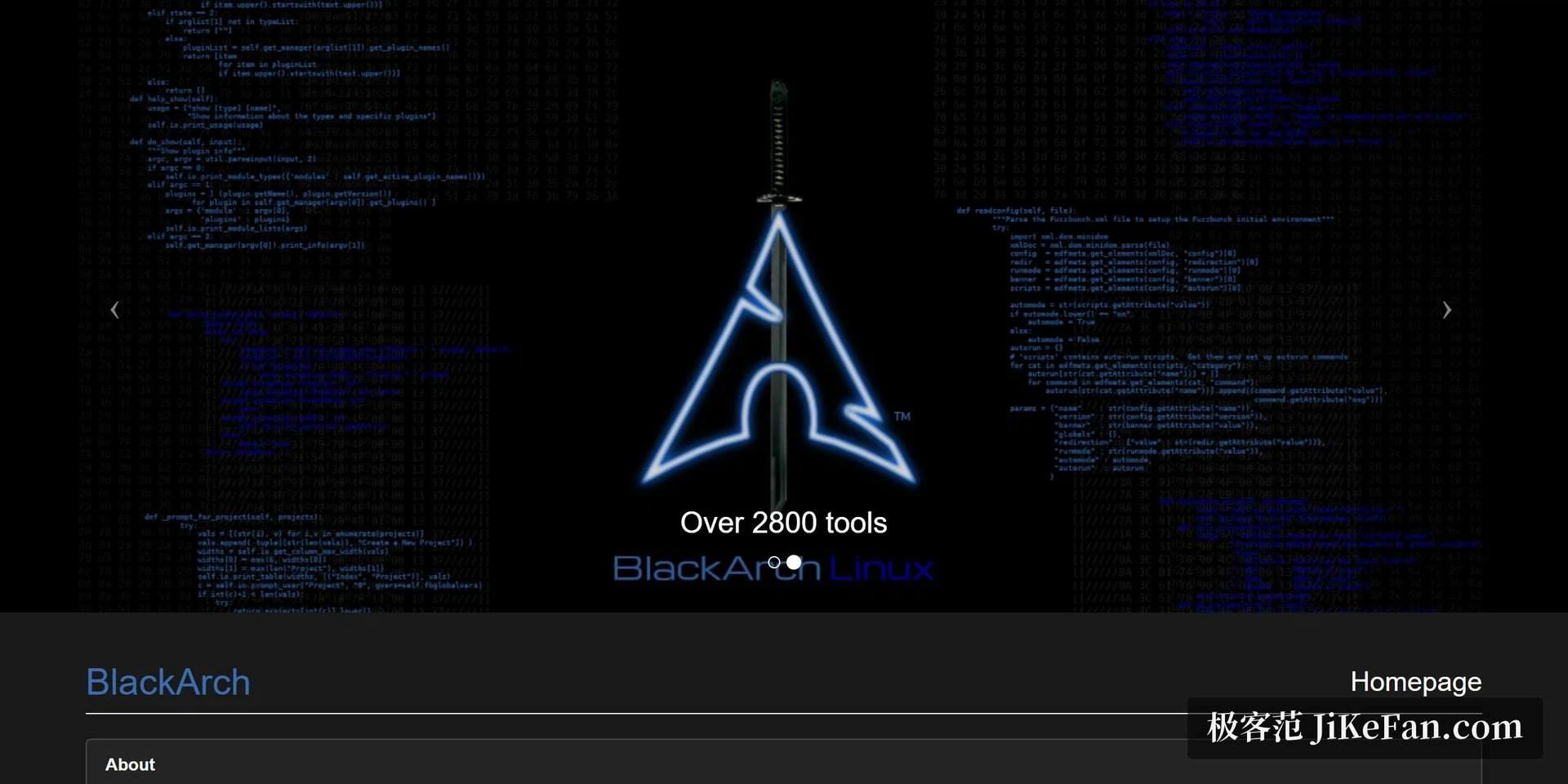
Among people who work in security research there is a shorthand. One distribution is described as a complete kit that arrives ready to use, and BlackArch is described as an armoury you draw from. It is built on Arch Linux, and its repositories hold 2865 tools organised into several dozen professional categories: information gathering, vulnerability analysis, reverse engineering, forensics, wireless work and more. No comparable distribution carries a larger collection.
The rolling release model of Arch is part of the argument rather than a side note. Tools follow their upstream versions instead of waiting for the next release cycle, which matters when a method depends on behaviour that changed two months ago. For a researcher who needs the current version of a specific utility, that is a real advantage and not a slogan.
Two ways to get it
The most flexible part is that a reinstall is not required. On an existing Arch machine, the official setup script adds the repository, and from there the package manager handles the rest: individual tools can be pulled in one at a time, or a group such as the web application set can be installed in a single pass.
For a standalone deployment the project publishes three images, a full one, a slim one and a network installer. The latter two are the recommended route, because a full install followed by rolling updates tends to produce conflicts that have to be untangled later. There are also virtual machine images prepared for the common hypervisors, which import and run, and those are the quickest way to build a throwaway environment for an experiment.
Written for people who already know the terrain
The entry threshold is real. The default window manager is a minimal Openbox, the graphical installation helpers are limited, and the documentation assumes a reader who is comfortable on the command line. Memory use at idle sits around 330MB, which is unexpectedly light for a collection of this size but does not make the system easier to learn.
The distribution assumes a user who already understands how Arch works and who knows which of those 2865 tools is the right one for the problem in front of them. That assumption is the filter, and it is deliberate: a curated menu of friendly applications would defeat the purpose of having the whole armoury available.
The boundary that has to be stated first
Tools of this kind belong on systems you own or are authorised to test, and nowhere else. Permission is not a formality here but the line between research and an offence, and the professional literature on the subject treats it the same way. The same applies to test environments: an isolated lab machine is the place to learn, not a network somebody else depends on.
For anyone who meets both conditions, this is currently the platform with the widest coverage of tools in one place, and the fact that it can be attached to an existing system rather than replacing it makes the decision much smaller than it looks.
Which route to take
The choice between the two routes is mostly about what kind of machine it is. On a working laptop used for everything, adding the repository to an existing Arch install keeps one system to maintain and one set of updates to watch. On a machine kept purely for testing, one of the reduced images is better, because it starts from a known state and can be thrown away afterwards without losing anything that mattered.
There is also a maintenance cost to be honest about. A rolling repository of this size changes often, and a machine that is only switched on twice a month will face a large update when it does. Treating it as a lab rather than as a daily driver is the arrangement most people end up choosing, and it keeps the tool collection out of the way of ordinary work.
BlackArch has never positioned itself as a friendly introduction for beginners. It is an ammunition store for professional researchers: rolling updates, take what you need, and blend into the Arch system already in place. The high threshold is the selection mechanism, and the breadth of the collection is the moat.