
Manjaro: Arch Without the Command Line Before Breakfast
Summary
Manjaro is a desktop Linux distribution built on Arch. It wraps the parts Arch leaves to experience - a graphical installer, graphical software management, a tool for hardware drivers - and keeps the rolling repositories underneath, so a machine can keep updating without a reinstall.
Recommend- Name
- Manjaro
- Version
- 25.0.8
- Pricing
- Free
- Open source
- Open source
- Operating system
- Linux
- Website
- https://manjaro.org/
- Updated
- 2026-10-05 18:27
Making Arch approachable
Manjaro is a desktop Linux distribution built on Arch. Arch is known for two things: a small, explicit system, and a rolling model in which software arrives continuously instead of in numbered releases. Both qualities come with an assumption - that whoever installs it knows what they are doing - and the installation and the upkeep are exactly where that assumption bites. Manjaro's approach is to wrap those stages. Installation runs through a graphical guide. Software is managed from a graphical interface. Hardware drivers have a tool of their own. Underneath, the Arch repositories and the rolling model are still there, which is the point: the convenience is a layer, not a replacement.
That distinction matters more than it sounds. Wrapping a distribution usually means freezing it, so that a friendlier surface comes with an older and slower-moving base. Here the base keeps moving, and what has changed is who does the folding. The user no longer assembles the system from instructions; the user still receives updates on the same schedule as anyone on the base.
Official editions, chosen by desktop
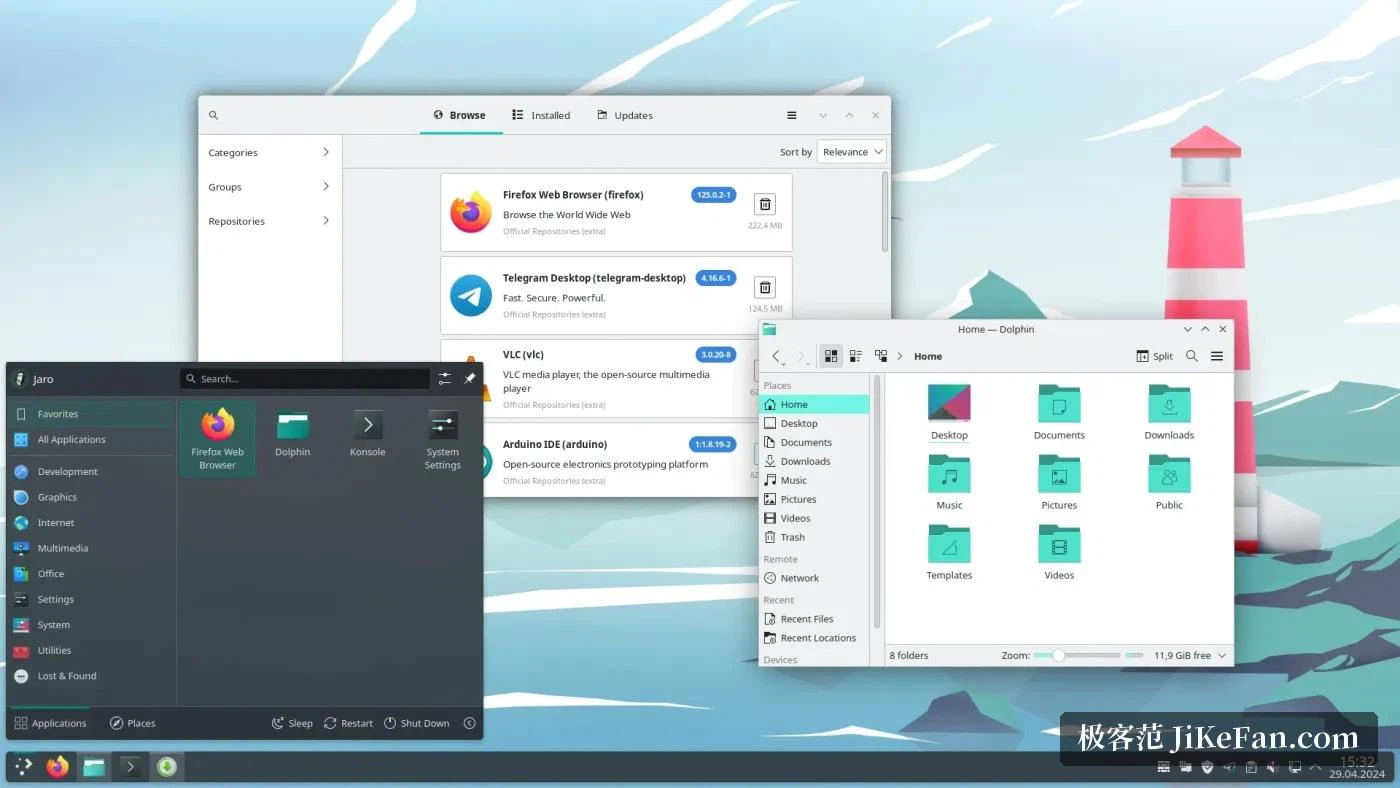
The official editions are preconfigured, and the main difference between them is the desktop environment. The Xfce edition is the lighter of the three and suits a machine with modest resources. The KDE Plasma edition carries the most features and the most customisation. The GNOME edition offers a different interaction style altogether, with its own logic about where things live. Beyond the official three there are community editions covering further desktop environments and window managers, which is where someone with a specific preference usually ends up.
The published minimum is roughly 1GB of memory and 30GB of disk space. Treat that as a floor rather than a target: a desktop that only just fits inside the minimum has no room left for the caches, the browser profiles and the local data that accumulate in the first month, and the machine will feel worse than its hardware deserves.
Rolling updates, and rolling back
A rolling release means no reinstalling every half year and no major-version upgrade with its own set of migration notes. Software and system components are pushed continuously. The price is maintenance done more regularly rather than in a single annual burst: read the announcements before updating, and deal with a dependency or driver problem when it appears instead of accumulating several of them. Deferring is the failure mode here. A machine updated once a year on a rolling base is not a machine that receives a year of changes; it is a machine that receives a year of changes at once.
To lower the risk, the choice of filesystem at installation time does real work: a filesystem with snapshot support, combined with a snapshot tool that takes an image before and after an update, allows a failed update to be rolled back to the last state that worked. That is the difference between an incident and an afternoon. It is worth setting up before it is needed, because the moment it is needed is the moment it cannot be set up.
Tools and the current series
A few things get used in day-to-day upkeep. A graphical package manager handles searching, installing and the management of updates. A hardware driver tool identifies graphics and other devices and installs the appropriate driver. The kernel itself can be switched in the system settings, which is useful when a newer kernel fixes something and an older one is needed as a fallback. Beyond the official repositories, community repositories can be enabled for a larger supply of packages. As of 2026 the official stable series has reached 25.
What the middle path costs
The appeal of this distribution is usually described as a compromise, and a compromise has a specific shape. What is gained is the software currency and the configurability of the base, without the stage where the system is assembled by hand from a command line. What is paid is the disappearance of the person who used to absorb the surprises. On a fixed-release distribution, an awkward dependency is something the maintainers encounter and resolve before it reaches the user. Here it reaches the user, and the user is expected to read enough to recognise it. That is not a defect; it is the model working as designed, and it is the reason the tooling around announcements and snapshots exists at all.
To get the freshness and the configurability of the Arch family without building the system line by line, this is the usual compromise. The condition is accepting the rhythm of a rolling base: updating on a regular schedule and glancing at the announcements before doing so is far steadier than installing it and leaving it alone.