
openSUSE: a Leap that stays put, a Tumbleweed that keeps rolling, and a graphical control centre
Summary
A community distribution sponsored by SUSE whose Leap edition is built from enterprise source, with a rolling edition beside it and a slower middle path. Nearly every system setting is reachable from one graphical tool, and failed upgrades can be rolled back.
Recommend- Name
- openSUSE
- Version
- 16.1
- Pricing
- Free
- Open source
- Open source
- Operating system
- Linux
- Website
- https://www.opensuse.org
- Updated
- 2026-10-06 09:33
A community distribution with an enterprise spine
Most distributions are either built by volunteers or shipped by a company. This one is a rarer shape: a community project sponsored by SUSE and maintained by people around the world, where the Leap edition is compiled directly from the source of the enterprise product. The practical consequence is that a home machine or a small server gets the stability that a corporate system is paid for, at no cost, without the support contract that usually comes with it.
It is free and open source, and the community edition can be used by an individual at no charge. If commercial support is needed later, moving to the company product line is a smooth step rather than a migration project, and that path from community to enterprise is the part of the offering that is genuinely unusual. For anyone who wants a Linux system that is installed once and then quietly works for years, it is hard to leave out of the shortlist.
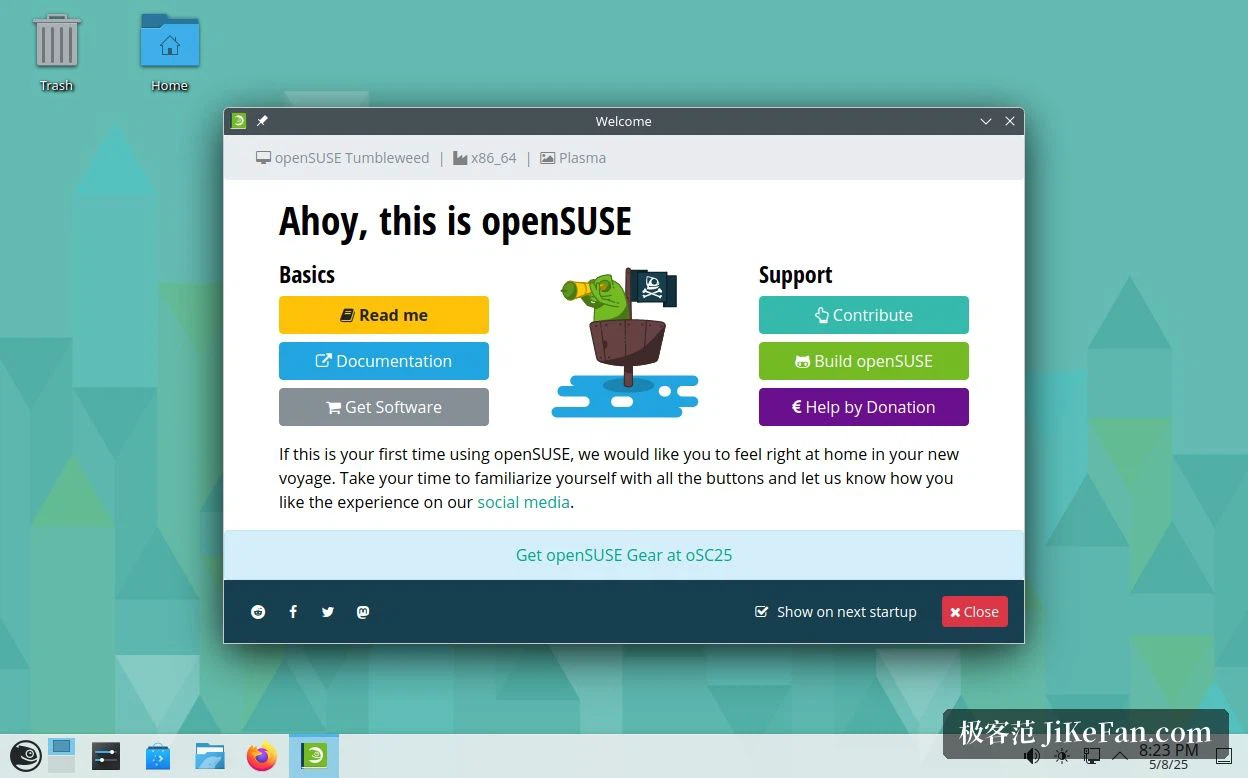
Two lines, and a slower path between them
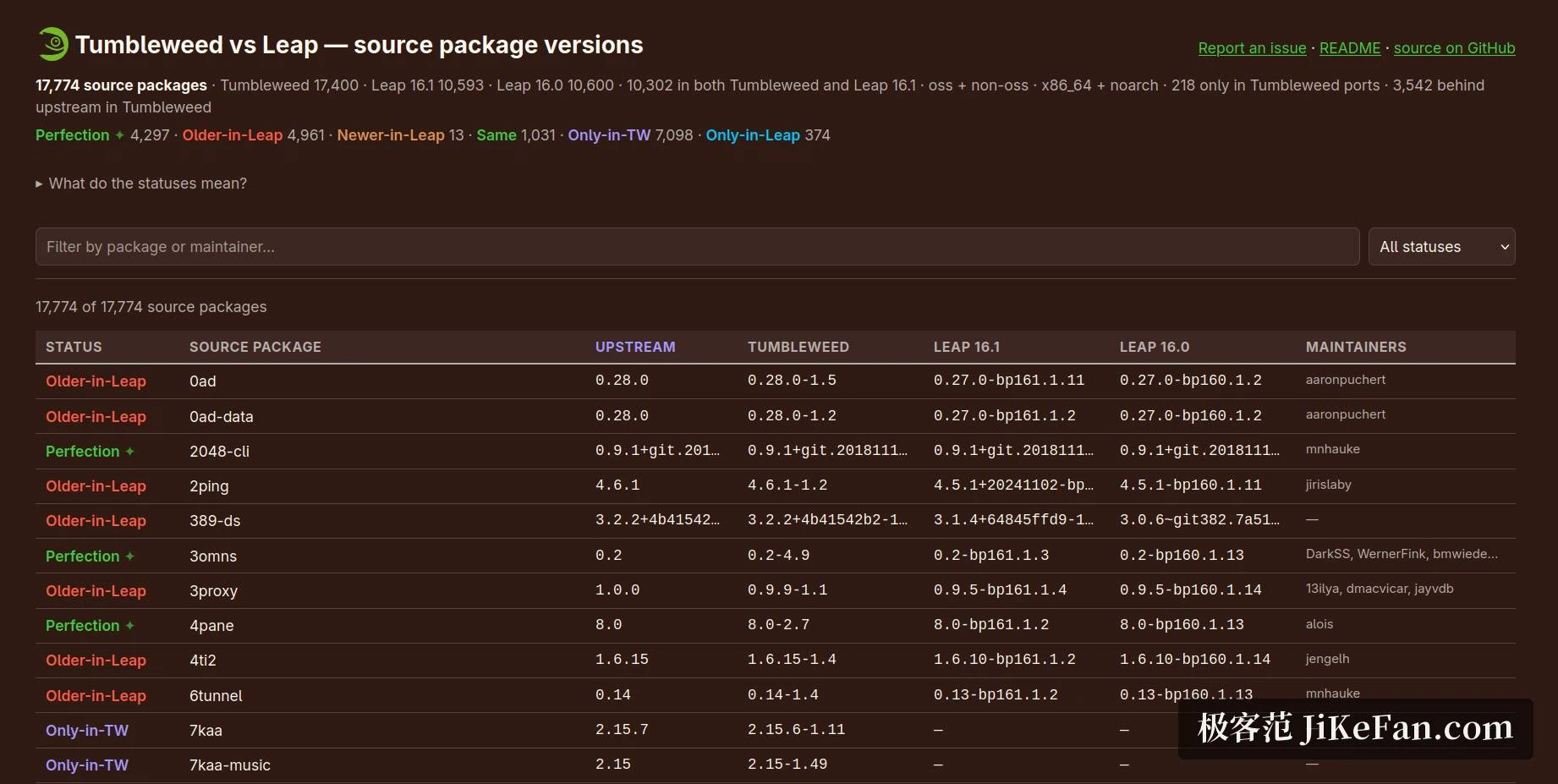
There are two editions, and the choice between them is the whole decision. Leap is the regular release: the same origin as the enterprise product, stability before novelty, aimed at servers, workstations and anything that has to keep running. The current Leap 16 series also brings a new generation of installer and a graphical package manager, and the installation experience is noticeably better than it used to be.
Tumbleweed is the rolling edition: the newest kernel, desktop environment and software stack, with fresh snapshots published daily after automated testing, which suits developers and people who want new features as soon as they exist. Between the two sits a third option with a monthly pace, holding on to freshness while giving up the daily churn. That middle path is easy to overlook and often the right answer for a machine somebody depends on but also wants current.

One place for nearly every system setting
The most recognisable feature is the system management tool. Partitioning, the boot loader, networking, the firewall, software repositories, system services: almost every system-level setting can be handled in its graphical interface, which is close to unique in the Linux world and saves an enormous amount of reading before a change is made. Beside it sit a command line package manager and a snapshot tool for the Btrfs file system, so a failed upgrade can be rolled back to the previous state with a single action instead of a rescue evening.
The quality side is less visible but explains a great deal. An automated testing framework simulates a real user performing a graphical installation on every snapshot, which is why a daily-updated rolling edition manages to stay usable. Snapshots that would have broken something are caught by machines rather than by whoever installed them first.
The two editions are not rivals and neither is a compromise. Leap exists because a machine that holds other people work should not change shape every week; Tumbleweed exists because a machine used to build things has to keep up with what is being built against. A household with one of each is not unusual, and the slow middle path covers the case where the same machine has to do both jobs without the owner wanting to think about it again.
Which edition for which job
As of 2026-09 the stable Leap series is 16.1, released in 2026-04, while Tumbleweed continues through rolling snapshots. Installation images and a network installation are both offered, and the official hardware requirements are modest enough that an older computer still copes with basic desktop work.
The advice writes itself once the difference is clear. Servers and production machines take Leap, where the security update window is long and the enterprise origin removes surprises. Development and experimentation take Tumbleweed, where the newest stack is simply there. A newcomer to the desktop can pick one of the mainstream desktop environments during installation and lean on the management tool for almost everything afterwards. Images and documentation are on the official site, and the least risky first step is a virtual machine.