
-
Ornith spans 9B to 397B and writes its own training tasks
From DeepReinforce, Ornith hands task writing, scaffolding and solution writing to the model itself, comes in three sizes from 9B to 397B, and ships under MIT with a 256K context and local deployment.
-
Continue review: an AI coding assistant where you pick the model
An open extension that plugs into the editor you already use and talks to whichever model you point it at: cloud, local, or a private deployment inside the company network, with the configuration written in a file you own.

-
Claudette gives parallel coding agents a real workbench
An open source desktop companion that sends several agents into their own branch worktrees, meters the context each one burns, and keeps the diff and the editor in the same window.
-
Zoo Code splits one assistant into a team of four roles
A community continuation of Roo Code that turns one agent into four fixed roles, shows every change as a diff before it lands, and throws a guard over dangerous commands during long unattended runs.
-
Codex CLI ships with the network off and a sandbox around your files
The network is off by default and writes stop at the working directory, with edits and commands passing an approval step; rewritten in Rust it is one static binary that also runs unattended in a pipeline.
-
bolt.diy: a whole Node.js runtime inside one browser tab, generating full stack apps with your own model
An open version of a well-known online tool, rebuilt so the model is yours to choose: code runs inside a Node.js sandbox in the browser tab, dependencies install, a development server starts, and the result appears in a preview beside the conversation. Output arrives as discrete steps, so a failure can be repaired at the step that broke.
-
SWE-agent: hand it a bug report and it reads the code, edits the files and returns a patch
A research agent that takes a single bug report and carries the repair to the end: it clones the project, reads the description, hunts for the relevant files, edits them, runs the tests and hands back a patch that can be merged. Its real contribution is not the model but the interface built for reading and editing code.
-
Dyad: describe the idea in plain language and get a website that runs, built on your own machine
An open desktop builder: describe the application you want, and it generates a conventional web project on your own disk, runs it on a local port and refreshes as you talk. Every round is versioned and can be rolled back, the code stays yours in a clean repository, and a hosted backend can be attached when the thing needs to store data.
-
Kilo Code: an open coding agent that catches its own mistakes and works in parallel
An open coding agent that closes the loop by itself: it writes the change, runs the tests, reads the failures, finds the cause and repairs it, mostly without being asked. Bigger tasks are split across sub agents working in separate branches at the same time, and the model behind the work can be swapped at any point.
-
Qwen Code: an open terminal agent that reads the whole repository and edits the code itself
An open coding agent that lives in the command line: it loads the entire repository into context, takes a request in plain language, locates the files, makes the edit, runs the tests and corrects itself until they pass. Planning mode, parallel helper agents, reusable skill packages, and a model layer you can point anywhere.
-
Tabby: a coding assistant that lives on your own server, so source never leaves
An assistant you host yourself as a single service process, with no external database and no cloud dependency. Completion, in-editor questions and an administrative console are packaged together, the repository is indexed so answers refer to your own code, and a mainstream graphics card is enough to serve a small team.
-
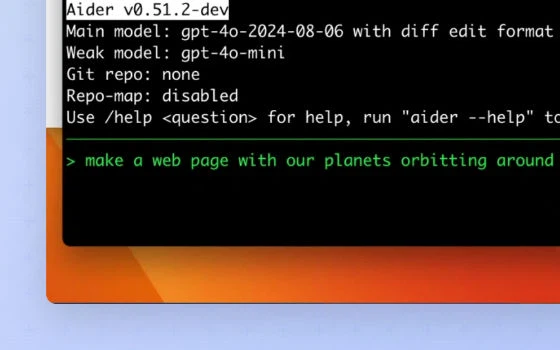
Aider: pair programming inside your terminal, with every change committed
An AI pair programmer that lives in the terminal, so the editor never has to be opened. It reads the repository, proposes a change, applies it, runs the tests, and commits every modification to version control with a written message, leaving a clean path back. Free and open source; only model calls cost money.
-
Cline: an open coding agent that plans first and lets you undo anything
An open coding agent that lives in the editor. It reads the project, proposes a plan, and only then touches files; every change leaves a checkpoint you can revert. You supply the model key, so nothing is marked up and no repository leaves your machine. Also available as a command line tool and a library.
-
OpenHands: an open agent that writes code and fixes bugs inside a sandbox
An open platform for software engineering agents. Each session runs inside its own container, which is destroyed afterwards, so installing dependencies and running risky commands cannot touch the host. Any model can be attached, and the same agent is reachable from a terminal, a browser, an SDK or a hosted service.
-
Pi: a terminal coding agent built from four tools and a very short prompt
A deliberately small coding agent for the terminal: four tools, a system prompt under a thousand tokens, and everything else left to an extension system the agent can write for itself. No built-in planning mode, no task list, no bundled tool servers, and a clear account of why each was left out. Free and open source.
-
第 1 / 2 页