
LBSwork turns one sentence into a map dashboard, without hand-assembled location data
Summary
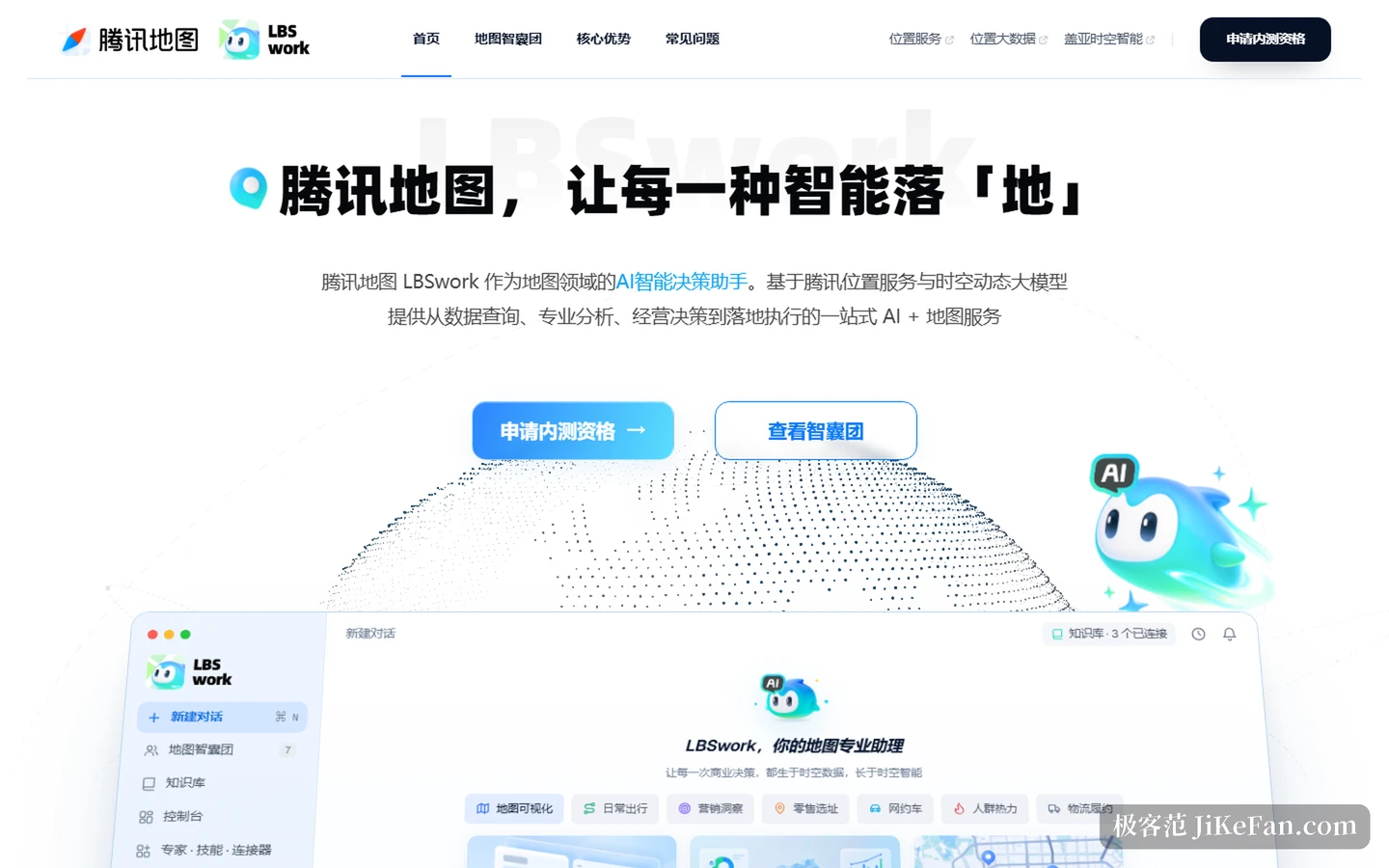
LBSwork is a desktop AI workbench from Tencent Maps: seven specialists cover map visualisation, travel, marketing insight and retail site selection, and one sentence produces a dashboard that can be demonstrated as it stands. Access currently requires an application.
Recommend- Name
- LBSwork
- Version
- 20261104
- Pricing
- Free
- Open source
- Proprietary
- Operating system
- WindowsmacOS
- Website
- https://lbsai.qq.com/
- Updated
- 2026-11-04 23:00
Turn one sentence into a map dashboard that can be opened and demonstrated. That is the promise, and it also explains what Tencent Maps is selling here: not a map, but something that puts the map to work on your behalf. LBSwork, a desktop AI map workbench, was presented at the company's global digital ecosystem conference on 30 October 2026.
One sentence, one dashboard
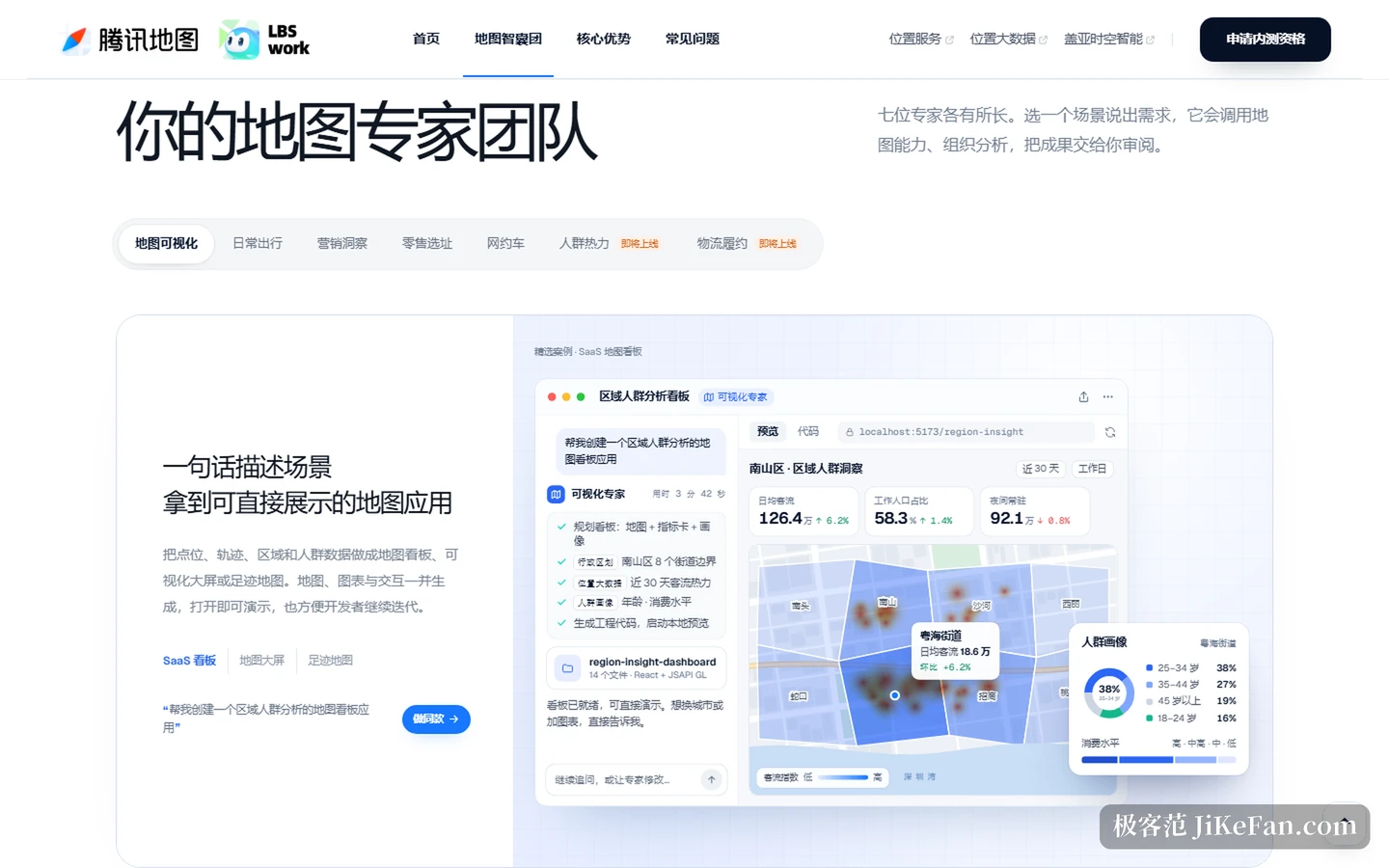
Using it feels close to a chat window. Describe the scene in the input box, pick a specialist, and leave the rest to it. The example given by the vendor is a request to build a map dashboard for analysing the population of an area. From there it plans the dashboard layout itself, pulls administrative boundaries, layers in footfall heat for the past thirty days, computes audience profiles, and ends with a local preview page that opens straight away.
In that published case the visualisation specialist finished in 3 minutes 42 seconds. The output was a React project on JSAPI GL, fourteen files in all. What matters is not the number of lines generated but the shape of the deliverable: not a screenshot and not a PDF, but a page that can be edited, iterated and shown to somebody. Change the city, add a chart, and the next sentence carries on from there.
Seven specialists, each holding one stretch of the process
The product splits its capability into seven specialists, which it calls a map brain trust. Map visualisation turns points, routes, areas and population data into dashboards, large screen displays or footprint maps. Daily travel arranges scattered places into an itinerary that walks through the days. Marketing insight uses authorised location data to look at footfall scale, audience profile and catchment. Retail site selection takes a team's own criteria, stores them in a knowledge base, calls on them when a new site is assessed, and can forecast sales for a new store from existing store data. The ride-hailing direction leans towards after-the-fact attribution: take one feedback ticket and decide whether navigation was actually at fault, then produce a reply that can be sent to the passenger. Population heat and logistics fulfilment are both marked as coming soon; the first compares hourly intensity across several areas, the second tidies delivery addresses, flags the ones needing confirmation and offers a multi-point route reference.
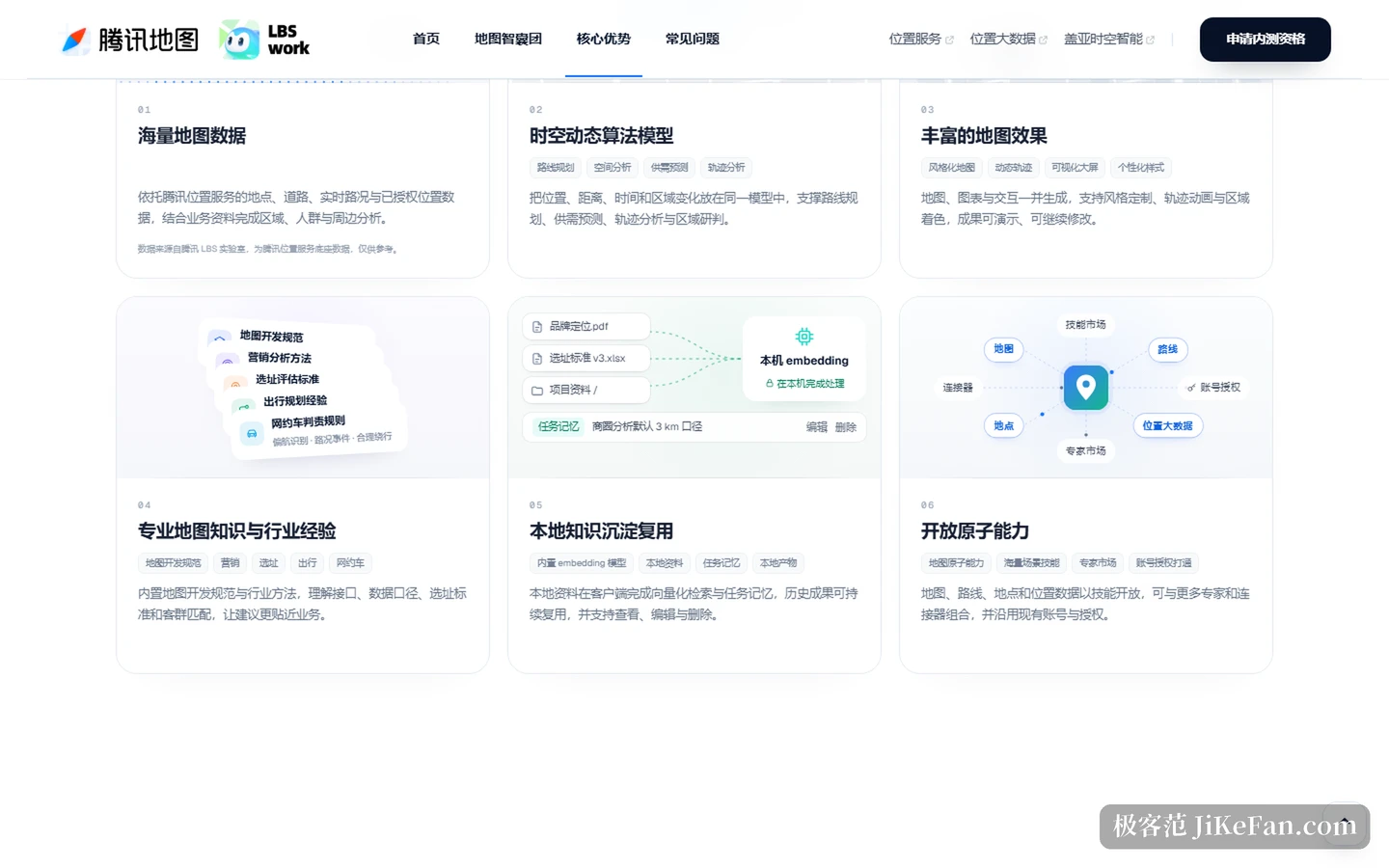
Splitting scenes to this granularity means prompts no longer have to be invented. Behind each kind of request sit fixed data sources, fixed definitions of the metrics and a fixed output format. A user describes the business; there is no need to teach a general model what a commercial district is or what footfall means.
The hard part is never the drawing, it is the definition
Spatiotemporal data rarely breaks in the visualisation layer. Footfall at three stores cannot simply be added together, because the same people may have visited all three. A shop by a river measured with a five hundred metre radius counts people on the far bank who cannot cross. Human analysts avoid these mistakes through experience; a model will happily compute them with complete confidence.
LBSwork puts the control into the process instead. The statistical definition is locked before work starts, the framework watches the whole run, and delivery has to include not only the conclusion but the evidence behind it. The vendor calls this base the spatiotemporal Harness, sharing its origin with WorkBuddy. The aim is that swapping the underlying model leaves the business code and the data contract untouched. For anyone building industry solutions that is worth more than any single feature, because models iterate while definitions must not drift.
Who it is aimed at
The official site is explicit: industry customers in retail, culture and tourism, and mobility, where decisions need location and population seen together, plus individual developers working in the map domain. Assessing a new site for a chain, sizing the audience before a campaign in a commercial district, working out where visitors to a tourism project come from: all of these require holding spatial relationships and data definitions together, which is exactly the part general models handle worst.
The desktop layout shows the same intent. The left column holds a new conversation, the map brain trust, a knowledge base, a console, and a section for specialists, skills and connectors. The knowledge base means an enterprise can feed in its own site selection criteria and industry rules, so conclusions come out in its own terms instead of starting from general common sense every time.
For now, you cannot simply walk in
One thing has to be said plainly: the button on the site reads apply for beta access, not download. The product is not open to everyone yet, and an ordinary user has to apply before trying it. Population heat and logistics fulfilment are still marked as coming soon, so five of the seven directions can be experienced in full today.
Pricing has not been published, and the positioning suggests a product aimed at business customers. For someone who only wants a few points marked on a map it is probably heavy. For someone who has to answer whether a location works every week, compressing a repeated analysis into one sentence saves time that can be measured in money.
The ambition is not to replace the map but to move it from looking something up to working something out. What it sells is the definition and the evidence, a process that makes every site assessment and every campaign review traceable, and that is precisely the step most often skipped and least skippable when AI enters a traditional industry.